



Bitcoin stagnated around $88,000 in early 2026, following weeks of sideways trading. Although price trends appear to be stagnant, on-chain data suggests that the market may be quietly changing behind the scenes.
CryptoQuant’s three indicators indicate that selling pressure is easing, even as macro uncertainties continue to dampen upside momentum.
sponsored
Long-term holders show signs of accumulation
Bitcoin price is struggling to regain key resistance levels after a sharp pullback in late 2025. Sentiment remains fragile due to the lack of follow-through buying, with traders awaiting confirmation that the correction is over.
The first signal comes from long-term holder (LTH) supply data. After months of negative numbers, the 30-day net change in LTH supply has turned positive by approximately 10,700 BTC.
This change suggests that long-term investors are no longer distributing the coin on a large scale.
Rather, supply is gradually returning to stronger hands, a pattern often seen at consolidation stages rather than market tops.
sponsored
LTH SOPR signals balance, not surrender
The second graph tracks the spent output return (SOPR) for long-term holders. This indicator tells us whether long-term holders are selling at a profit or at a loss.
Currently, LTH SOPR is hovering around the neutral 1.0 level. This shows that long-term holders are not setting themselves up for a loss or rushing to exit at a loss.
Historically, this move has been consistent with the market finding equilibrium after a correction rather than going into a deeper breakdown.
sponsored
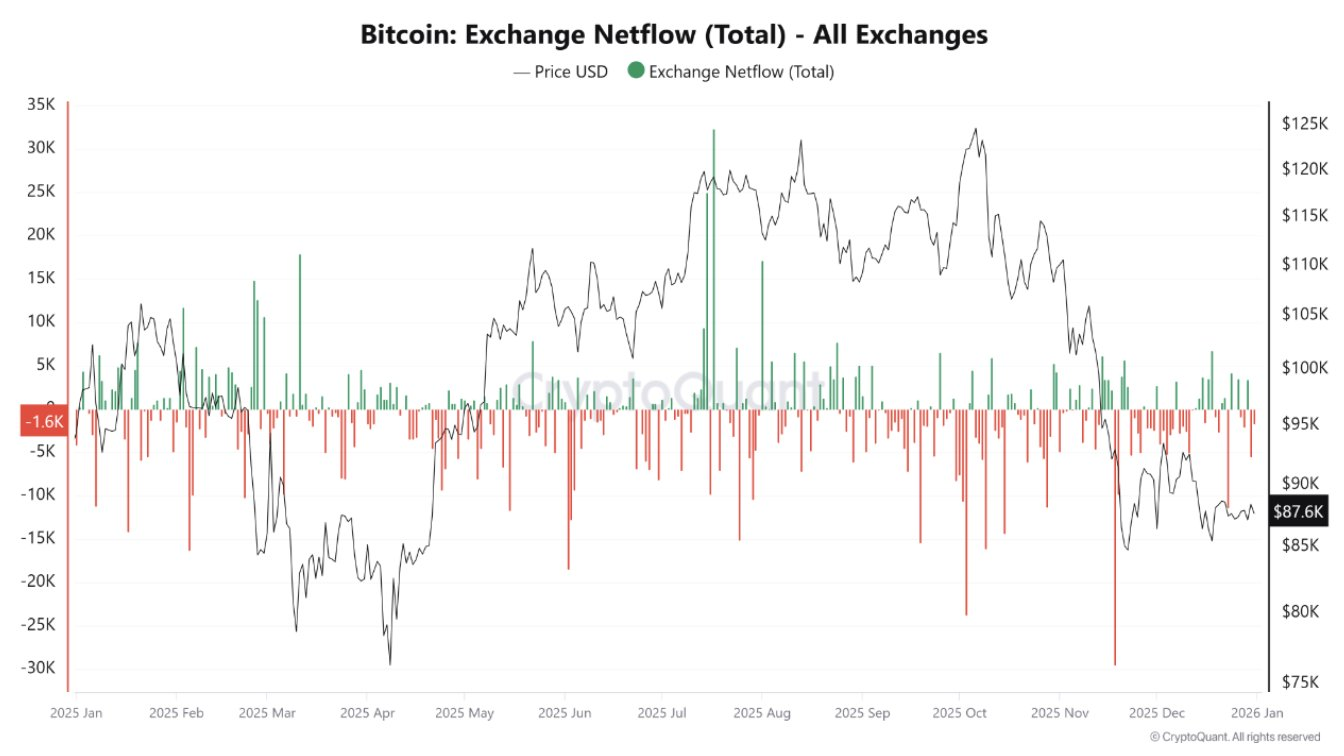
The third metric looks at netflow on Bitcoin exchanges. Recent data shows that net outflows continue, with more Bitcoin leaving exchanges than flowing into them.
This trend reduces the immediate sell-side supply in the spot market.
However, the lack of recovery in prices suggests demand remains cautious due to tight liquidity and delayed expectations for a US rate cut.
sponsored
Will Bitcoin price recover in January?
Taken together, the charts paint a mixed but improving picture. Supply-side pressures appear to be easing, and long-term holders remain confident.
Still, prices remain range-bound due to weak demand and macro headwinds. A quick rise to $100,000 in January will likely require a new catalyst.
Without that, Bitcoin could continue to hold its value and build a foundation that could support a strong recovery in the second half of 2026, rather than breaking out immediately.
