




Quantum computing’s threat to Bitcoin is often dismissed as a distant story, but if you look closely, you may notice that its effects may already be starting to appear.
Recent research and institutional developments suggest the clock may be ticking faster than expected.
Sponsored Sponsored
Quantum computing has already reached Bitcoin, but not as expected
Bitcoin’s recent underperformance against gold has drawn fresh scrutiny from institutional investors. However, this is not due to traditional market forces, but rather due to the risks of quantum computing (QC), which could someday compromise that encryption.
Strategists are now treating these threats as more than theoretical, reshaping portfolio allocations and sparking debate over Bitcoin’s long-term safety.
BeInCrypto reports that Jefferies strategist Christopher Wood has removed a 10% Bitcoin position from his flagship Greed & Fear model portfolio and reallocated it to physical gold and mining stocks.
Wood cited concerns that quantum computing could break the keys to Bitcoin’s Elliptic Curve Digital Signature Algorithm (ECDSA) and undermine its store of value theory.
“Financial advisors will read this kind of research and keep their allocations low or zero to their clients because quantum computing is an existential threat. Until this is fixed, there will be a yoke around BTC’s neck,” wrote popular X user Batsawpyum.
Research supports this warning, with a 2025 Chaincode Labs study estimating that 20-50% of Bitcoin addresses in circulation are vulnerable to future quantum attacks due to reused public keys. Approximately 6.26 million BTC (equivalent to $650 billion to $750 billion) could be leaked.
Meanwhile, the Projection Calculator’s graph reflects this immediate risk, showing that the power of quantum hardware is increasing exponentially over time.
Sponsored Sponsored
As the number of qubits in quantum machines accelerates, especially after Google’s 2025 milestone, the possibility of cryptography-related quantum computing (CRQC) is becoming more realistic.
Bitcoin’s decentralized structure adds to the challenge. Unlike traditional banks, which can mandate quantum-secure upgrades through centralized control, Bitcoin requires changes to be coordinated across a decentralized network.
There is no risk committee, no authority, no single body that can force immediate action.
“I used to dismiss the quantum computing (QC) risks to Bitcoin as far-fetched, but I no longer do so. The usual backlash is something like this: QC hasn’t been a threat for years. But the entire financial system is in trouble…[Bitcoin]can technically be upgraded, but it would require slow and cumbersome coordination across the decentralized network. No one can say, ‘I’m going to switch now.’
Quantum computing risks cast a shadow on Bitcoin’s institutional appeal
Markets are beginning to reflect these concerns. Bitcoin’s year-to-date underperformance against gold is down 6.5% in 2026, while gold has surged 55%. The January 2026 BTC/gold ratio was 19.26, consistent with advisors’ caution.
Sponsored Sponsored
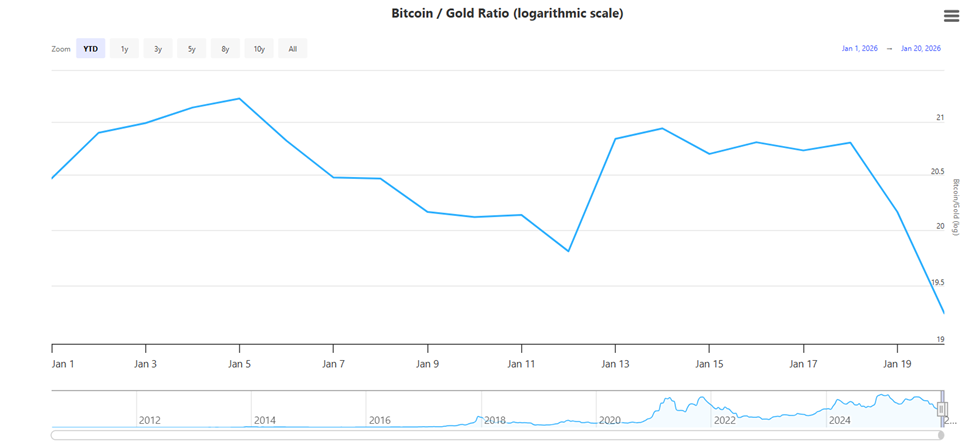
Each institution’s response is different. While Wood reduced his exposure, Harvard reportedly increased its Bitcoin allocation by almost 240%.
Similarly, Morgan Stanley has begun advising wealth management clients to allocate up to 4% of their portfolios to digital assets. Similarly, Bank of America allows allocations ranging from 1% to 4%.
This indicates that support is not disappearing, but rather is dispersing based on different risk assessments.
Still, some say that quantum risks are low probability but high impact. Coinbase’s David Duong points out two major threats: quantum computers breaking ECDSA keys and targeting SHA-256, which underpins Bitcoin’s proof-of-work system.
Sponsored Sponsored
Vulnerable addresses include traditional Pay-to-Public-Key scripts, certain multi-signature wallets, and exposed Taproot setups.
Address hygiene, avoiding address reuse, and moving coins to quantum-resistant addresses are considered important mitigation strategies.
Post-quantum cryptography standards, finalized by NIST in 2024, provide a roadmap for future protection. However, Bitcoin adoption remains complex.
Cardano’s Charles Hoskinson warns that premature adoption can significantly reduce efficiency. Meanwhile, DARPA’s quantum blockchain initiative suggests that significant threats could emerge in the 2030s.
However, the rapid progress shown in the forecast diagram suggests that the timeline could accelerate, especially if the integration of AI compresses quantum development.
Quantum computing issues have moved from theory to concrete implications for portfolios. Bitcoin’s declining performance is not simply a reflection of market cycles. Rather, it reflects the creeping weight of existential risk, forcing financial institutions to decide how to allocate capital and face technological challenges that networks have never faced before.
Until Bitcoin’s decentralized system can fully coordinate quantum-resistant upgrades, the “yoke” on BTC’s neck remains a reality.
