




Stablecoin liquidity on the XRP Ledger (XRPL) has nearly doubled over the past month, putting the network within reach of the $1 billion supply milestone as Ripple looks to position its blockchain for automated payments.
The surge gives Ripple stronger footing for one of its most ambitious pitches to date: a dollar-denominated payment rail that allows artificial intelligence agents to settle transactions in seconds, enforce spending rules and operate without manual approvals every step of the way.
According to data from DeFiLlama, the stablecoin supply on XRPL is approximately $770 million, increasing by approximately 97% in the past 30 days.
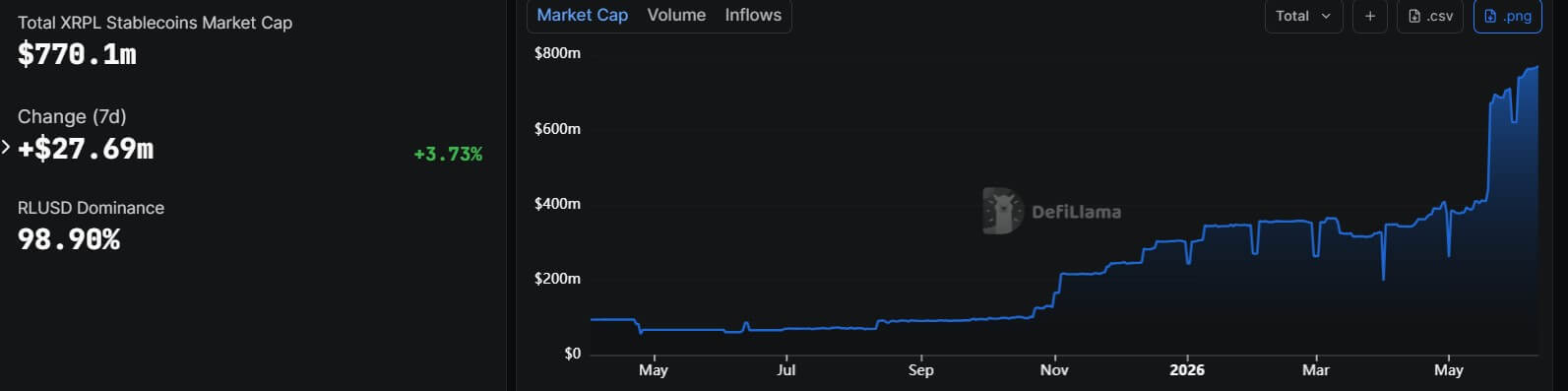
According to RWA.xyz, which tracks a broad set of tokenized real-world assets and stablecoins, XRPL has a stablecoin market capitalization of approximately $901.7 million, with 30-day transfer volume increasing 122% to $4.95 billion.
The gap between the two data providers reflects methodological differences, but they both exhibit the same trends. Dollar-pegged assets on the XRP Ledger are rapidly increasing, with Ripple’s own stablecoin, RLUSD, driving most of the increase.
According to DeFiLlama data, RLUSD accounts for nearly 99% of the stablecoin supply on the XRP Ledger, with approximately $761.7 million issued on the network. RWA.xyz lists RLUSD’s market cap across supported blockchains at approximately $1.65 billion.
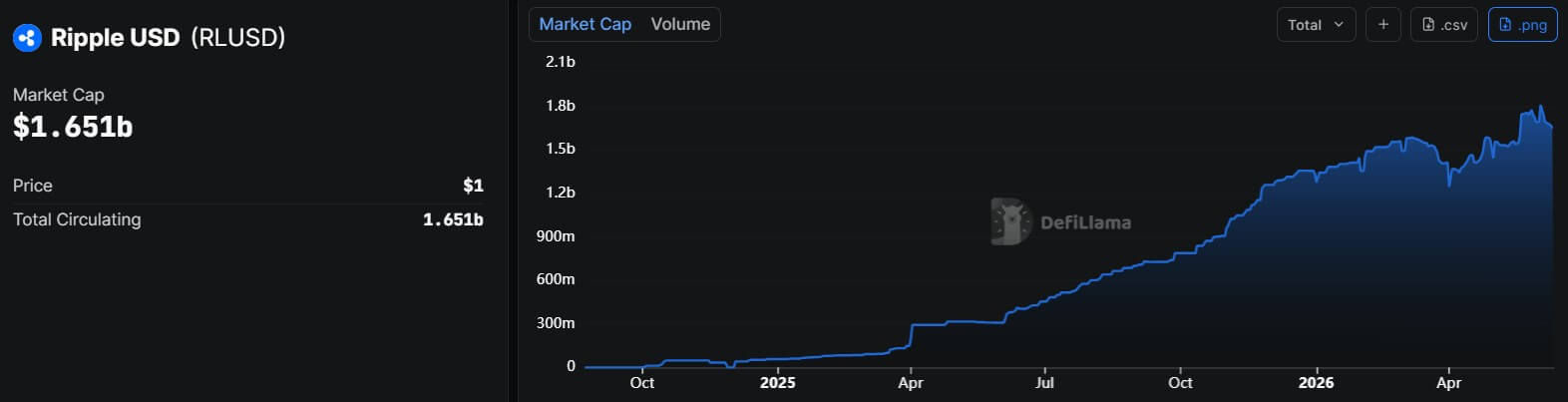
This concentration gives Ripple unusual leverage over the dollar layer of XRPL and strengthens the argument that RLUSD can become a payment tool for institutions, developers, and software agents that require predictable access to dollars on-chain.
A more difficult question is whether current growth reflects sustained payments demand or an early position ahead of a market that is still nascent.

The rise of agent commerce
Artificial intelligence agents are moving beyond passive chat interfaces to software systems that can perform actions on behalf of users and businesses.
When it comes to payments, this change poses real problems. Agents who need to access APIs, pay for cloud computing, purchase data, settle invoices, or complete multi-step workflows can’t always wait for a representative to approve each transaction. It also cannot easily function with payment rails designed around card forms, billing accounts, batch payments, and delayed matching.
That’s the gap Ripple is trying to exploit.
The company released its XRPL AI Starter Kit this week. This is a developer package designed to easily build AI agent payment flows on top of XRPL. The first phase includes an MCP server that lets you query XRPL documents with compatible AI coding tools, Claude skills for wallet creation and payments, and new tutorials for building agent transactions.
Ripple is also tying its toolkit to x402, an open payment standard built around the web’s HTTP 402 “Payment Required” status code. With a contribution from t54, XRPL now supports x402 payments using XRP or RLUSD, allowing agents to pay for API calls, model inference, and other digital services.
The pitch is honest. Instead of creating an account, storing an API key, purchasing prepaid credits, or waiting for a billing relationship to clear, agents can receive a payment request and send a small amount to continue the workflow.
Ripple claims that XRPL has several properties that make it suitable for its design. Transactions settle in seconds, fees are predictable, and payments are handled at the protocol layer rather than through arbitrary smart contract code.
The ledger also supports management of escrow, multi-signature, deposit authorization, trust lines, and more, giving financial institutions a way to limit who their agents can pay and on what terms.
These features are central to the RLUSD strategy. Although XRP can move value across the network, many commercial workflows still require dollar units. Invoices, software subscriptions, payroll, treasury remittances, and API pricing are typically denominated in fiat currency.
RLUSD provides Ripple with a stablecoin that can be tied directly to these use cases while maintaining payment activity within the XRPL ecosystem.
Mastercard gives essays mainstream space
Ripple’s AI agent push also provides context for broader payments this week, as Mastercard launched Agent Pay for Machines, a service aimed at machine-speed payments across software agents, connected devices, and automated business workflows.
Mastercard described the system as a way for companies to ensure that agents can continue to transact while operating within authorization, governance and payment controls. Ripple was among the participating companies, along with a broader group including Coinbase, Stripe, Solana Foundation, Polygon, OKX, Cloudflare, and more.
For Ripple, Mastercard’s efforts will help drive adoption of RLUSD beyond crypto-native users. The company can now position XRPL and RLUSD within a larger institutional conversation about how autonomous software should be able to spend money.
Markus Infanger, senior vice president at RippleX, said companies will only allow autonomous agents to operate at machine speed if the necessary control functions work with the autonomous agents. He claims that XRPL and RLUSD can provide internal audit trails for settlement, predictable costs, compliance parameters, and transaction flows themselves.
Other Ripple executives are planning the launch with a long-term perspective as well.
RippleX head of product Jazzy Cooper said payments in the next decade may no longer be run primarily by humans. In her view, that means autonomous agents need to be treated as a key user group of financial infrastructure rather than edge cases.
The comments indicate how Ripple wants the market to interpret its recent stablecoin growth. The rise of RLUSD has allowed the company to lend liquidity to payment strategies built around institutions, developers, and automated software systems.
This framing is beneficial for Ripple as the stablecoin market is already dominated by much larger rivals. Tether’s USDT and Circle’s USDC remain the industry’s deepest sources of dollar liquidity.
RLUSD doesn’t need to significantly overtake them for Ripple’s strategy to work, but it does need to become the preferred dollar asset in the payments environment that Ripple is targeting.
Chasing the $182 billion machine economy
The broader agent payments market remains divided between speculative blockchain activity and early signs of commercial use.
Much of the current activity is focused on Base, the layer 2 network fostered by Coinbase that has become the most active venue for x402 adoption. According to Chainalysis, agent payments on Base increased from near zero in the second half of 2025, topping 100 million transactions in about three quarters.
However, the company cautioned that much of the early growth was due to meme coin farming, as users tested and gamed x402-based payment flows in speculative environments.
The data also show that the quality of activity is changing over time. According to Chainalysis, transactions worth at least $1 now account for 95% of the total amount sent through agent payment protocols, up from 49% at the beginning of 2025.
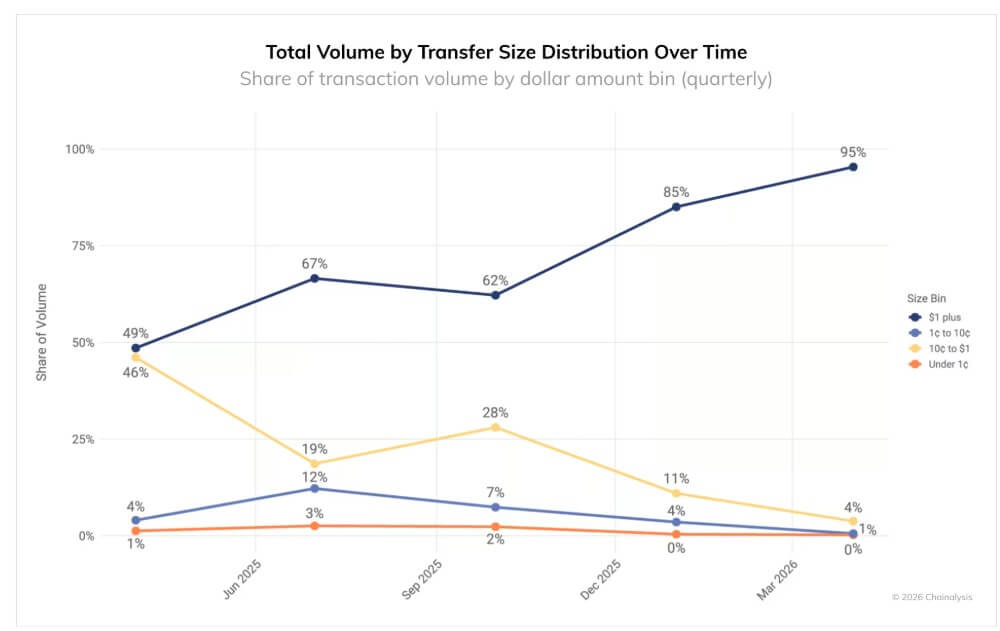
This suggests that the market is starting to move beyond low-value experimentation, even if adoption by companies is still in its infancy.
While Base, Solana, and Polygon currently lead the market for hosting aggressive developer deployments, Ripple is entering the competitive space with a different focus.
Rather than relying on retail, the company is looking to appeal to corporate treasury, corporate billing, and institutional payments use cases through built-in controls in RLUSD and XRPL.
This strategy reflects the type of customers Ripple is trying to win. Companies that allow AI agents to spend money are likely to require spending limits, audit trails, compliance controls, and stable dollar settlements before allowing automated systems to meaningfully move capital.
The size of the potential market explains its urgency. Industry forecasts suggest that agent payments could grow from about $7 billion to $182.97 billion by 2033, representing nearly 50% annual growth.
J. Ayo Akinyele, Head of Engineering at RippleX, sees this opportunity in a similar light. He said the agent economy is developing faster than many observers expected, with billions of dollars of value potentially moving through workflows between agents as AI systems autonomously pay for services, access data, and settle transactions.
That is the market that Ripple is preparing for with the RLUSD and XRPL AI starter kits. The company wants developers to build payment flows that allow agents to create wallets, transfer funds, track transactions, and pay for services using XRP or RLUSD over x402.
The direct indicator is liquidity. If the supply of stablecoins on the XRP Ledger exceeds $1 billion by the end of this month, Ripple will have a stronger foundation to promote XRPL as an enterprise payment method for autonomous software.
But subsequent quarters would present an even bigger challenge. The market still needs to demonstrate that AI agents can generate consistent, non-speculative payment demand and that companies are willing to settle their activities through RLUSD.
