




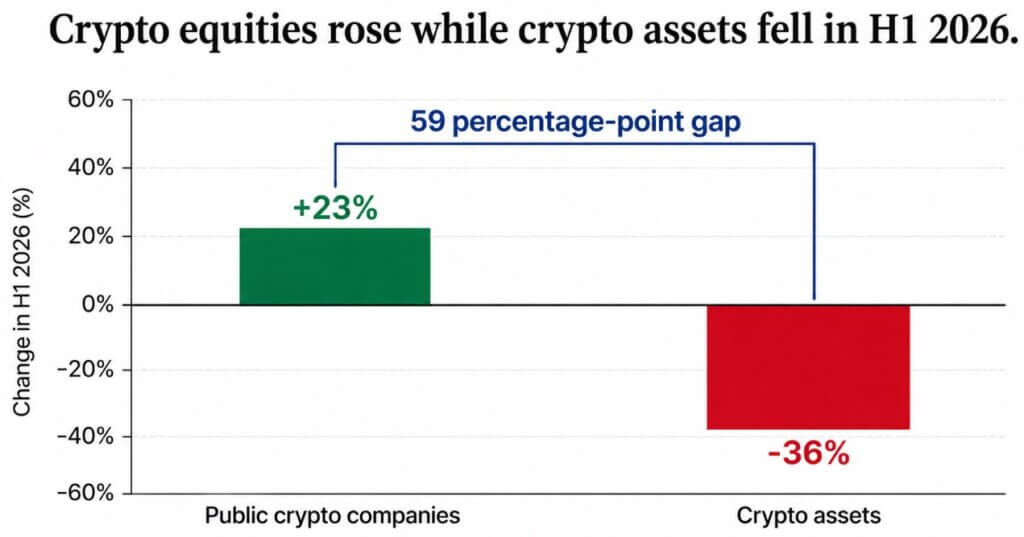
Bitwise reported that in the first half of 2026, listed cryptocurrency companies rose 23%, while crypto assets fell 36%, resulting in a difference of 59 percentage points.
The stock could be pricing in a recovery above the level at which the token is currently trading, or it could be capturing the revenue that crypto adoption generates for companies through fees, yields, and services that exist regardless of whether the token rises, falls, or stands still.
Throughout recent crypto cycles, crypto stocks and major tokens have generally moved in the same direction. As Bitcoin and other big assets rose, much of the industry benefited, with exchanges increasing profits, miners expanding, and venture capital returning.
Whether that connection still holds is one of the issues raised by Bitwise’s report.
Components of a stock basket
Bitwise’s Crypto Stock Theme (BITQ) has recently listed Coinbase, Strategy, IREN, BitMine, MARA, Galaxy, Figure, Cipher, Hut 8, and Riot among its top holdings.
This combination spans fee-based platforms, Bitcoin treasury companies, and miners whose valuations are still very sensitive to BTC, so the 23% increase compresses several different exposures into one number.
Stablecoins make the clearest case, as DeFiLlama puts the stablecoin market cap at nearly $310 billion, with Tether generating about $482 million and Circle about $193 million in 30-day revenue, most of which comes from the yield on the assets backing the tokens.
Circle figures show reserve income last quarter was $653 million, up 17% from a year earlier, and the company just received final OCC approval to operate National Trust Bank.
That return occurs regardless of whether the person using the stablecoin purchases volatile crypto assets as an investment.
Coinbase’s retail derivatives revenue exceeded $200 million annually in the first quarter, and its prediction markets business exceeded $100 million annually within two months of launching in the United States.
Robinhood’s total net revenue for the first quarter rose 15% year-over-year to $1.07 billion, despite a 47% decline in cryptocurrency trading revenue to $134 million. Offsetting the decrease were other trading income of $147 million primarily from options, equity, net interest income and event contracts. During the quarter, customers traded a record 8.8 billion event contracts.
TeraWulf offers the clearest non-trading version. The company has a 20-year data center lease agreement with Anthropic worth an estimated $19 billion in contract revenue, but the deal has little bearing on whether Bitcoin’s price recovers.
Growth AreasWho will capture revenue first? Should revenue-generating tokens rise?Stablecoin Issuers, Reserve Managers, Payment CompaniesReserve Yields, Payment Fees, No DistributionsExchange Public Companies, Market Makers, CustodiansTransaction Fees, Spreads, Subscriptions , Custody Not Necessary Prediction Market Platforms, Exchanges, Liquidity Providers Fees, Spreads, Events No Contract Volume Tokenization Issuers, Custodians, Transfer Agents, Infrastructure Companies Issues, Services, Custody, Settlement Mining only if tokens collect fees / AI Data Center Public Miner, Power Site Owner, AI Customer Hosting Revenue, Leases, Computing Contracts Ethereum / Hyperliquid Style Tokenless Token Holder, Validator, Protocol Funds Fee Burn, Staking Yield, Repurchase Yes, If Mechanism Works
Mechanism for claiming tokens
Ethereum burns a portion of every transaction fee, tying network usage directly to a decline in token supply, while HyperLiquid directs most of its fees to funds that buy back tokens.
These mechanisms create channels for network activity that influence the supply or demand for tokens. Stablecoins typically do not pass reserve income to holders, but exchange shareholders gain visibility into a company’s financial health through shares rather than protocol tokens.
Second-quarter numbers also complicate purely bearish views, with Bitwise’s Crypto Innovators 30 index up 30.6% in the quarter.
The company’s large-cap crypto index fell 15.4% over the same period, prediction market volume reached $43.2 billion, and tokenized real-world assets rose towards $33 billion.
Usage continued to grow during the same period as the token declined, which is also to be expected from the lagging asset explanation.
Treasury Secretary Scott Bessent said in June that stablecoins, tokenization and new payment systems will shape the future of money, with language treating this infrastructure as more dollar piping than crypto speculation.
According to a study cited by the ECB, the $3.5 billion inflow into dollar-backed stablecoins could reduce yields on three-month Treasury bills by around 2.5 to 3.5 basis points, evidence that stablecoin growth is already impacting traditional interest rate markets on its terms.
How does the gap close from here?
As risk appetite returns and ETF flows improve, DeFi and app revenues could begin to translate into fee burn, staking rewards, and buybacks that go directly to token holders. A broader recovery in Bitcoin and other major assets will narrow the divergence, but the magnitude of the change will also depend on the performance of crypto stocks.
The result means that the old adoption theory still works for assets built with mechanisms attached to capture real value.
If stablecoins, exchanges, tokenization platforms, and AI-powered miners continue to expand while Bitcoin, Ethereum, and most altcoins remain weak, the divergence could persist or widen beyond the 59 percentage point gap recorded in the first half of the year.
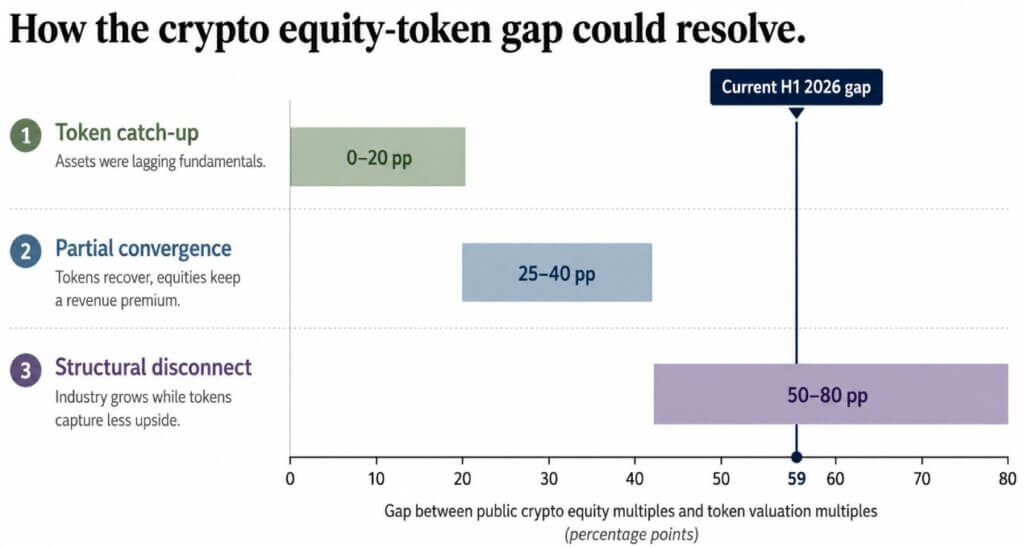
The graph shows three possible paths for the gap between crypto assets and tokens. Token catch-up, partial convergence, or permanent structural discontinuity. This result means that cryptocurrencies continue to succeed as an industry, but the majority of its tokens fail to capture that success.
First half numbers show that cryptocurrencies can build real businesses. The open question is whether the tokens investors bought to own that growth had an actual mechanism to earn it, or whether the industry found a way to keep profits and keep the asset on the sidelines.
