




The U.S. Supreme Court recently blocked President Donald Trump from using emergency powers to impose widespread tariffs around the world.
However, President Trump quickly responded by announcing new tariffs based on another legal authority. This has led to confusion as to whether tariffs will actually be reduced or increased. Here’s what’s actually happening.
What the Supreme Court actually banned
The Supreme Court did not ban tariffs outright. Instead, the court ruled that President Trump could not use the International Emergency Economic Powers Act (IEEPA) to impose tariffs.
IEEPA is an emergency law. This allows the president to freeze assets, block transactions, and restrict trade. But the court said it did not recognize customs duty, which is considered a type of tax. Only Congress has clear constitutional authority to levy taxes.
This means that certain tariffs that President Trump imposed using emergency powers must be suspended.
However, this ruling did not remove other customs powers.
President Trump’s response: Use other laws to continue tariffs
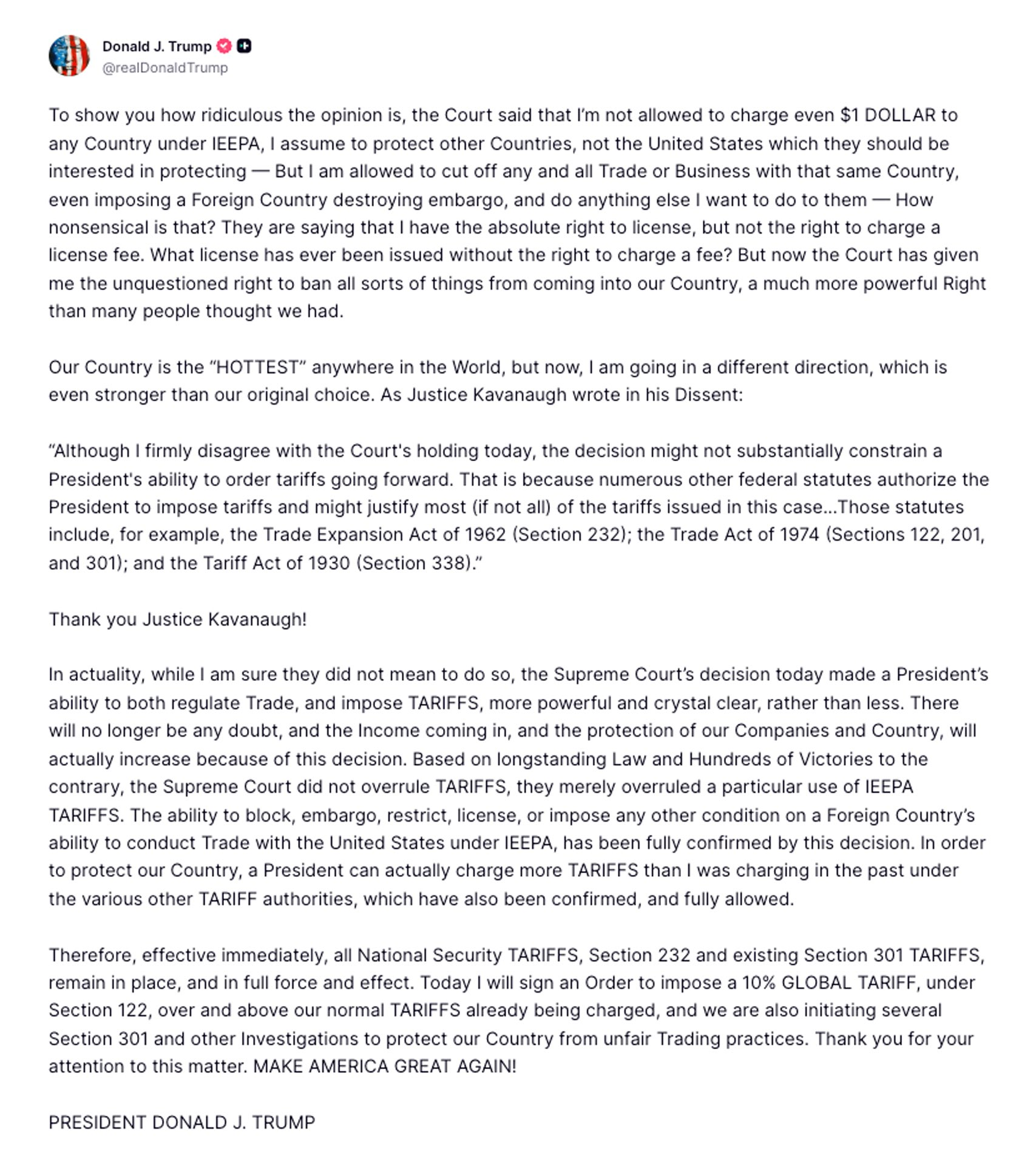
In response, President Trump said existing tariffs under Sections 232 and 301 would continue to apply. These tariffs target imports based on national security risks or unfair trade practices. The Supreme Court did not block these laws.
More importantly, President Trump announced the imposition of a new 10% tariff worldwide under Section 122 of the Trade Act of 1974. This is another law that allows the president to impose temporary tariffs to address trade imbalances.
Simply put, President Trump is using different legal powers to replace prohibited tariffs with new ones.
He is also launching an investigation that could lead to further tariffs in the future.
Why President Trump says he remains powerful
Trump has argued that the ruling actually clarifies his powers, rather than weakening them. Although the court restricted one measure, it recognized that other customs powers remained in effect.
This means that the president can legally impose tariffs as long as he uses the correct law passed by Congress.
The important change is not whether tariffs exist, but how they are imposed.
Market impact
The market initially reacted positively as the ruling reduced uncertainty. Investors prefer clear legal rules to unpredictable emergency actions.
Stocks and cryptocurrencies initially rose as the decision eased fears of sudden trade disruptions. Bitcoin, which is sensitive to global liquidity and risk sentiment, also showed signs of recovery.
However, President Trump’s new tariff announcements could still cause inflationary pressures and trade tensions. Tariffs can increase costs for businesses, slow economic growth, and reduce investor confidence.
Commodities such as gold and silver could benefit as tariffs increase economic uncertainty. These assets often rise during times of global tension.
Tariffs have not been abolished so far. Instead, we are moving to a new legal framework, which means trade tensions and market instability are likely to continue.
