




Strategy (formerly MicroStrategy) expanded its market funding capacity on March 23, filing for new programs for common stock and two preferred securities, bringing the company’s total effective issuance capacity to more than $60 billion.
The 8-K filing signals a reconfiguration of the capital stack behind the company’s Bitcoin financial strategy, ending one old program while adding new ATM lines.
Under the new program structure, Strategy, Inc. may sell up to $21 billion of Class A common MSTR stock, up to $21 billion of STRC preferred stock, and up to $2.1 billion of STRK preferred stock through an expanded syndicate of distributors.

The company has added Moelis, AGP/Alliance Global Partners and StoneX to its existing distribution group under an omnibus distribution agreement, according to the filing.
Meanwhile, Strategy plans to continue to use its previous common stock prospectus, which covered approximately $15.85 billion, and its previous STRC prospectus, which covered approximately $4.2 billion, until these shares are sold. The previous STRK offering, which covered approximately $20.34 billion, closed on March 22.
This leaves Strategies with approximately $64.15 billion in cumulative effective issuance capacity across its ongoing common stock and STRC programs and new STRK lines.
Notably, the company did not say it had raised that amount, and the 8-K repeatedly referred to the securities as stock that the company “may issue and sell” over time.
Still, the document is likely to be read as a funding map for the next stage of Strategy’s Bitcoin financial plan.
The company has repeatedly used public market activity to expand its Bitcoin holdings, and is being closely monitored for what changes in its capital structure imply about its future purchasing capacity, dividend obligations, and dilution risk.
Strategy is the largest public holder of Bitcoin, holding 762,099 Bitcoins. Based on the company’s total purchase cost of approximately $57.7 billion, the average acquisition price would be nearly $75,700 per Bitcoin.
SaylorTracker data showed the position had more than $3 billion in unrealized losses.

STRC takes center stage as Strategy reshapes preferred stock structure
The clearest signal in the filing is the expanded role of STRC, the company’s floating rate Series A perpetual stretch preferred stock.
Strategy filed a certificate increasing the number of authorized STRC preferred shares from 70,435,353 shares to 282,556,565 shares, an increase of 212,121,212 shares.
In contrast, treatment of STRK went in the opposite direction. Strategy filed a reduction certificate to reduce the number of authorized STRK preferred shares by 229,529,256 shares, from 269.8 million shares to 40,270,744 shares.
This difference is noteworthy because the two instruments occupy different positions in Strategy’s capital structure.
The March 23 filing identifies STRK as the company’s 8.00% Series A Perpetual Strike Preferred Stock, a convertible security with an initial conversion rate of 0.1000 shares of Class A common stock for each STRK share and an initial conversion price of $1,000 per MSTR share, subject to adjustment.
This embedded call option is unique among the company’s preferred stocks: STRD, STRK, STRE, and STRC.
Interestingly, STRK has previously attracted the attention of investors due to its transformation capabilities. In July 2025, STRK briefly exceeded $129 per share, 29% above the company’s liquidation preference of $100, which pays an 8% dividend. Since then, the price has fallen to $77 at the time of writing.
Strategy has reduced the size of its channel compared to pre-filing levels by reducing both the number of authorized shares and the size of its active STRK issuance lines.
Meanwhile, STRC has quickly become the most liquid preferred stock on the market since its inception in 2025, with average daily trading volume of approximately $295.9 million, according to data shared by Chairman Michael Saylor.
Its liquidity now exceeds the combined average daily trading volume of its seven closest competing preferred stocks, including those of Boeing, KKR & Co and Four Corners Property Trust.
The STRC product offers investors a variable dividend yield of 11.5%, and the product has already attracted institutional investors such as BlackRock’s iShares Preferred ETF, Income Securities ETF, Anchorage, and asset management company Strive.
Data from STRC.live shows that the program has funded the acquisition of over 50,000 BTC since its inception.
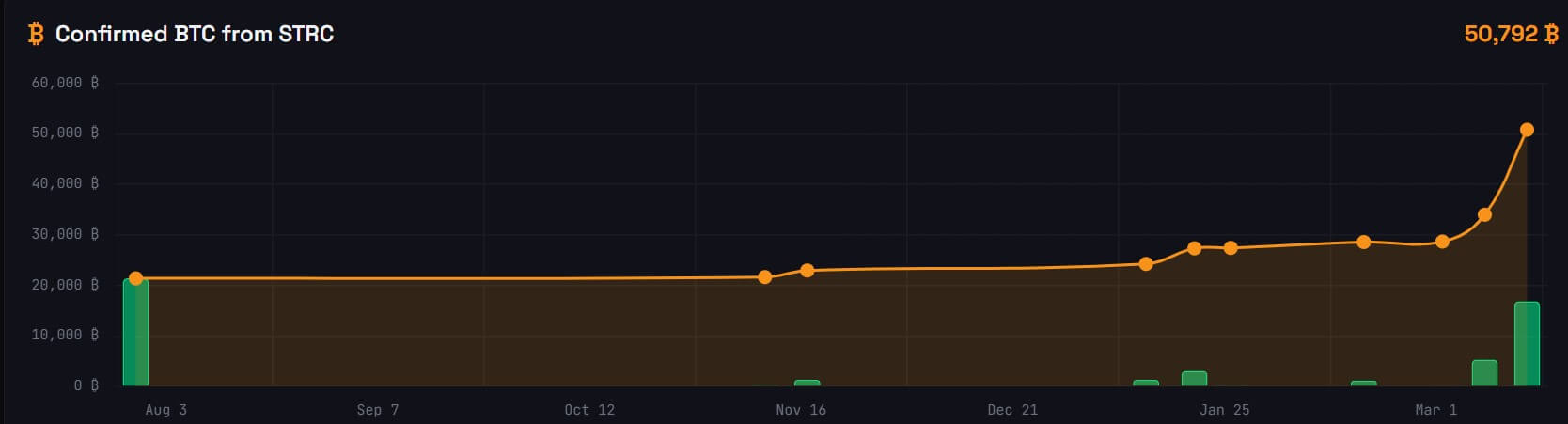
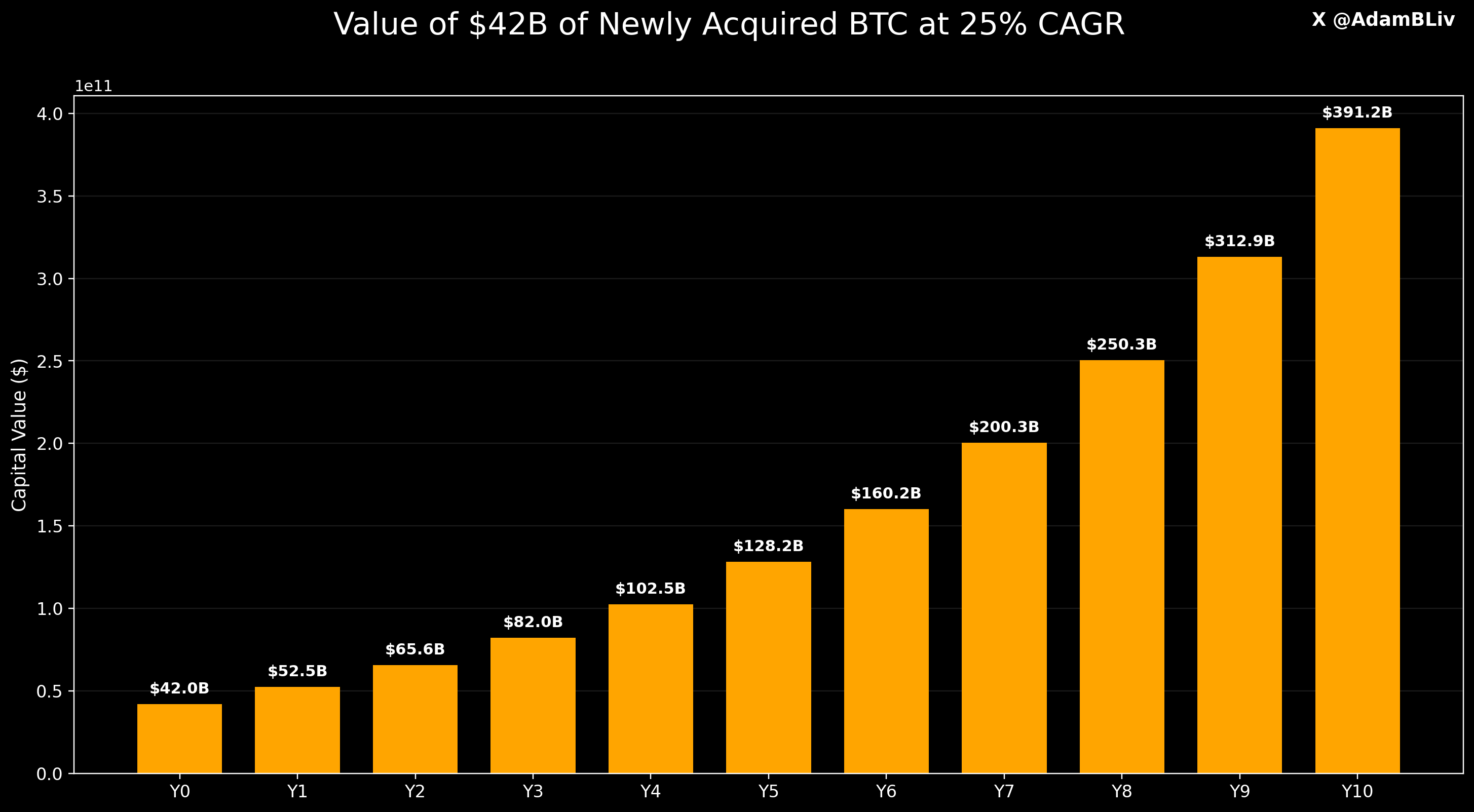
Bitcoin analyst Adam Livingston argued that the expanded STRC program has more purchasing power than the headline numbers suggest.
He explained that with the current balance sheet setup, for every $1 of STRC issuance, approximately $1.94 of MSTR issuance is required to keep the company’s amplification rate flat.
If STRC issuance continues at the recent pace of approximately $2 billion per month, the corresponding common stock issuance required to maintain that ratio will push Strategy’s total BTC acquisition rate to nearly $5.9 billion per month, he said.
Based on that calculation, the newly announced $21 billion STRC and $21 billion MSTR envelope, once fully deployed, could fund purchases of over 450,000 BTC within approximately 5-7 months, but the MSTR leg is likely to bottleneck the pace of execution.
STRC’s dividend burden and long-term capital issues
However, the flexibility built into expanded ATM programs comes with increased costs.
If the $21 billion STRC program is fully utilized, annual dividend obligations will increase by about $2.4 billion, according to The Block analyst Ivan Wu.
The company has set aside approximately $2.25 billion in reserves to fund these obligations, providing a cushion against rising costs of capital.
However, traditional credit analysts remain skeptical of the underlying mechanism.
Jeff Dorman, Arca’s chief investment officer, argued that while Strategy’s balance sheet looks safe when comparing assets and liabilities, it doesn’t meet the most important credit metric: interest coverage.
He said Strategy had virtually no profit before interest and taxes, indicating there was no interest compensation.
Dorman wrote that if the company does not sell Bitcoin, it will eventually default on its debt and preferred stock.
On the other hand, if a company continues to sell more shares to cover interest and dividends, common stock becomes diluted. If a company sells Bitcoin to fund its capital structure, the underlying asset will suffer.
He concluded:
“You can’t pay your bills (interest and dividend payments) without cash flow. That cash flow has to come from somewhere.”
