



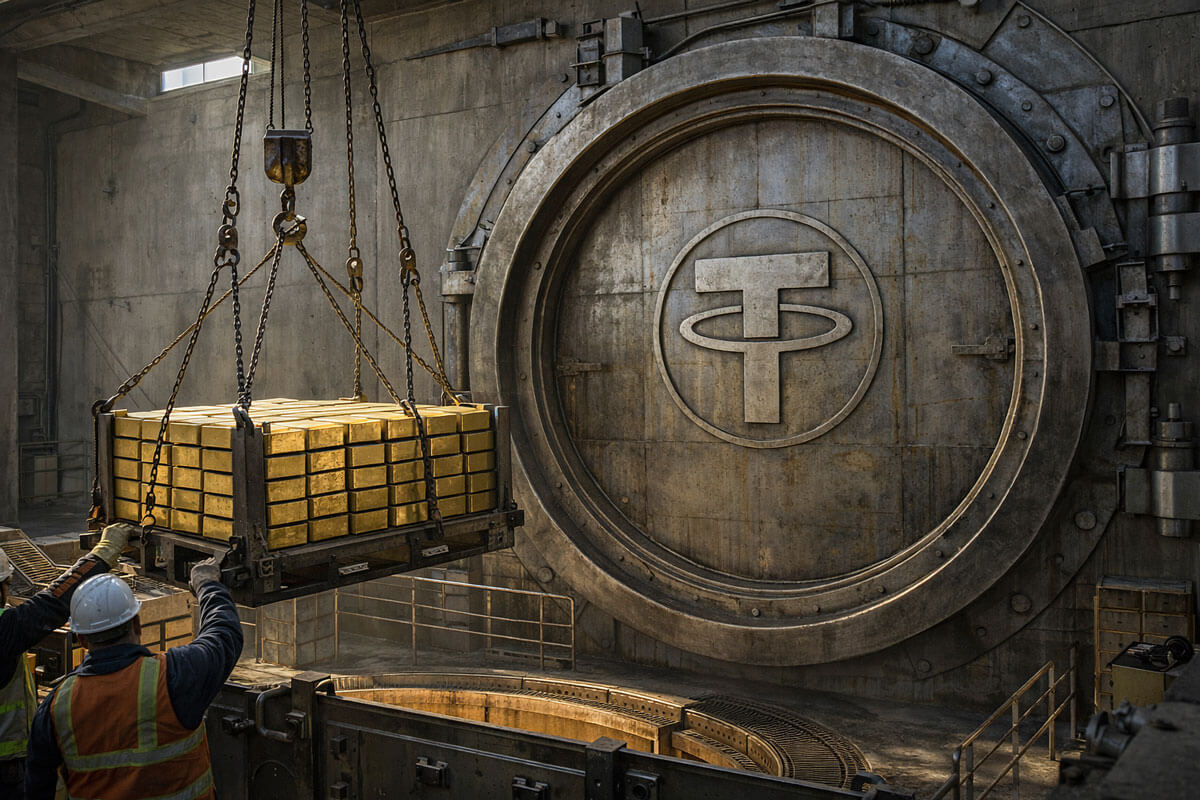
Tether spent early 2026 expanding into gold. By the end of March, the company had already trimmed the senior staff behind its push, turning what looked like an ambitious story into a test of what the company wanted to look like before auditors delved into its books.
Paolo Ardoino said Tether wants to allocate 10% to 15% of its $20 billion proprietary investment portfolio to physical gold. Two days later, Tether reported 2025 profits of more than $10 billion and excess reserves of $6.3 billion.
The company had already poached two precious metals traders from HSBC to build what Ardoino publicly calls “the world’s best gold trading venue.”
The traders were Vincent Domian, former global head of metals trading at HSBC and director of the London Bullion Market Association, and Matthew O’Neill, who oversaw precious metals production across Europe, the Middle East and Africa.
Tether was acting like a balance sheet empire builder, expanding its reserves and cultivating the image of a financial institution that could compete directly with JPMorgan and HSBC in the bullion market.
Tether fired both by March 31st. The rate cut, just three months into his term, came as gold prices fell 12.7% on a monthly basis, heading for the steepest decline since October 2008, according to reports.
Alongside a leadership reset at the investment level, formal audit engagement by the Big Four, and a reported suspension of funding, the job cuts take on a different weight.
The move appears to be a deliberate redrawing of what Tether wanted to be before undergoing testing.
Why this matters: Tether is more than just a crypto company changing staffing levels. USDT sits at the heart of the cryptocurrency market plumbing, so any move that suggests simplified reserves, increased controls, or audit readiness matters far beyond one desk or one asset class.
Audit key points
Tether’s March 24 announcement that it had formally engaged a Big Four company for its first full financial statement audit contained specific language.
The company said this process goes beyond the certification standards used across stablecoins and covers reserve optimization, internal controls, and financial reporting.
On the same day, Tether put a planned raise of up to $20 billion on hold pending an audit, as potential investors and bankers called for more transparency. On March 12, CIO Richard Heathcote had already stepped down from day-to-day operations and was replaced by deputy Zachary Lyons.
There is a broader timeline for Tether’s moves this year.
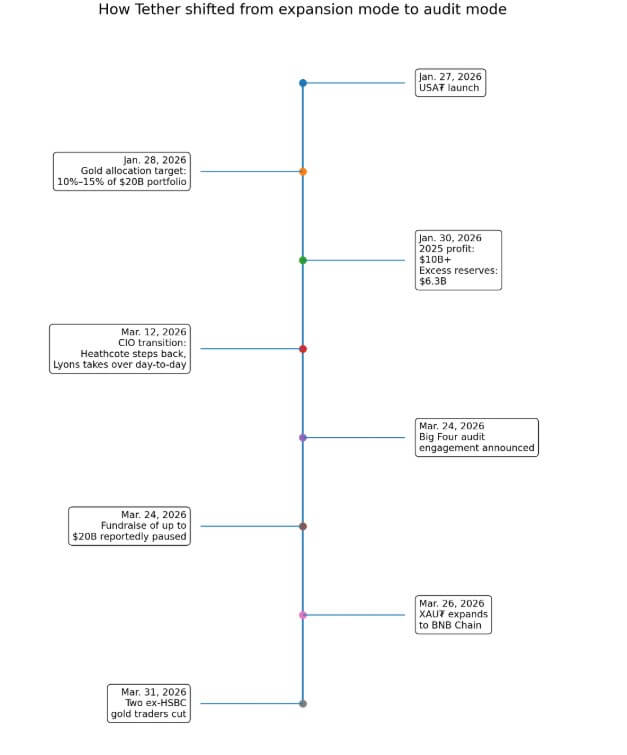
USAT was launched on January 27th, gold allocation ambitions announced on January 28th, profit disclosure on January 30th, investment leadership transition on March 12th, four major audit announcements on March 24th, funding suspension report on the same day, XAUT expansion to BNB chain on March 26th, gold desk layoffs on March 31st.
These moves track companies restructuring around a single internal priority: making provision boundaries more readable, clearly separating non-reserve portfolios, and arriving at a simpler audit process by early 2026.
Tether will still have around 130 tonnes of physical gold at the end of 2025, and four days before it goes off-desk, it extended XAUT to the BNB chain, noting that the tokenized gold market will grow from around $1.3 billion to more than $4 billion in 2025, with XAUT accounting for around 60% of that market.
Tether said it is still building a “state-of-the-art gold team” to optimize operations and reposition gold from an extended symbol to a reserve asset and tokenized commodity.
This is the central change in the story. Tether seems to be moving from extended optics to auditing optics. The question is no longer about how broad its ambitions are, but whether it can make the story of its vast reserve force look clean enough to withstand sufficient scrutiny.
Information disclosure competition
Circle has spent years leveraging disclosure as a competitive weapon.
MetricTether / USDTCircle / USDCCirculation / Market Cap $184B+$77B+Disclosure Frequency Proof; Currently moving to full audit Weekly Reserve Disclosure External Assurance Full Audit Announcement of the Big 4 Monthly Reserve Guarantee Reserve Descriptions from the Big 4 Simplified Institutional Disclosure for Large and Extensive Reserve/Boundary Questions Strategic Issues in the Pitch Article Credibility Gaps Despite Advantage Disclosures Used as a Competitive Weapon
USDC has more than $77 billion in circulation as of late March 31, publishes reserve disclosure weekly, and receives monthly reserve guarantees from the Big Four.
Tether’s USDT exceeded $184 billion, coexisting with a persistent credibility gap that Circle’s institutional investors exploited in corporate sales cycles. By committing to a full financial statement audit rather than continuous certification, Tether aims to close that gap without giving up its trading volume advantage.
Timing tracks regulatory deadlines. The OCC’s proposed GENIUS Act rules, distributed in February 2026, specifically cover financial reporting, including reserve assets, redemption criteria, risk management, audits, and examinations of foreign issuers.

New regulatory standards require end-to-end analyzability of stablecoin issuers’ provisioning systems and governance. Tether’s March 24 announcement was made in response to both Circle’s disclosure pressure and the reality that USDT’s $184 billion is regulated regardless of management’s wishes, and is a direct response to that standard.
Reuters noted that Tether’s equity as a percentage of assets has fallen to 3.3% at the end of 2025, and cash-like reserves have fallen to 76% of assets. Meanwhile, the percentage of holdings in Bitcoin, gold, secured loans, etc. rose to 24%.
Tether disclosed $6.3 billion in excess reserves against approximately $186.5 billion in debt, which represents a cushion of approximately 3.4%. At this margin, a complete audit has the importance of solvency optics for businesses, thwarts dominant market currencies across crypto trading pairs, and serves more than 550 million users.
On March 30, the Federal Reserve issued a memo stating that payment stablecoins could impact liquid asset markets, bank reserve balances, and the implementation of monetary policy.
The IMF study found that a 1% increase in the combined market capitalization of USDC and USDT would reduce the one-month Treasury yield by 1.9 basis points at the bottom, while the BIS/IMF paper found that more than 70% of stablecoin cumulative net inflows came from non-USD currencies.
Tether’s efforts to shore up its books come just as USDT is attracting attention from both central banks and the crypto market.
potential consequences
If the process is completed without significant complications to the structure of reserves or related entities, Tether will resume raising capital with a near-circle disclosure profile, expand institutional access to USDT, and reframe the gold desk cut as a type of operational decision made by a mature financial infrastructure provider.
Goldman Sachs predicted that gold would reach $5,400 an ounce by the end of 2026. If prices recover, XAUT will capture upside while physical desk tether reduction will be a sunk cost.
The company will likely replace the Empire Optics for a few months with something more durable. It’s the right to be priced like an audited infrastructure, rather than a crypto-native operator operating on good faith and quarterly certifications.
Scenario Trigger Tether Change Meaning for the Cryptocurrency Market Bull Case: Fundraising resumes without the preparation of clean audit materials and the complexity of affiliates. The disclosure profile approaches the circle. Gold desk reduction appears disciplined USDT gains institutional credibility. Discussion is calmly put on hold. Bear case: Audit is prolonged. Completion is delayed due to administrative/classification/documentation issues. Funding remains on hold. Scrutiny of preliminary compositions continues and rivals gain ground for the story. Every move in BTC/gold rekindles reliability concerns.
The bearish case is that the audit will take longer. Management or classification issues in a $20 billion proprietary portfolio. Although formally segregated from USDT reserves, it is routed through related parties, requires clean documentation, delays completion, and funding remains shelved.
Every time the price of Bitcoin or gold moves, the debate over the composition of the reserves starts up again in the news cycle, and Tether can no longer be contained through certificate renewal.
The 3.4% capital cushion leaves little room for the narrative to change, and each quarter that an audit is not completed opens more room for competitors to claim the foundations of credibility that Tether has surrendered by requesting inspections before results are available.
The company that built the world’s most important stablecoin is now betting that looking auditable is more valuable than looking ambitious.
The next test is whether the audit is completed on time and whether the hold boundaries, controls, and affiliate documents are clear enough to be retained. Until then, each delay casts doubt on the credibility of the issuers behind cryptocurrencies’ most important trading dollars.
