




Although the market recovery remains fragile in February, some notable signs have emerged. Based on these signs, analysts are predicting that altcoin season could arrive in March.
However, investor sentiment remains cautious and funds still favor Bitcoin over altcoins, which could hinder a broader recovery.
Hope to return to altcoin market in March
According to data from CryptoQuant, only about 5% of altcoins listed on Binance are trading above their 200-day simple moving average (200-day SMA). This means that 95% remain below this level, reflecting the current poor performance of altcoins.
But historical patterns offer a glimmer of hope. Over the past two years, this ratio has typically stayed below 15% for up to five months, then recovered. This pattern appeared from June to October 2024 and again from February to June 2025.
This ratio began to decline in October last year and has now fallen for the first time in five months. This development raises expectations for potential demand growth, as investors may see most altcoins as having fallen to attractive price levels.
Meanwhile, multiple analysts identified early positive signals on the February OTHERS/BTC chart, which tracks altcoin market capitalization excluding Bitcoin versus BTC.
Analyst Blade pointed out that the chart shows a possible reversal on the monthly time frame. The MACD indicator broke above the signal line and formed a green histogram bar for the first time since early 2024. Similar signals appeared before major altcoin rallies in 2017 and 2020.
“Momentum changes and structural compression typically precede expansion. The greatest alternative season is coming,” Braid predicted.
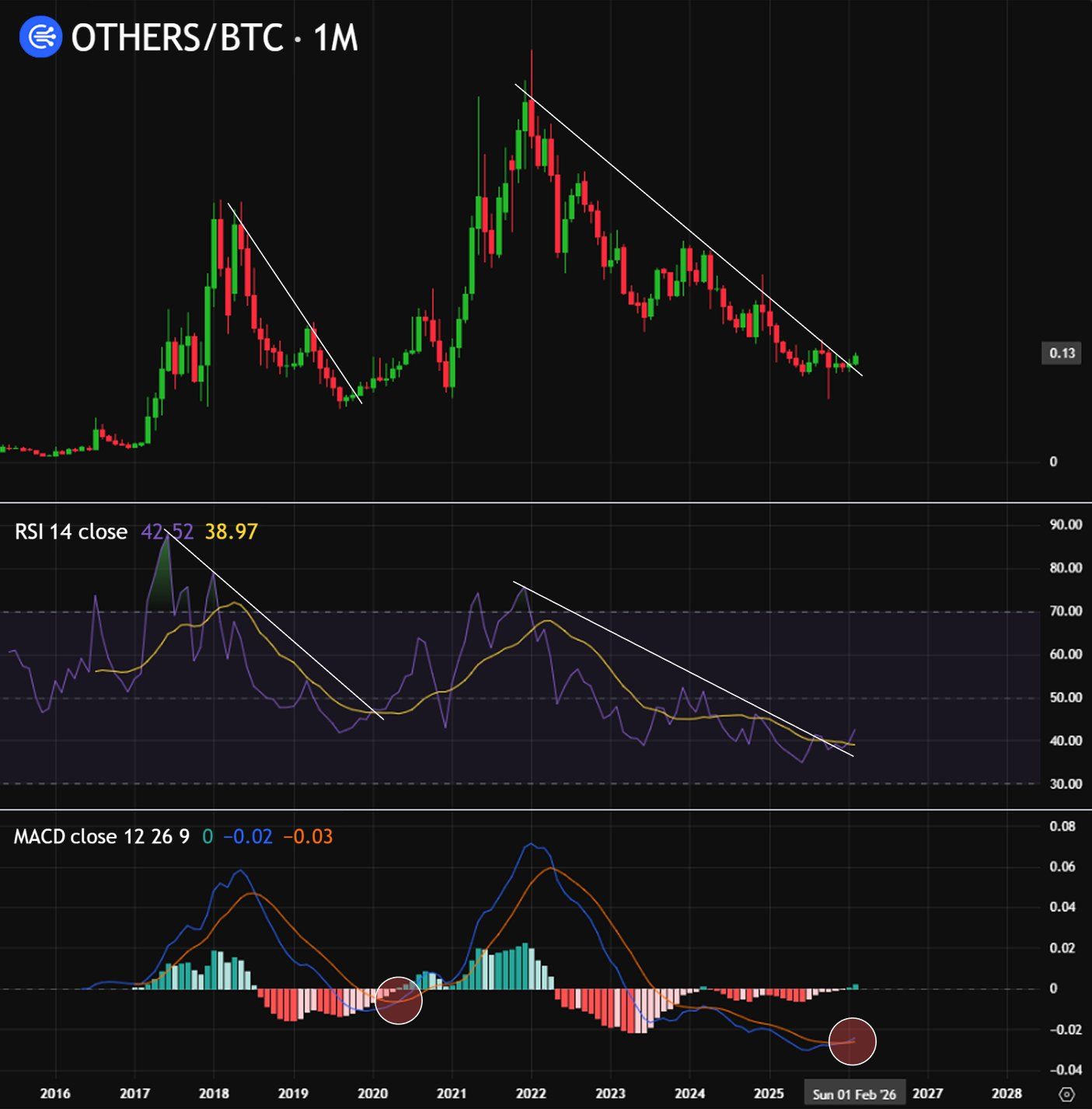
These factors have fueled expectations that altcoins could recover in March.
Altcoin investors remain cautious
From a more balanced perspective, CryptoQuant data shows that the ratio of altcoin trading volume to Bitcoin trading volume on centralized exchanges (CEX) has fallen to its lowest level in the past year.
In 2025, this ratio peaked at approximately 3.5. After that, it gradually declined, falling below 2.5 by the end of last year, and continued to hover around 2.2 by the beginning of 2026.
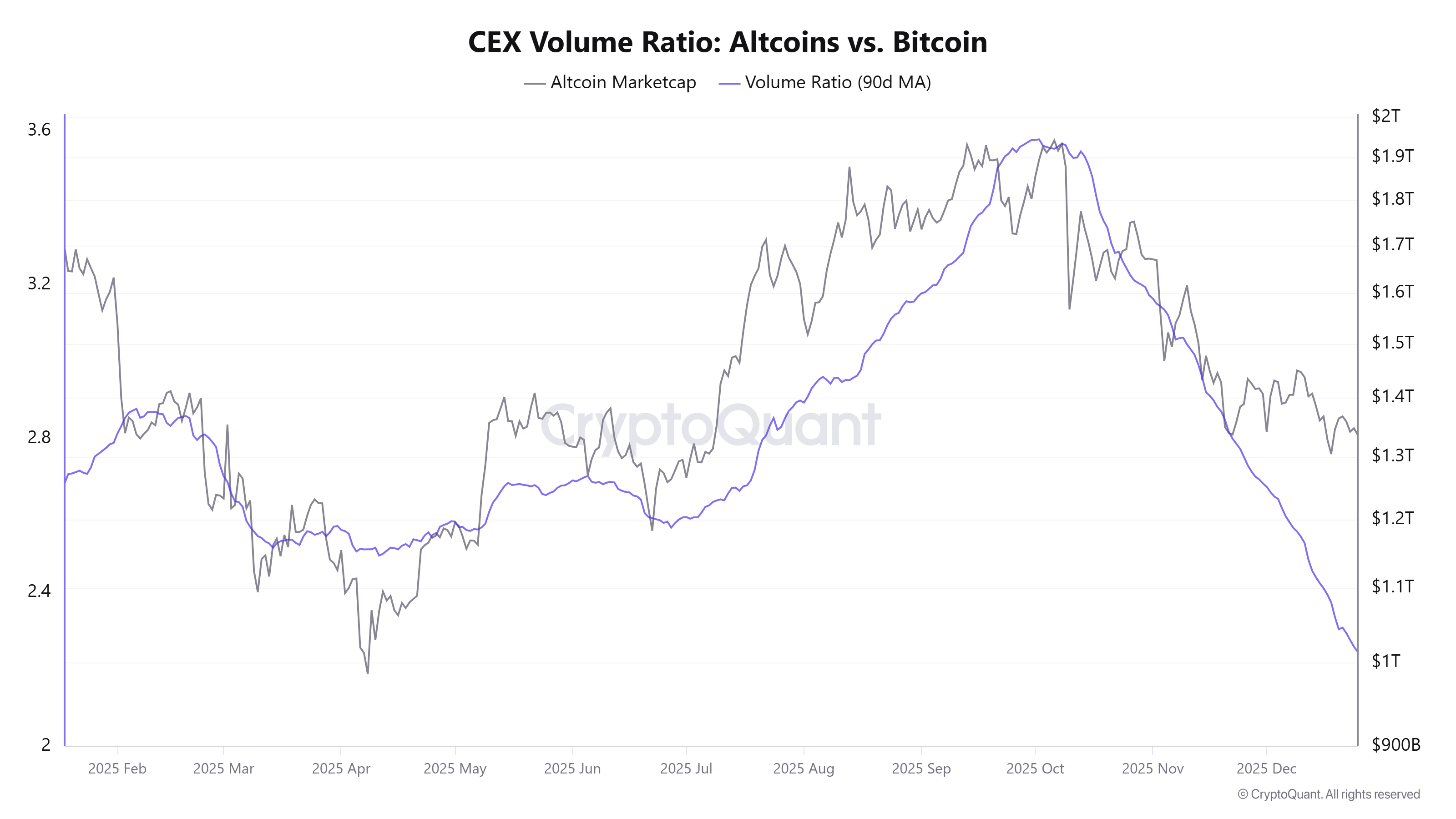
This trend shows that investors’ expectations for the altcoin season remain weak. Capital continues to be primarily concentrated in Bitcoin, with altcoins relatively neglected on centralized exchanges. A true altcoin season will likely require sustained capital rotation and new inflows into the market.
At the time of writing, the Altcoin Season Index is at 43, which is still far from the 75-point threshold required to confirm an Altcoin Season.
According to a recent report from BeInCrypto, the altcoin market is facing 13 consecutive months of net selling. Even if altcoin season does materialize, it will likely be selective and driven by strong fundamentals.
