



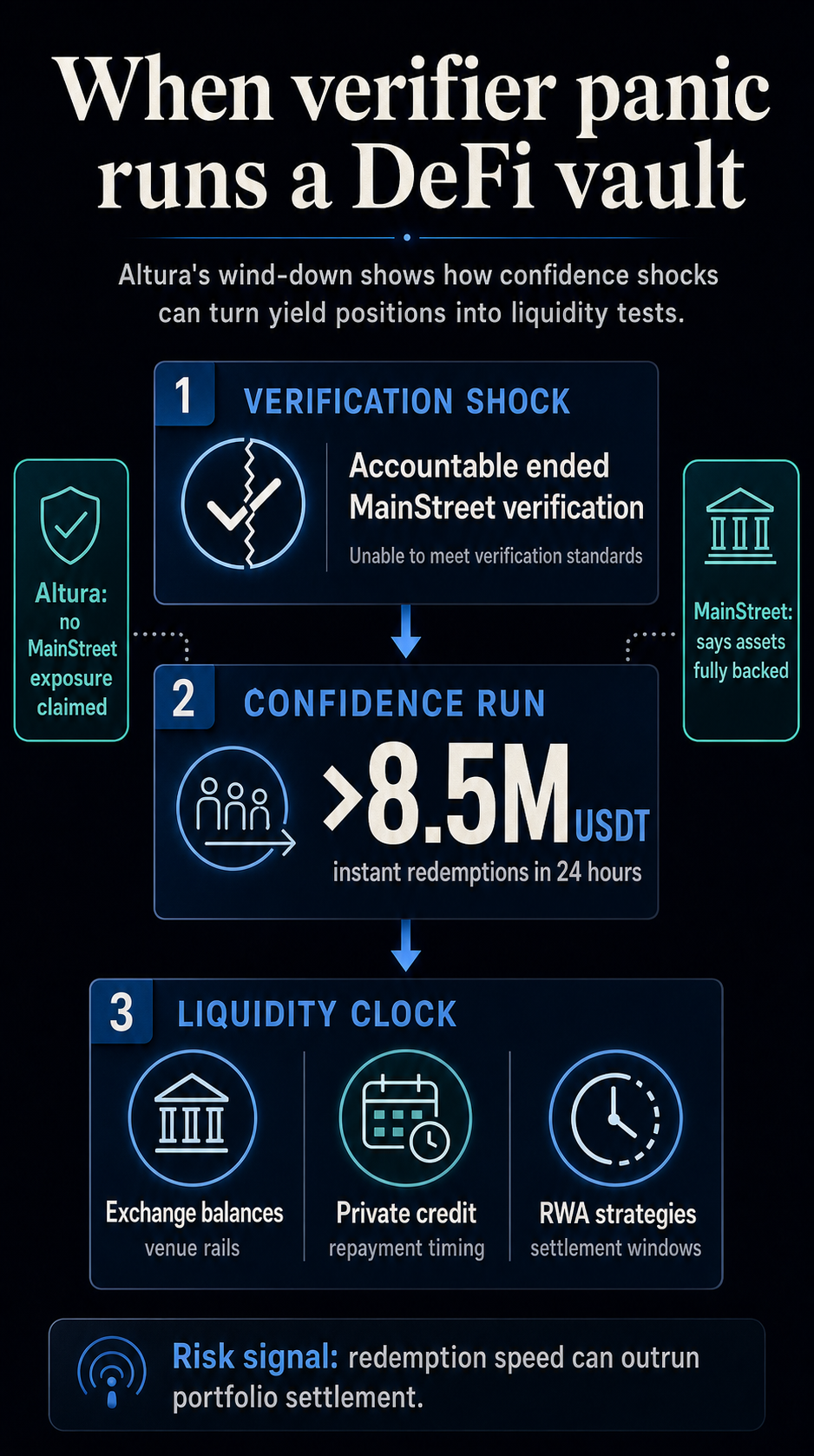
The verification dispute on MainStreet has sparked widespread confidence concerns across high-yield stablecoin products, with over 8.5 million USDT leaving Altura in 24 hours and prompting the team to begin an orderly shutdown of the vault.
CEO Ranveer Arora said users had redeemed more than $8.5 million before the end of the period began. Altura also said he has no involvement with MainStreet or its strategy, so this episode is less about proven asset links and more about what happens when users simultaneously lose faith in nearby yield products.
The push began after Accountable ended its verification relationship with MainStreet, citing unmet verification standards. MainStreet said its assets remain fully backed, but the loss of the third-party verification layer still changes the question for users viewing similar products. If everyone heads for the exit, can Vault turn its positions back into cash fast enough?
That’s the operational risk identified by Altura. Although redemption appears simple from the user side, exchange withdrawals, private credit repayments, and RWA settlement windows can all run on different clocks.
Main Street later said the closure of the third-party reserve certification dashboard did not reflect asset losses or portfolio deterioration.
Altura’s own caveat is just as important. The protocol stated that it has no exposure to MainStreet or its underlying strategy, and explained that borrowers in the HyperEVM lending vault, associated USDT/AVLT market, and Ethereum vault are unaffected by the MainStreet event.
As users saw validation providers move away from yield-bearing stablecoin products, questions shifted from whether they had exposure to adjacent protocols to whether similar products could handle everyone requesting cash at once.
Party Public Claims Relevance Unresolved Issues Altura More than 8.5 million USDT was redeemed in the 24 hours before the orderly downsizing began. Indicates that the withdrawal pressure has reached the operating level of the vault. How quickly the remaining positions will return cash. Responsible MainStreet failed to meet verification standards. It removed the confidence signals that the market depended on. What specific criteria are not being met? MainStreet Assets remains fully supported and did not see any asset losses due to the dashboard shutdown. Prevents disputes from being treated as resolved bankruptcy claims. Whether confidence is returned without the same verifier. There is no direct exposure to Altura Main Street. I’ll leave the Altura episode framed as a contagion of confidence rather than a contagion of proven portfolios. Whether redemptions will be delayed as updates continue.
When all users need cash, liquidity moves front and center
Stablecoin users often focus on tokens. In this case, it was USDT, one of the main payment rails for cryptocurrencies. USDT has a market capitalization of around $186 billion and a 24-hour trading volume of over $51 billion, comfortably maintaining its $1 peg.
This context is split in two directions. Since USDT is a deep market infrastructure, USDT-denominated vaults need to be huge to impact overall liquidity. At the same time, a vault’s liquidity is determined by how the vault uses deposits, where assets are located, what settlement rules are applied, and whether counterparties can return cash in the same timeline as users expect.
Altura’s final statement pointed to that reality. Exchange allocations may be easier to turn into liquid balances than private credit or RWA strategies, but even exchange balances can be dependent on venue procedures, withdrawal rails, and market conditions. Private credit and RWA positions introduce a separate clock, as their repayment, redemption, or settlement windows may not match the speed of DeFi withdrawal queues.

Because of this discrepancy, confidence is important even if the loss is not certain. If the first group of users can redeem immediately, and subsequent users have to wait until their positions mature or close, everyone has an incentive to redeem early. The mere possibility of staged liquidity could accelerate redemptions.
But scale still has meaning. The Altura tracker set the protocol at tens of millions of dollars and created redemption wave material of 8.5 million USDT compared to the vault footprint. Therefore, large same-day withdrawals can change a portfolio built for yield into one built for liquidity.
The next signal is the redemption clock
The expansion of the stablecoin market makes this lesson difficult to ignore. The stablecoin sector has a market value in the hundreds of billions of dollars and a daily trading volume of tens of billions of dollars. The yielding version promises stable units plus returns generated by strategies that may not be immediately reversible.

These products may work, but the risks are partly operational in nature. Reserve claims, validation dashboards, exchange allocations, private credit positions, and RWA strategies all become paramount when users decide they no longer need yield and just want cash.
For Altura, the next signal is termination. whether positions are redeemed on an orderly timeline, how often Altura updates users, how much liquidity is restored at each stage, and whether the process avoids hasty exits from slow assets. The source records support liquidity issues. We do not support treating the Main Street dispute as evidence regarding Altura’s assets.
The test for the rest of the high-yielding stablecoin market will be whether verification can withstand stress as a trust tool, rather than becoming a single point of panic. While the Proof-of-Reserve dashboard and third-party certificates are intended to reduce uncertainty, the termination of a relationship can also become a headline that users interpret faster than the issuer explains it.
That’s the lesson from Altura’s redemption rush. In DeFi vaults, trust is not a soft metric. Users decide whether to leave funds in the strategy long enough for the strategy’s timeline to work.
The post $8.5M DeFi vault raised overnight: A wake-up call for traders chasing high yields appeared first on CryptoSlate.
