




Cardano price is coming back into focus after a failed breakout attempt. ADA is down about 2% in the past 24 hours and has been trending lower since January 6th. Still, the damage remains contained. Over the past seven days, ADA’s price has remained almost flat and never turned negative.
This balance is no accident. Cardano maintains its bullish structure and the buying pressure remains. However, behind the scenes, the types of purchases are changing. This change is now the main risk factor determining whether the ADA remains stable or declines.
Sponsored Sponsored
The bullish wedge remains intact as momentum signals provide support for now.
Cardano continues to trade within a descending wedge pattern that has been in place since early November. A descending wedge is generally bullish as selling pressure eases while prices fall. As long as the lower limit is maintained, the breakout scenario remains valid.
This structure explains why ADA defended the $0.383 support zone. This level previously acted as resistance, but turned into support after the breakout attempt in January. Maintaining that has so far prevented a deeper pullback.
Momentum data initially support this stability. The Money Flow Index (MFI) uses both price and volume to measure buying and selling pressure. From early November to January 10, ADA prices were on a downward trend, while MFI prices were on an upward trend. This divergence suggests that market buying is still active behind the scenes.
Want more token insights like this? Sign up for Editor Harsh Notariya’s Daily Crypto Newsletter here.
Taken at face value, this appears to be constructive and helps explain why price did not break below despite being rejected by the upper trend line. However, momentum alone does not tell you who is buying. Holder behavior is more important than indicators to determine whether this support is durable.
Sponsored Sponsored
Changing holders reveals weakening of beliefs beneath the surface
On-chain data shows clear differences between long-term and short-term holders.
Distributions to long-term holders are increasing. The age band of spent coins in the 365 days to 2 years cohort rose sharply on January 9th. Activity for this group jumped from approximately 1.92 million ADA to 4.51 million ADA, an increase of approximately 135% in just 24 hours. This spike indicates that older holders may be exiting their positions rather than sitting through the volatility.
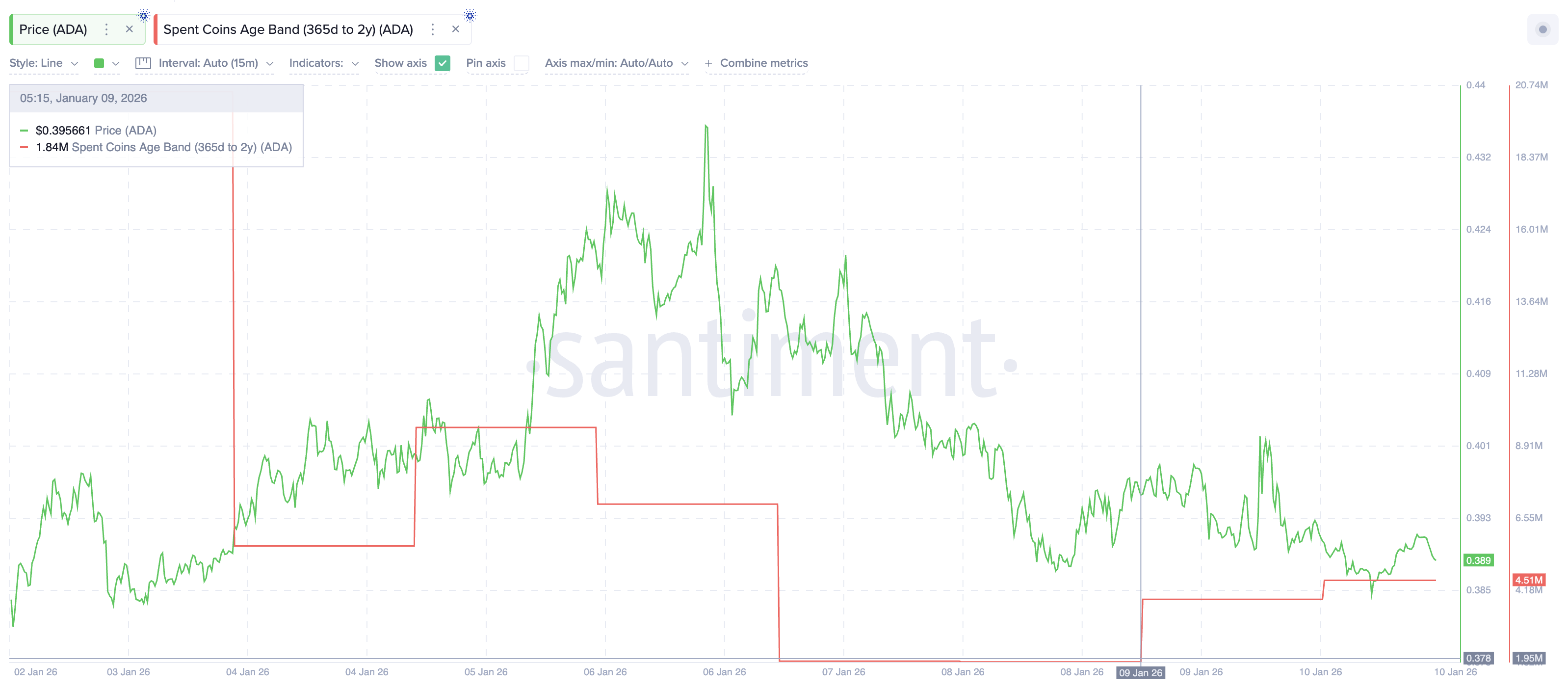
The Spent Coin Age Band measures how long a coin has been held before being moved and shows which groups of holders are actively selling.
Short-term behavior tells the opposite story. Sales activity decreased significantly in the 30- to 60-day cohort. Spent coins in this group decreased from approximately 55.42 million ADA to 4.28 million ADA, a decrease of nearly 92%. This decline indicates that short-term participants may be absorbing supply rather than selling.
Sponsored Sponsored
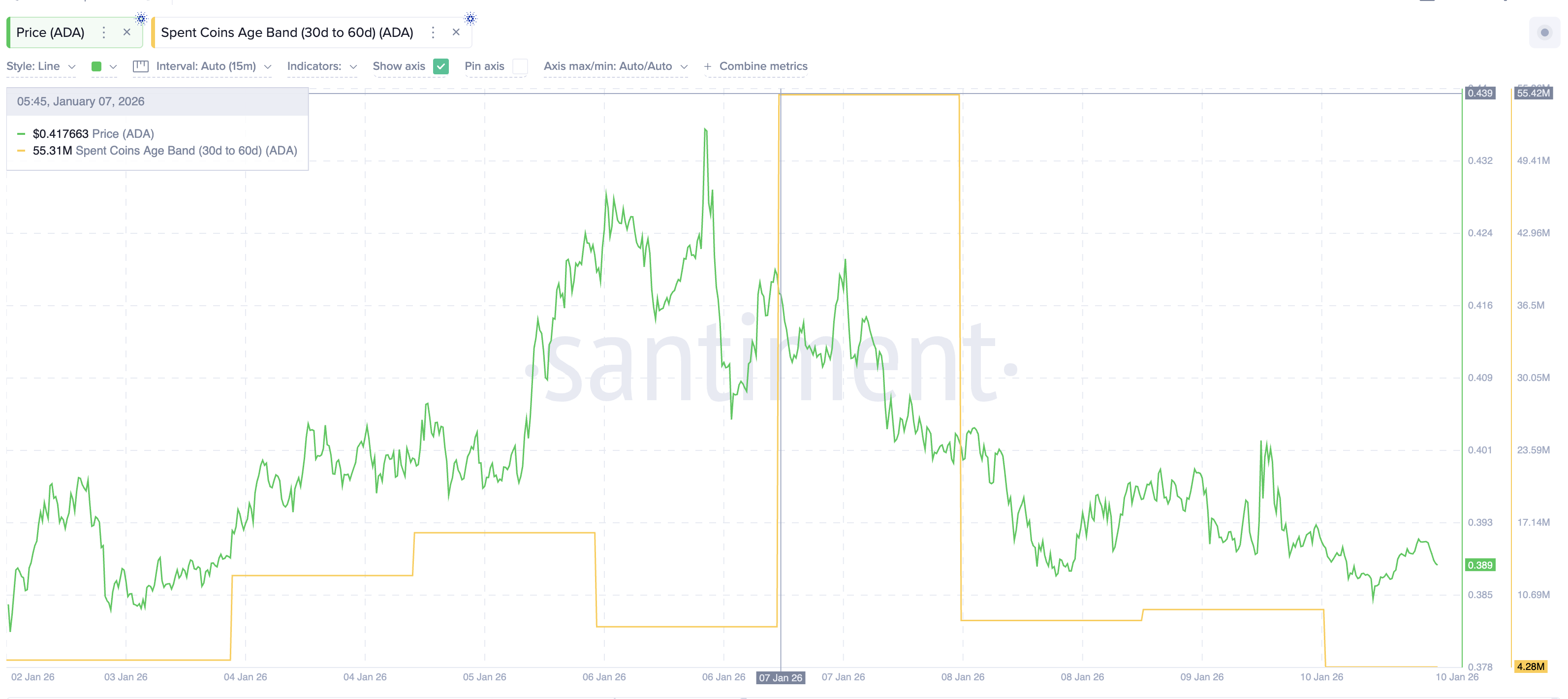
This shift reframes the previous MFI signal. The rise in MFIs is likely to reflect short-term buy-in rather than renewed long-term confidence. When voters sell and short-term traders intervene, prices can temporarily stabilize, but that support is fragile because short-term holders’ funds are usually speculative.
This combination increases risk as speculative capital replaces patient capital. The positioning of derivatives, described next, reinforces that imbalance.
Derivatives skew and key levels will determine next Cardano price movement
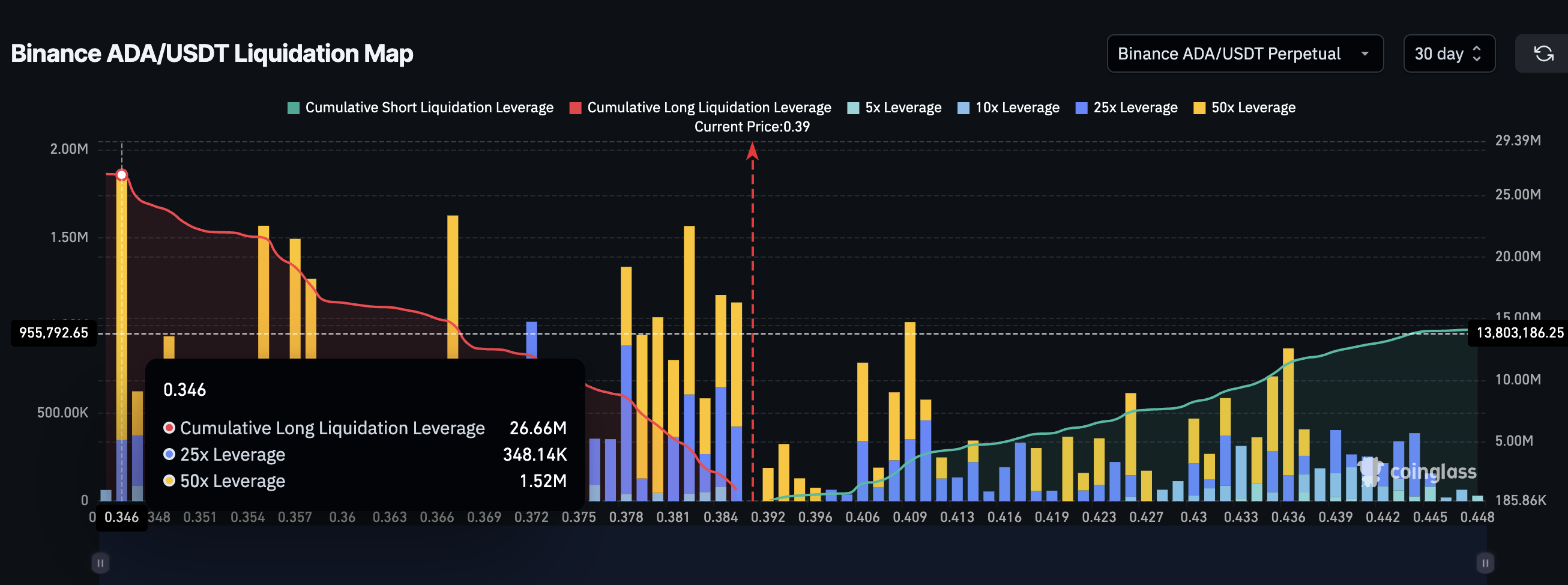
Liquidation data shows that the market is leaning heavily in one direction. In Binance’s ADA-USDT perpetual market, the cumulative long liquidation leverage is nearly $26.66 million, while the short liquidation leverage is nearly $14.11 million. This indicates a strong bullish bias with long exposures being approximately 89% higher than short exposures.
Sponsored Sponsored
While this bias may seem positive, it also increases downside risk. If recently injected speculative funds are withdrawn and prices fall, crowded long positions may be quickly unwound, accelerating losses from forced liquidations.
From a pricing perspective, the roadmap is clear. ADA requires a daily close above $0.437 to revive the bullish case. This would lead to a breakout of the weak downtrend line (with only two touchpoints), as per the wedge’s target, and the path to the predicted 49% upside is once again open.
If Cardano price fails to regain that zone, the risk will decrease. A break below $0.351 will weaken the wedge structure and expose the next major support at $0.328. Losing these levels would confirm that the recent stabilization is dispersion rather than accumulation.
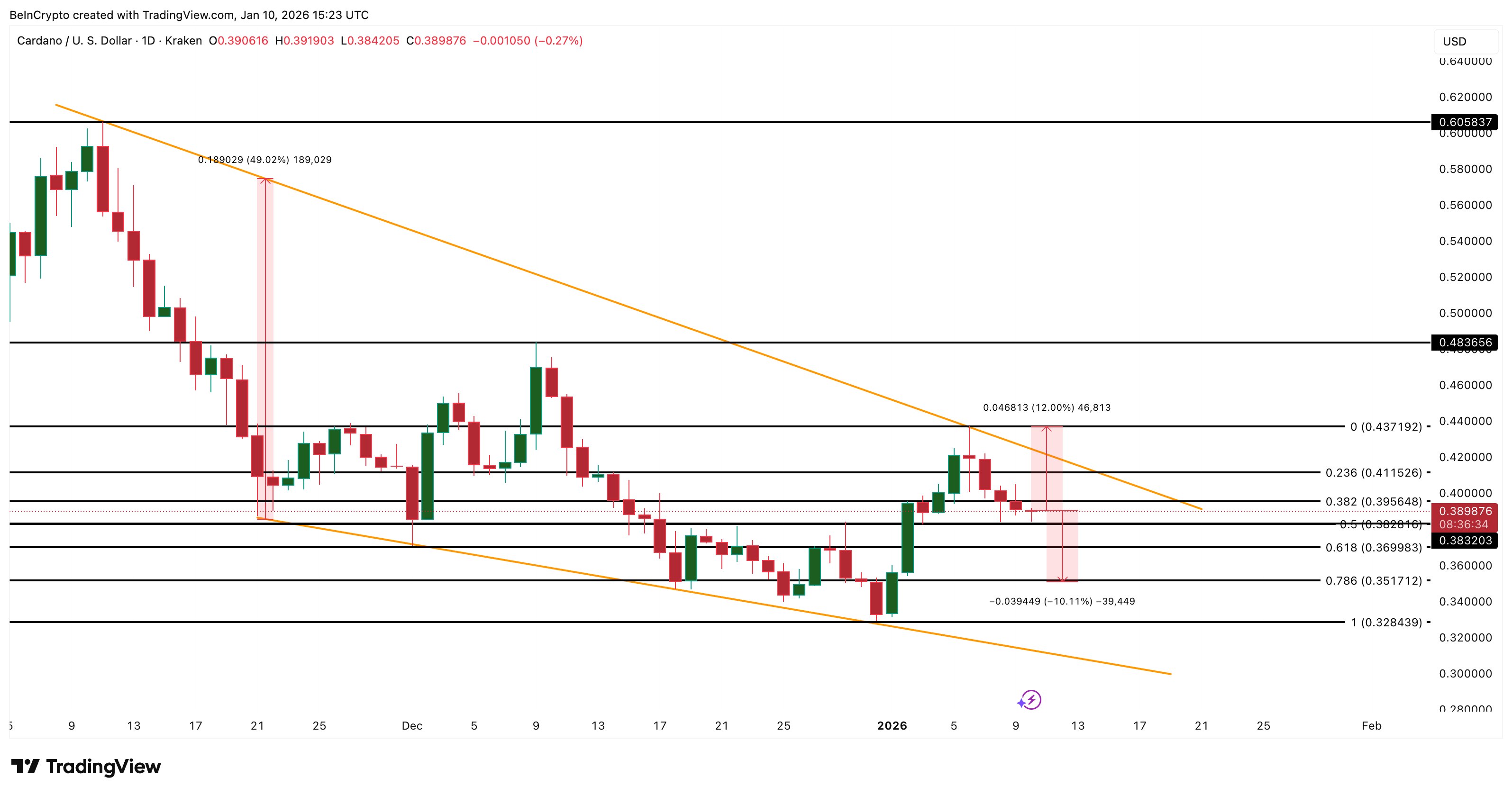
For now, Cardano’s price is balanced on the surface, but unstable internally. Although the wedge is intact and momentum appears to be supportive, long-term holders are selling and short-term buyers are stepping in, leaving little margin for error in derivatives positioning.
The next move will depend on how long speculative capital remains interested.
