






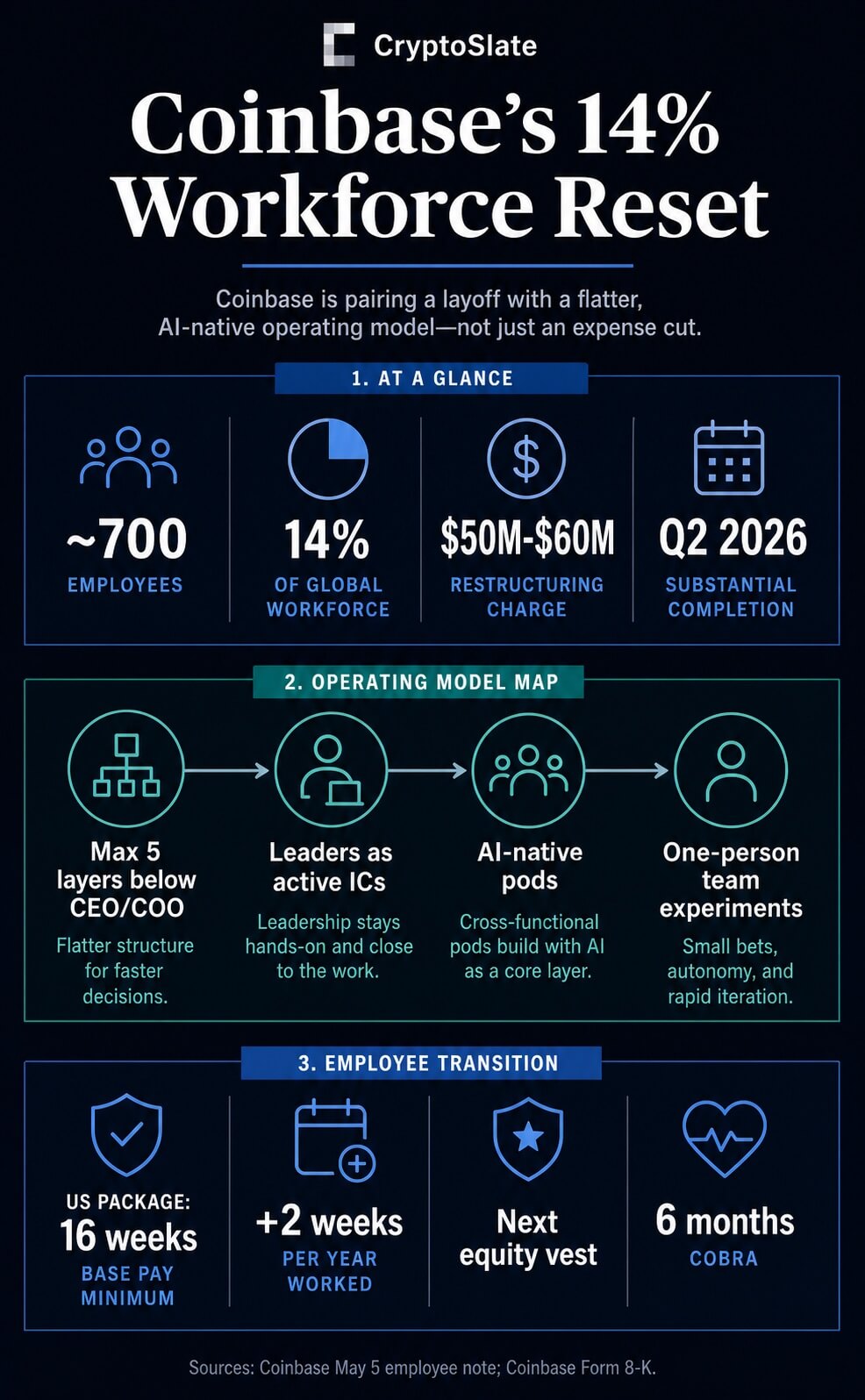
Coinbase plans to cut about 700 employees, or 14% of its workforce, under a May 5 restructuring plan that the company said would cost between $50 million and $60 million.
The company framed the move as a response to two factors: volatility in the crypto market and how artificial intelligence is changing operations within Coinbase.
Armstrong said in an employee memo that while the exchange remains positioned for growth in stablecoins, prediction markets, tokenization and other crypto products, the business remains volatile from quarter to quarter and a lower cost base is needed for the next stage.
Coinbase told the SEC that the plan is aimed at managing operating expenses under current market conditions and optimizing operations for the AI era.
The layoffs represent both a shift in strategy and a budget cut, according to the filing and memo. Coinbase is reducing its headcount while promoting a flatter company structure, returning administrators to the work of individual contributors, and testing a small AI-native team ahead of its first-quarter results on May 7th.
What Coinbase says has changed
Mr. Armstrong’s internal briefing consists of two parts. The first is a discussion of the familiar Coinbase cycle. Trading activity, asset prices, interest income, staking rewards, and user engagement can change rapidly along with the broader cryptocurrency market.
Although the company has weathered previous crypto winters, Armstrong said Coinbase is currently in a down market and needs to adjust its cost structure before entering the next phase of growth.
The second reason is AI. Armstrong said engineers are using AI to complete shipments in days that previously took teams weeks, while non-technical teams are shipping product code and workflows are automated.
His conclusion was that Coinbase needs to reinvent itself as a “lean, fast, AI-native” language, a language that translates layoffs into operating model resets alongside budget cuts.
The changes he outlined are tangible. Coinbase plans to flatten the organization to within five levels under the CEO and COO.
All leaders will be required to be strong individual contributors, and the purely managerial role that Armstrong described will come to an end. It will also be organized around AI-native pods, including experiments in one-person teams where engineering, design, and product responsibilities can assume a single role.

The memo said that for employees who leave, Coinbase has already removed their access to the system and will send details to their personal email accounts. U.S. employees receive at least 16 weeks of base pay, an additional two weeks for each year of service, next stock vesting, and six months of COBRA compensation.
The details of that operation draw out the story from the language of strategy. Coinbase claims that AI will change the amount of work that small groups can perform.
As a result, hundreds of people will soon leave while companies redesign jobs around the people who remain.
For those affected, the move will feel sudden. Armstrong said access to the system was removed because Coinbase has an obligation to protect customer information.
Security rationales make layoff mechanisms part of the operational story. The same controls to protect customer information also result in sudden HR actions for departing employees.

The financial situation was already changing.
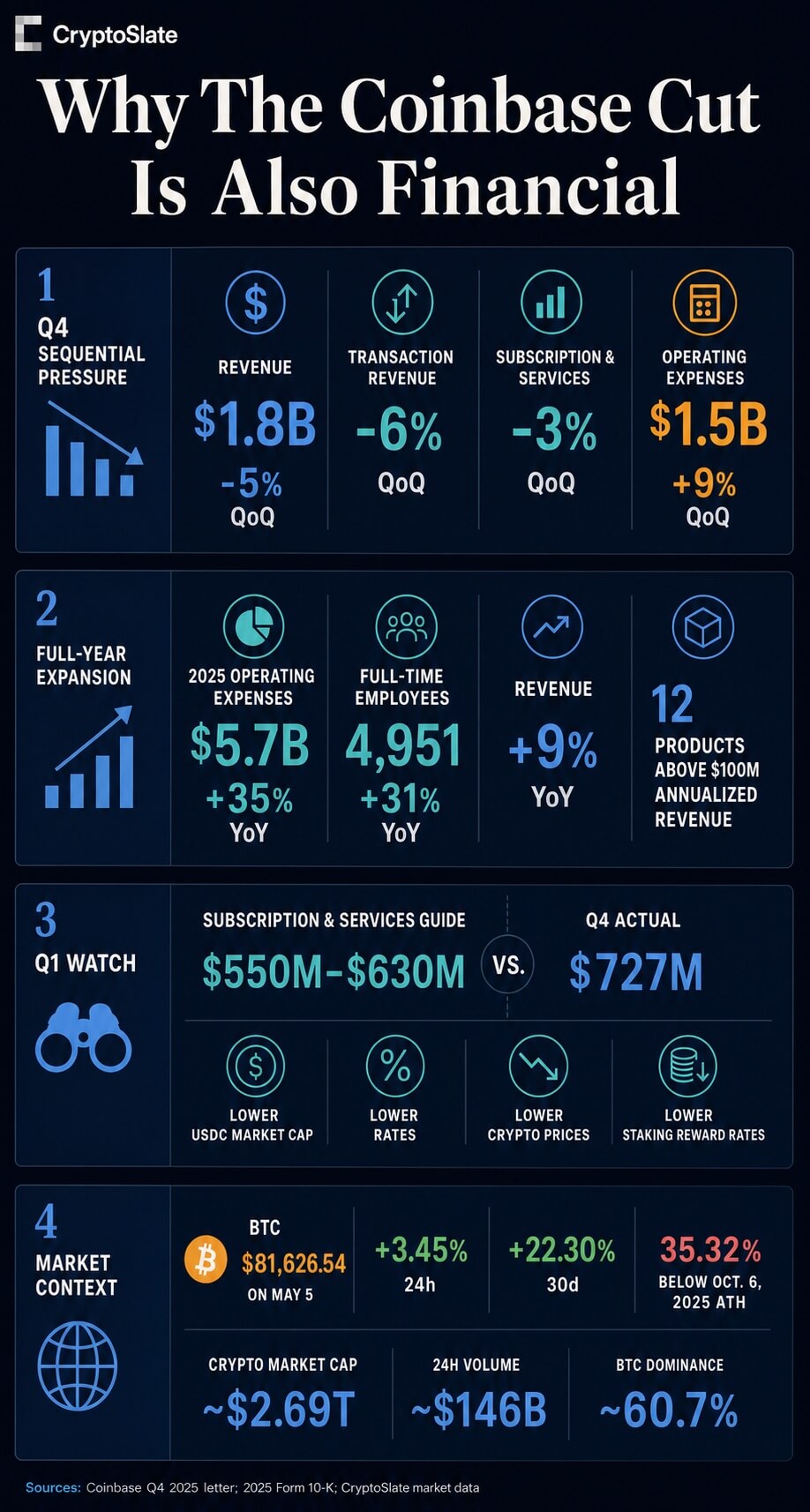
The objective basis for the reduction begins with Coinbase’s own financial disclosure. In its fourth quarter 2025 letter to shareholders, Coinbase reported that total revenue decreased 5% sequentially to $1.8 billion.
Transaction revenue decreased 6%, subscription and services revenue decreased 3%, and total operating expenses increased 9% to $1.5 billion.
Full-year numbers showed the company was still expanding. Coinbase said its 2025 revenue increased 9% year over year, highlighting its record breadth of products, including 12 products with annual revenue of over $100 million.
Expenses increased rapidly. Full-year operating expenses were $5.7 billion, an increase of 35% from 2024, and the number of full-time employees was 4,951, an increase of 31% from the previous year.
That contrast is at the heart of objective reading. Coinbase announced the cuts following a period of expansion, product growth, rising operating costs, followed by weak fourth-quarter metrics, and a February outlook that showed a decline in subscription and services revenue in the first quarter.
This will force employees to cut costs and reset for companies that were scaling toward a broader set of products. The outlook for February then became a more immediate pressure point. Even though Coinbase expected its headcount to continue to grow, several subscription and service drivers were expected to be lower than last quarter.
In the first quarter of 2026, Coinbase drove subscription and services revenue from $550 million to $630 million, down from $727 million in the fourth quarter. It cited a decline in USDC’s average market capitalization compared to the fourth quarter, a decline in interest rates, a decline in the average price of cryptocurrencies, and a decline in reward rates for staking protocols.

The same outlook said technology development and general and administrative expenses are expected to be roughly flat from the previous quarter, and headcount is expected to increase at a slightly higher rate than in the fourth quarter.
Two months later, Coinbase announced a 14% reduction in its workforce. First-quarter results won’t be released until May 7, so this set of results raises questions rather than firm conclusions.
The open question is whether the company is moving ahead of tangible revenue pressure points, using AI to reset its revenue per employee calculations, or both at the same time.
Market background is post-peak and unstable
Coinbase’s annual report confirms Armstrong’s broader points about volatility. The company warned in its 2025 Form 10-K that its operating results will fluctuate from quarter to quarter as crypto asset prices, trading volumes, customer engagement, developer activity, and regulatory conditions can change in ways beyond its control.
That risk is structural for Coinbase. Rising markets can lead to an increase in trading activity, assets on the platform, stablecoin balances, staking revenue, and sentiment.
When the market is down, some of these variables can move in the opposite direction, even as companies add products.
Current market conditions complicate any clear-cut “down market” explanation. CryptoSlate’s Bitcoin price page shows that BTC is still 35.32% below its all-time high of $126,198 on October 6, 2025.
CryptoSlate’s aggregated coin rankings page shows that the May 5th snapshot shows that the market capitalization of cryptocurrencies is approximately $2.69 trillion, the 24-hour trading volume is approximately $146 billion, and Bitcoin has an edge of nearly 60.7%.
This shows that although the market has recovered in recent periods, it is still a long way from the highs that shaped 2025.
The most accurate market framework is a post-peak volatile market. This distinction changes the analysis, as Coinbase’s revenue is driven by more than spot-level Bitcoin.
Its filings point to a wide range of combinations of market capitalization, interest rates, staking rewards, product mix, and trading behavior.
The AI adds a second layer to that image. AI productivity gains are expected to further strengthen in 2026, with the greatest impact concentrated in high-skilled services and finance, according to a March 2026 research report from the Federal Reserve Bank of Atlanta.
They also found that there was little evidence that AI would reduce total employment in the short term, and that larger companies were more likely to expect to cut staff.
This supports a qualified version of Armstrong’s argument. AI may be changing the amount of work Coinbase believes smaller teams can handle, especially in high-skilled services and finance contexts, where the Atlanta Fed has found greater impact.
A more complete interpretation is that Coinbase is combining a circular cost strategy with new claims about AI productivity.
The next test is disclosure
Coinbase has previously made large-scale layoffs when the crypto cycle turned against its cost base. According to the company’s 2025 annual report, the January 2023 reorganization affected 21% of its workforce and resulted in $142.6 million in costs related to market conditions and business priorities.
CryptoSlate covered its early rounds as Coinbase cut 950 employees amid another downturn.

The 2026 version is different as AI is now part of the official rationale and operating model. The company combines a survival argument with an argument that work itself has changed enough to justify fewer layers, fewer pure managers, and smaller teams.
That claim can only be verified through future disclosure. The first signal will be Coinbase’s Q1 report on May 7th, and it will be interesting to see if the revenue and expense backdrop worsens beyond February’s outlook.
The second is expense data from the second quarter onwards, and if all goes well, the company’s $50 million to $60 million in restructuring costs should start to translate into lower run-rate costs.
The third signal is productivity. If the AI-native pod model is viable, Coinbase should eventually be able to demonstrate it through metrics such as revenue per employee, pace of product releases, customer support efficiency, and other operational metrics.
Until then, the answer to why Coinbase is cutting jobs is two-fold. Internally, Armstrong said market volatility and AI require a leaner company.
Objectively, Coinbase is resetting its costs following rapid growth in expenses and headcount, slowing fourth-quarter metrics, and an outlook for the first quarter that is already weighed down by falling crypto prices, lower rates, and lower staking rewards. The May 7 earnings release will determine which aspect of that explanation carries more weight.
