





BlackRock is accelerating its efforts to bring Wall Street Yield to the blockchain, filing paperwork with US regulators to introduce a pair of tokenized money market funds.
The move marks a significant enhancement to the wealth management giant’s strategy to bridge traditional financial products with the rapidly expanding digital asset ecosystem.
The world’s largest asset manager intends to issue digital stocks to its existing multibillion-dollar treasury fund alongside an entirely new vehicle tailored specifically for crypto-native markets, according to a May 8 filing with the Securities and Exchange Commission (SEC).
This dual rollout targets the growing class of investors who park their wealth in digital wallets and stablecoins rather than traditional brokerage accounts. It also solidifies BlackRock’s position as a leading infrastructure provider for the rapidly growing tokenized real-world assets (RWA) sector.
Nate Geraci, president of investment advisory firm Novadius Wealth, characterized the filing as a precursor to the broader financial industry.
“We’re going to see more of this from top asset managers,” Geraci said, noting that BlackRock’s effort is likely the first of many similar strategic shifts expected from large institutional investors in the near future.
BSTBL and BRSRV
The first of the two proposed products would digitize a portion of the BlackRock Select Treasury-Based Liquidity Fund (BSTBL).
The $6.1 billion mutual fund operates under the strict quality and diversification obligations of Rule 2a-7 under the Investment Company Act of 1940 and will offer a blockchain-based stock class that will operate concurrently with traditional institutional stocks.
Tokenized BSTBL securities are set to debut on the Ethereum network.
In keeping with its traditional digital counterpart, the digital tier will maintain a conservative investment strategy, with 100% of its assets allocated to cash, Treasury bills, and overnight government-backed repurchase contracts.
The portfolio requires a dollar-weighted average maturity of 60 days or less, ensuring high liquidity and minimal risk.
The second application introduces a tokenized product from the ground up, the BlackRock Daily Reinvestment Stablecoin Reserve Vehicle (BRSRV).
Unlike Ethereum-specific BSTBL shares, BRSRV is designed for multi-chain deployments, maximizing interoperability across the decentralized web.
The fund is structured as a Treasury-backed short-term financial instrument and reflects BSTBL’s rigorous underlying asset profile. This means we only focus on short-term U.S. government debt with maturities of less than 93 days.
However, its structural purpose is clearly intended to serve as institutional-level plumbing for the crypto economy.
Position of the GENIUS Act
Industry analysts view the BRSRV filing as a highly strategic move aimed at taking advantage of the changing US regulatory landscape, specifically the National Innovation Guidance and Establishment for US Stablecoins (GENIUS) Act.
Market experts have widely speculated that BlackRock is positioning the fund as a compliant yield reserve asset for stablecoin issuers under the impending legal framework.
The asset manager is already deeply embedded in this space, currently managing around $65 billion in existing stablecoin reserves.
In particular, BlackRock recently submitted a comment letter to the Office of the Comptroller of the Currency (OCC) regarding the agency’s proposed framework for permitted payment stablecoin issuers (PPSIs).
In its letter, BlackRock advocated for a flexible, principles-based regulatory environment and formally supported the OCC’s proposed Option A.
This preferred regulatory path includes a quantitative safe harbor featuring daily 10% and weekly 30% liquidity thresholds, along with a 40% concentration limit and a 20-day weighted average maturity cap.
Importantly, BlackRock has asked the OCC to allow same-day-settled sovereign wealth market funds to count toward these weekly liquidity floors, a classification that would directly benefit vehicles like BRSRV.
Riding the wave of cryptocurrency tokenization
Meanwhile, BlackRock’s aggressive product rollout is being carried out against the backdrop of the expansion of the blockchain-based financial asset market.
According to data tracker rwa.xyz, the decentralized asset value of the tokenization market currently exceeds $30 billion, shared by over 767,000 investors. This represents an incredible acceleration of $10 billion since January 2026 alone.
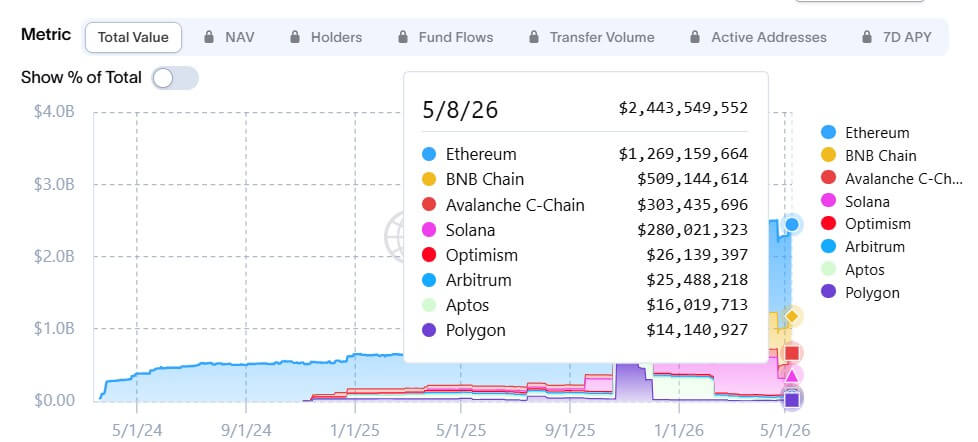
BlackRock already has a sizable slice of this market. The company’s existing BUIDL product ranks as the fourth largest tokenized fund in the world, with an estimated value of over $2.4 billion.
The corporate philosophy driving these product launches was clearly telegraphed by BlackRock Chairman and CEO Larry Fink earlier this year.
In his annual shareholder letter, Fink positioned digital assets as an essential tool for global financial modernization, but warned that the current U.S. economic model leaves too many middle-class workers behind.
Fink argued that the traditional financial system has disproportionately rewarded existing asset holders. He argued that by recording asset ownership on a digital ledger, the industry can significantly reduce the friction, cost and time required to move securities, ultimately democratizing access.
Fink writes:
“Half of the world’s population has a digital wallet on their mobile phone. Imagine if you could use that same digital wallet to invest in a variety of companies for the long term, as easily as sending money.”
Fink compared the current state of tokenization to the Internet in 1996, acknowledging that blockchain integration will not replace old models overnight.
Rather, he believes that products like newly filed money market funds are a necessary bridge to connect traditional financial plumbing to the digital distribution of the future, provided policymakers enact clear counterparty risk standards and digital identity checks.
