



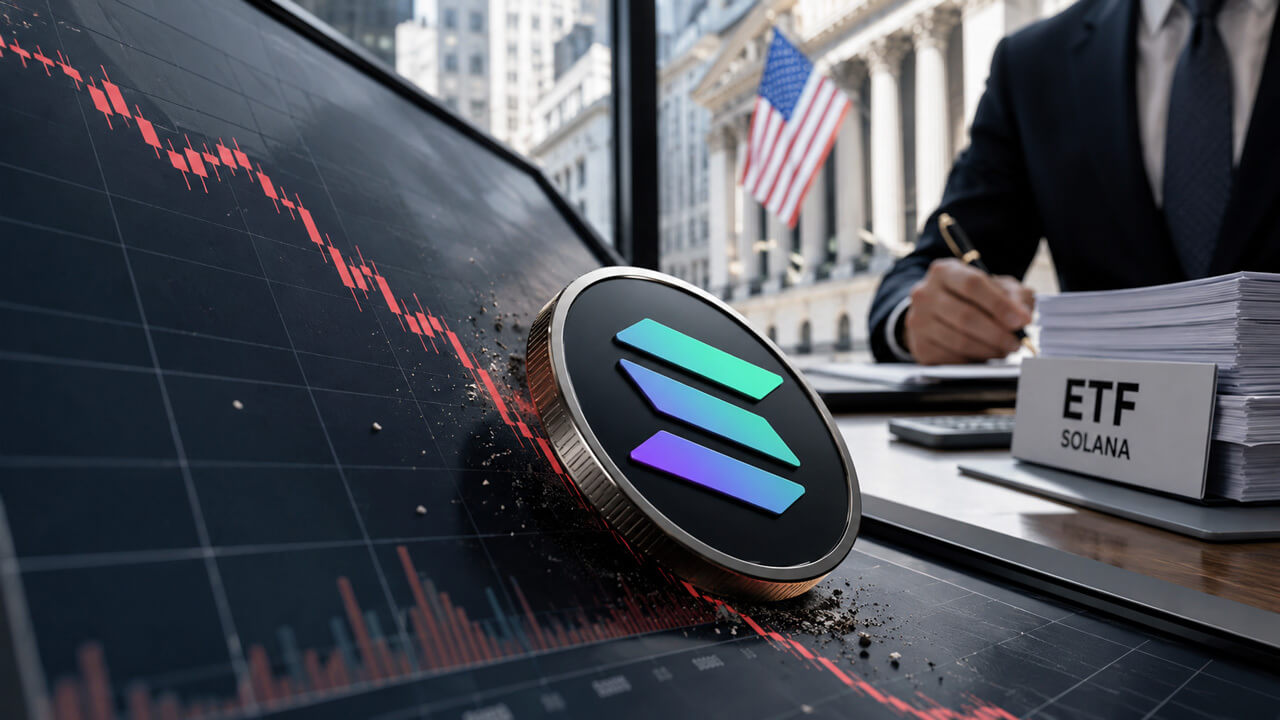
Solana’s spot ETF assets under management exceeded $1 billion by the end of the month, following May’s $115.3 million in net inflows, the highest monthly amount in 2026.
The market capitalization of tokenized real-world assets reached $2.8 billion, stablecoin supply exceeded $16.4 billion, PERP trading volume reached $64.6 billion, and Solana accounted for 97% of cumulative on-chain tokenized equity spot trading volume.
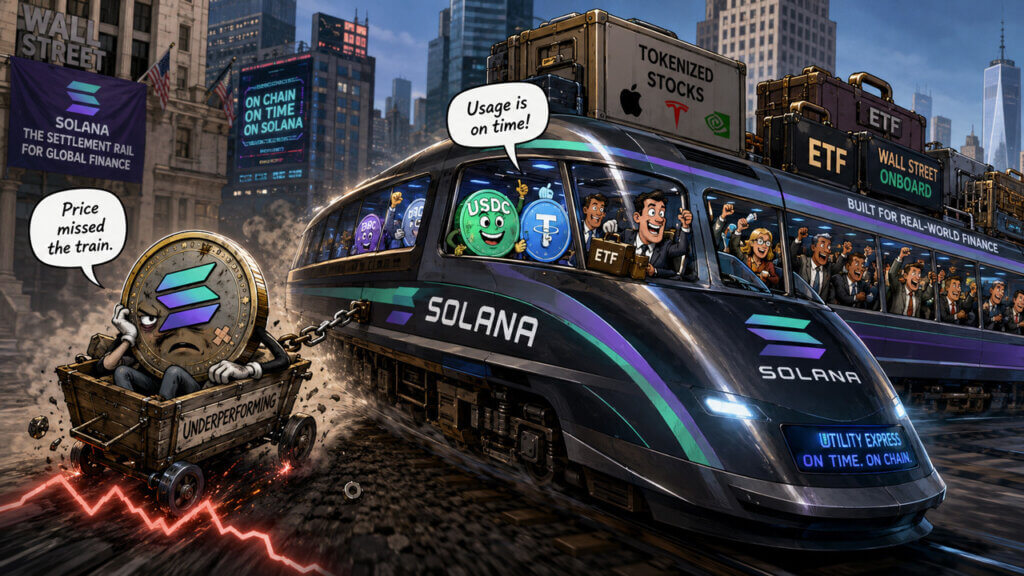
This simplifies the market question. Why is Solana falling when ETF flows and network usage are going in the opposite direction?
SOL is trading around $63, and the disconnect between network momentum and token price can be explained by the fact that activity and value capture are not equal, according to Jake Kenneth, senior research analyst at Nansen.
Fees, stablecoin flows, tokenized stock volumes, and ETF flows each benefit validators, issuers, platforms, and market makers before reaching SOL holders. Under Solana’s current pricing structure, the relationship between network usage, token burn, and SOL value capture is weaker than the key activity numbers indicate.
Solana Metrics Latest Numbers What It Shows Why It May Not Drive SOL Directly Upward Spot Solana ETF Has Over $1 Billion in Assets Under Management Institutional Investor Access Exists Demand for ETF Guarantees Continued SOL Spot Buying ETF net inflows are $115.3 million Highest monthly amount in 2026 Flows may be temporary and macro-sensitive Tokenized RWA market cap is $2.8 billion Institutional asset activity is growing Issuers and platforms value first Earn Stablecoin supply $16.4BSolana payment rail Users require little SOL other than transaction fees Perps volume $64.6B App activity is high Revenues can accrue to apps, LPs, validators One Tokenized Stock Spot Share 97% Solana Monopolizes This Niche Volumes Will Benefit Brokers/Platforms First SOL Price ~ $63 Tokens Not Following Fundamentals Market Still Questions Value Capture
The pricing structure behind the gap
Solana’s base fee is split 50% for writes and 50% for producer blocks. Priority fees that govern activity during high throughput periods flow 100% to validators starting with SIMD-0096.
This means that Solana has a busy day with high-priority fee activity and high block utilization, with the majority of fee income going to validators and burn leveling off regardless of throughput.
SIMD-0547, currently under discussion, claims that Solana’s burn rate is approximately 648 SOL per day even at sustained high throughput.
In a network that handles billions of volumes every day, this number reflects a design flaw in which usage occurs at the network operator and application layer before it accrues to SOL as an asset.
Users can settle $16 billion of stablecoins across Solana while holding only the minimum amount of SOL required for transaction fees. Trading volumes in stocks benefit the platforms and brokers that facilitate those trades. App revenue is accumulated at the protocol layer and frontend layer.
Kenneth noted that the breakdown from the $76-$98 range to the mid-$60s reflects macro risk-off pressures that are re-pricing high-beta assets due to supply dynamics, ownership distribution, and broader liquidity conditions that govern SOL prices in ways that don’t immediately deliver positive headlines.
Type of activity Primary beneficiary SOL Why capture is indirect Base transaction fee 50% burn, 50% direct supply to producer’s block Only half of base fee SIMD-0096 Priority fee to validators after SIMD-0096 100% High-demand activities reward validators instead of burns Stablecoin settlement Stablecoin issuers, payment apps, validators Users are minimal SOL Brokers, Issuers and Tokenization Platforms that allow you to trade while holding tokenized stocks Volume of stocks does not automatically require SOL accumulation Perps and app activity Frontends, LPs, market makers and protocols App revenue can bypass SOL holders ETF activity ETF issuers, custodians and market makers ETF AUM supports access but not necessarily sustained spot demand
macro layer
Solstice CMO Ryan Day said this week’s pricing for SpaceX’s IPO targets a valuation of about $1.75 trillion and revenue of at least $75 billion, with up to 30% of the shares allocated to retail investors, Reuters reported.
OpenAI and Anthropic are waiting behind the scenes, and when capital of that size moves into the market, they risk assets across equities, credit, and cryptocurrencies to raise cash.
All high beta assets are absorbing the same pressure, and SOL’s drawdown is a position in that reading, shared with Bitcoin, which is trading near $61,500.
Nasdaq’s fast-entry rules allow eligible newly listed mega-cap stocks to enter the Nasdaq 100 within 15 business days of listing, attracting passive capital demand for SpaceX once trading begins. This mechanism extends the period during which speculative funds stay away from cryptocurrencies.
The continued distance between SOL’s price and Solana’s underlying momentum over a longer period of time indicates a value capture structure.
A real bear case
Day points to a structural critique of Solana’s tokenomics, which assumes an initial inflation rate of 8%, an annual inflation rate of 15%, and a long-term floor of 1.5%.
At the current pace of disinflation, it will take approximately 5.7 years to reach final inflation. During that period, the supply of SOL will continually increase, and without burn, staking demand, or other sinks to offset large-scale issuance, dilution will become the dominant tokenomic force, regardless of ecosystem activity.
Regarding Pump.fun’s memecoin reputation, Day pointed out that all major chains follow the same memecoin trading cycle, and singling out Solana as a phenomenon that played out similarly on the Ethereum, Base, and BNB chains reflects an unevenly applied insider framing error.
While the inflation criticism is based on specific numbers, the memecoin criticism is a reputational fallout applied to transactions run by all major chains.
What the community is voting on
The reforms already being discussed directly address the value capture gap that the market is pricing in.
SIMD-0550 proposes doubling Solana’s annual disinflation rate from 15% to 30%, which would reduce the time to reach a final inflation rate of 1.5% from approximately 5.7 years to 2.8 years.
At today’s prices, proponents estimate that this change would reduce future SOL emissions by about $1.5 billion.
Anatoly Yakovenko has publicly supported this direction, and a public vote is being held on the strongest bearish case for Solana Tokenomics.
SIMD-0547 addresses price burn in Solana by adding resource-based base charges that are completely burned. Burn scaling is designed to scale directly with network resource consumption as priority fees are routed to validators.
If adopted, this would eliminate the gap between network activity and direct capture of token value, which causes tens of thousands of SOLs to burn on days of real stress on the network, leaving 648 SOLs free per day.
Validator support, community coordination, and activation timelines introduce significant uncertainty. Solana’s core community openly discusses both the supply and combustion sides of the tokenomics equation, and the market is looking for answers on exactly those points.
Proposed Targeting Issue Change Proposed SOL Impact Potential Key Uncertainties SIMD-0550 Inflation/Dilution Doubled Annual Inflation Rate 15% to 30% Terminal Inflation 1.5% Path Shortened from Approximately 5.7 Years to Approximately 2.8 Years Verifier Support, Activation Timeline, Market Confidence SIMD-0547 Weak Fee Burn Adds a resource-based base fee that is completely burned Achieves burn scale in the network with real resource consumption Stress Implementation Details, Fee Impact, Validator Economics Current system activity does not directly equate to capturing a portion of the base fee being consumed. Priority fees go to validators before SOL owners, usage benefits the ecosystem Burn will remain too small unless fee design changes
Once the SpaceX IPO wave dissipates and macro liquidity recovers as SIMD-0550 and SIMD-0547 head toward activation, SOL will gain a reliable path to rerating through lower future dilution, higher burn per unit of activity, and an infrastructure that has already demonstrated the advantages of ETF demand, institutional clearing rails, and tokenized equity.
Assets with documented actual usage have historically been the first to reprice when risk appetite recovers.
Solana’s contradictions will deepen if reforms stall, inflation retains its token grip, and macro pressures persist.
While the chain accumulates real activity through stablecoin payments, stock trading, and access to institutional investors, SOL’s share of the value of that activity is shrinking.
What the market is waiting for is for SOL to prove that it captures what the network is going to be.
