




The downturn in the cryptocurrency market wiped $112 million from Tesla’s pre-tax second quarter results. The unrealized loss reduced earnings to common stockholders by $87 million after tax, or $0.02 per diluted share.
The book value of Tesla’s digital assets decreased from $786 million as of March 31, 2026 to $674 million as of June 30, 2026, according to the company’s second quarter shareholder update.
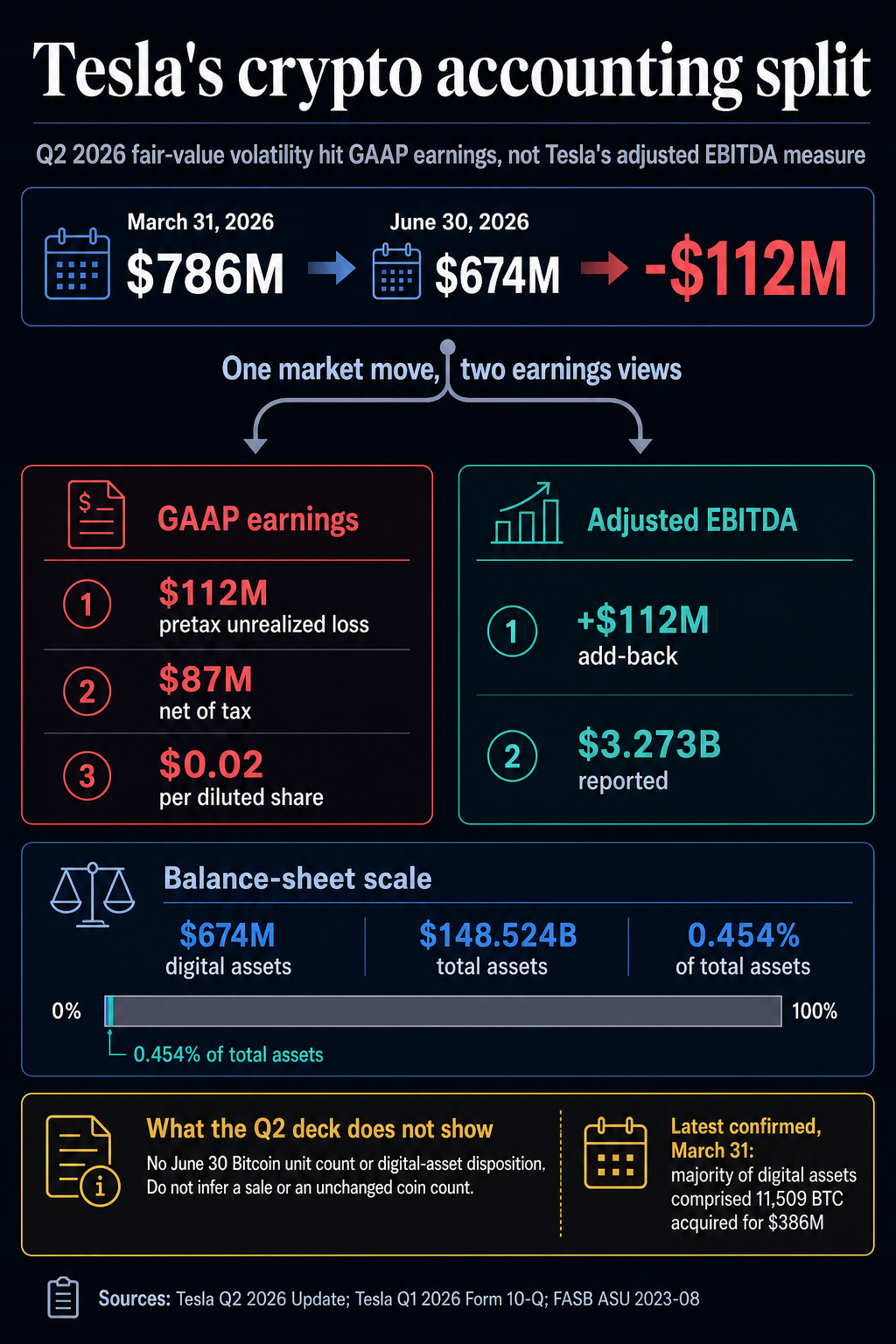
Tesla’s March 31, 2026 filing reported that Bitcoin comprised the majority of the company’s digital assets, including 11,509 BTC acquired for $386 million.
The June 30th shareholder document did not disclose the number of coins or the disposition of digital assets, and as of July 23, 2026, Tesla’s Investor Relations page did not list a second quarter Form 10-Q.

Why did the loss impact GAAP revenue?
Pursuant to the Financial Accounting Standards Board’s crypto asset standards, eligible holdings are measured at fair value each reporting period, with changes in fair value recognized in net income. This makes the impact on your bottom line symmetrical. An increase in price can result in unrealized profits, while a decrease in price can result in unrealized losses before a sale.
The adjusted metrics favored by Tesla tell a different story. The second quarter adjustment fully reversed the $112 million digital asset loss when calculating adjusted EBITDA of $3.273 billion.
The paper loss depressed Tesla’s GAAP earnings but did not impact its adjusted EBITDA. There was also no cash outflow from the business.

This difference, rather than broader balance sheet exposure, is what changes what Tesla’s profits look like on paper.
Digital asset balances of $674 million accounted for approximately 0.454% of Tesla’s total assets of $148,524 million at the end of the quarter. Therefore, Tesla does not operate like a Bitcoin-only financial company whose capital strategy is focused on asset accumulation, even though cryptocurrency volatility can still leave a visible mark on reported profits.

The second-quarter results also show a reversal of Tesla’s fourth-quarter 2024 fair value gain. CryptoSlate reported that this accounting boosted its GAAP net income by $600 million in the prior period.
If the cryptocurrency market continues to fluctuate, Tesla’s reported earnings will likely fluctuate with it. If Tesla continues with the same adjustment process, those changes could again be excluded from Adjusted EBITDA.
The next primary filing will be important for updated Bitcoin units and transaction disclosures.
Until then, the change in book value establishes the accounting effect, not whether Tesla changes the size of the position.
