



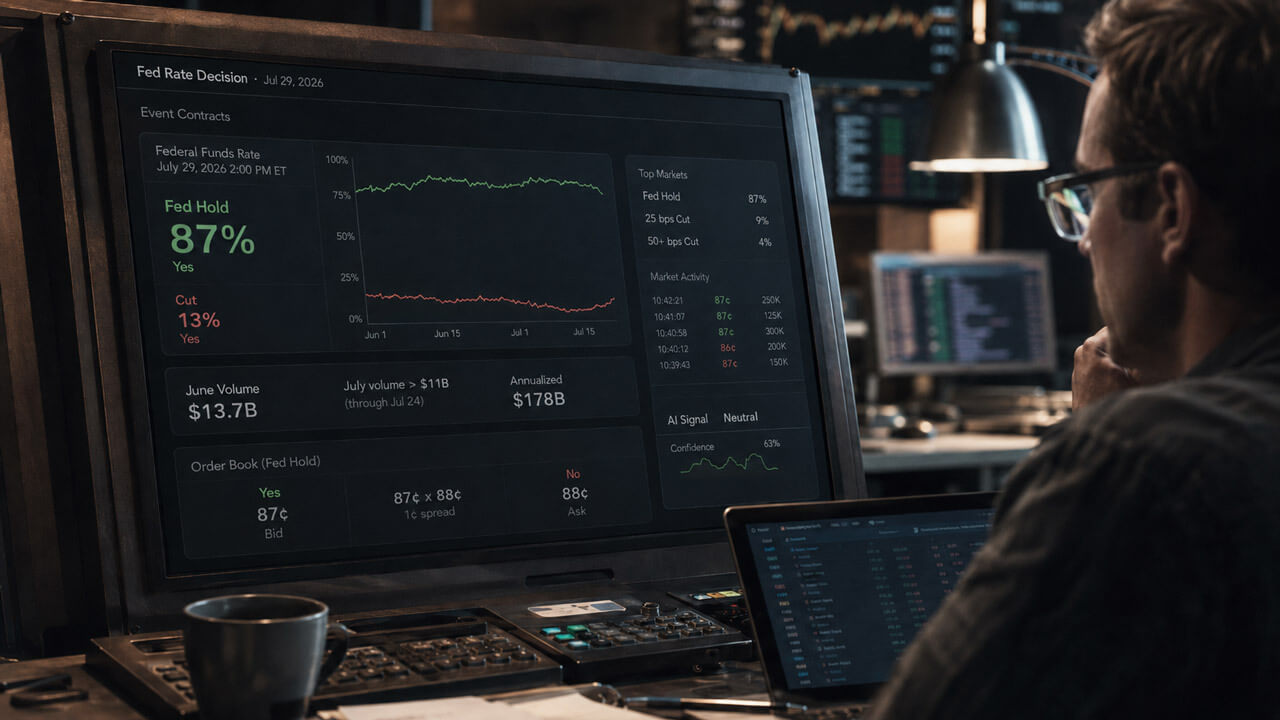
On July 28th and 29th, the Federal Reserve will hold a meeting to determine its next interest rate decision, and traders will try to price the results through bonds, currencies, cryptocurrencies, and contracts that are settled directly on the central bank’s announcements.
A Reuters survey of 104 economists conducted on July 21 found that all expected the Fed to keep interest rates on hold at 3.50% to 3.75%.
Kalsi’s July contract is 87% dependent on that outcome, with roughly $29.7 million listed on that page, but someone still has to put a price on the remaining 13%.
Its trading partners now include market makers, quantitative firms, funded trading shops, and AI agents that monitor prices, compare related contracts, and update probabilities around the clock.
Financial institutions are testing event contracts and brokers are wiring up liquidity providers. Funded trading firms, whether human or algorithmic, are starting to treat settled contracts as a way to identify traders who can out-price the crowd against uncertainty.
Together, these forces can strengthen order books, accelerate price discovery, and centralize advantage among companies with the fastest infrastructure.
The combined monthly trading volume of Karshi and Polymarket reached a peak of $13.7 billion in June and has already exceeded $11 billion in July. These numbers show that prediction markets are already trading on a professional scale.
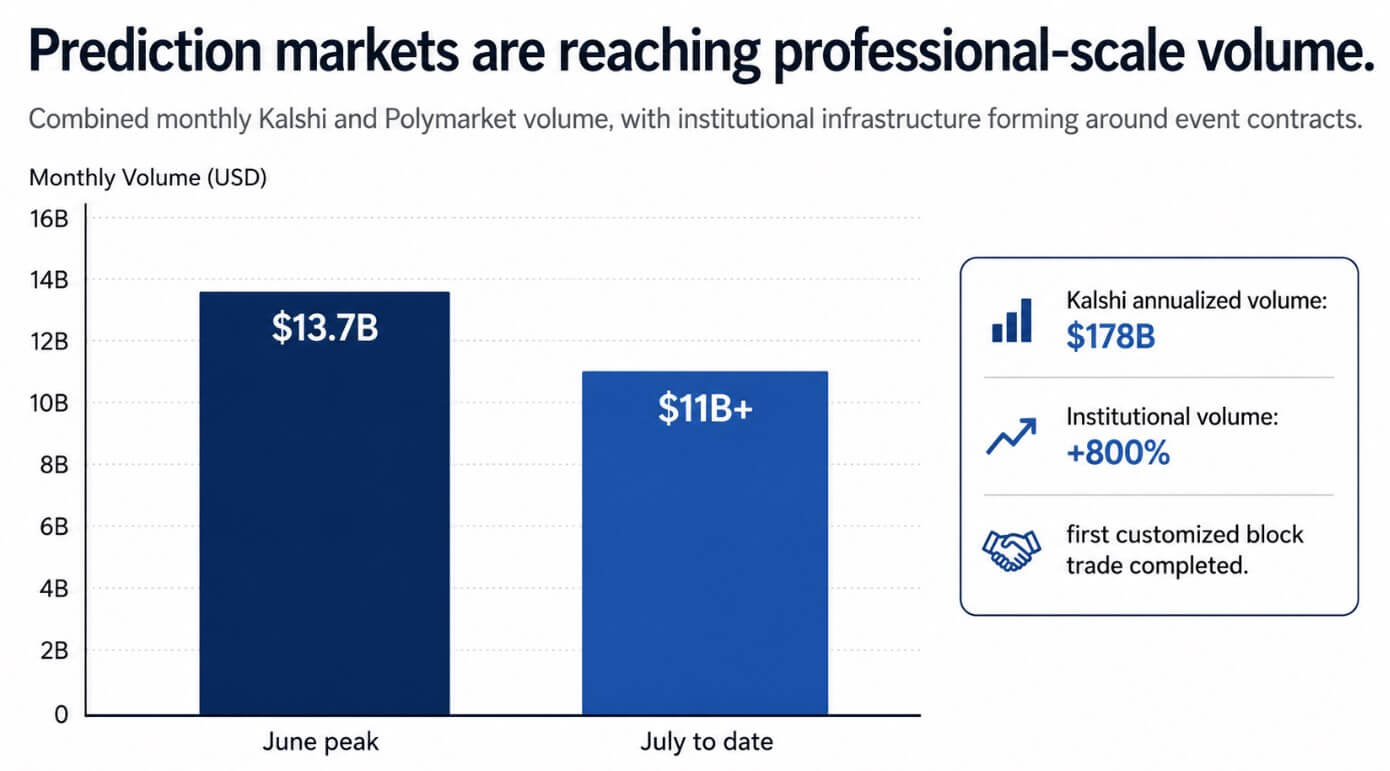
Kalsi said annual trading volume more than tripled in six months to $178 billion, institutional trading volume increased by 800%, and the company completed its first customized block trade.
Clear Street, Marex, and Jump Trading have each built part of their access layer around that growth. Clear Street connects institutional investors to Kalshi, Marex works across both Kalshi and Polymarket’s infrastructure, and Jump helps institutions gain direct access to event markets.
AQR, Susquehanna, and OKX tout their role as prediction market experts in addition to their construction.
Corporate Treasury is testing these same contracts to hedge tariff and regulatory exposures, but this requirement would only work if someone committed to setting the price on the other side of the transaction on an ongoing and large scale.
Building a functioning market requires the supply side to quote in both directions, compare relevant contracts across venues, and be willing to correct prices the moment they appear wrong.
Edge measurement
Louis Regis, founder of on-chain prop company Propr and a former Credit Suisse quantitative trader, argued that event contracts allow traders to be more selective than in traditional markets because the skills they reward are easier to read and risks are limited.
Because contracts are resolved based on defined outcomes, allocators can examine whether traders are consistently pricing probabilities better than the market. This test separates skill more clearly than a directional profit and loss record where market direction and margin blend into the numbers.
The Foresight Arena benchmark estimates that it takes approximately 350 resolved binary predictions to detect an actual 2 percentage point edge with reasonable statistical confidence, and that it takes approximately four times as long to confirm a 1 point edge.
Short-term winning streaks in a small number of Fed or election contracts can result from favorable market choices, correlated positions, or rare results that just happen to be right.
What Funded Companies Can Measure Why It Matters Alert Probability AdjustmentsDid traders repeatedly buy probabilities where resolution was too low, or sell probabilities where resolution was too high?Distinguishing between skill and luck requires a large number of resolved contracts. Performance after fees and slippage indicates whether the edge can withstand the actual execution costs. For thin books, the edges of the paper may disappear. Tests whether drawdown control traders can tolerate clusters of bad events. Marginal downside does not eliminate correlation losses. Reveal whether the market specialization edge originates from macro, political, crypto, sports, or regulatory events. Niche expertise may not be transferable across categories. Live capital conversion indicates whether the simulated signal is strong enough to be A-booked. Nominal funds may overstate the actual venue liquidity. Sample size foresight arena suggests that small edges require hundreds of solved predictions to validate. A hot streak across several major events is not enough.
Propr plans to extend its valuation model to Polymarket, allowing traders and AI agents to qualify for accounts of up to $100,000, hold up to $300,000 across multiple accounts, and earn 80% profit sharing if successful.
The company treats all trades as signals, copying some to the live venue as A-booked positions and simulating the rest internally as B-booking positions, giving traders the same profit or loss in both cases.
Currently, Propr copies about 5% of the signal to live venues. The rest will remain B-books, a holding pattern that Regis believes is to collect enough data to responsibly deploy financial capital, and payments will be settled on-chain in USDC regardless of how they are booked.
execution issues
Regis expects AI agents to be particularly well-suited to prediction markets. Each contract follows a fixed structure, produces an observable price, and is resolved based on set rules.
Agents can monitor the market and continually reprice on a minute-by-minute basis, Regis argued, and the structured environment and continuous reprice additions give them a real trading advantage.
In the Prediction Arena benchmark, six Frontier models were awarded $10,000 each to trade autonomously on Calci and Polymarket from January 12th to March 9th.
These models lost between 16% and 30.8% of their capital in Karshi, and the average return in Polymarket was smaller, still at a negative 1.1%. Another research paper on converting predictions into profits argues that prediction accuracy translates into expected profits only if there is a suitable betting strategy and sufficient liquidity to execute it.
Prediction markets can be a very clean laboratory for AI traders to test how good their models are at turning predictions into profitable trades.
range of results
In a bullish case, funded traders, market makers, and agents supply enough raw capital to tighten spreads, deepen the order book, and bring calci and polymarket prices closer together.
A January 2026 working paper investigated common contracts across Polymarket, Kalshi, PredictIt, and Robinhood. They found that when liquidity and trading activity were high, polymarkets often led Kalsi in price discovery, with directional order flow helping to determine which venue moved first.
More live capital could extend that lead across more contracts and compress the gap between platforms.
In a bearish case, the edge will be concentrated in a few companies with the fastest infrastructure. Casual traders consistently lose out to their more informed trading partners, and liquidity dwindles when events are most difficult to price.
“I’m confident in the direction, not the size,” Regis said. A single funded company, even one that is rapidly expanding, is a small source of funding next to a market that already moves tens of billions of dollars a month.
Scenarios What Happens Who Benefits Key Risks Bull Cases: Professional Liquidity Flywheel funded traders, market makers and AI agents to tighten spreads, deepen bookkeeping and correct expired prices faster. Institutions, venues, seasoned traders and users are demanding better prices. The edge remains concentrated, but the quality of the market has improved enough to justify it. Base case: Professionalization remains selective as Fed decisions, elections, sports, and deepest contracts on crypto improve liquidity while long-tail markets remain thin. A venue with professional traders and the strongest main market. Most prediction markets are too shallow for use by institutional investors. Bear Case: Adverse Selection Prevails Faster firms catch the mispricing before casual traders can react, and liquidity disappears at the moment when pricing is difficult. Quant desk, bot and prop farm with great infrastructure. Prediction markets become less like the wisdom of the crowd and more like retail flow trading with professionals. Black Swan: Trust or Legal Shock Dispute resolution, manipulation episodes, or regulatory blocks slow institutional adoption. Competitors with better compliance and payment reliability. Professional capital remains on the sidelines until market rules are solidified.
The Fed’s July 28th and 29th stays were already close to being finalized before the statement was printed. The competition unfolds in the remaining tail, the probability band outside the same consensus, and the moment when CPI, GDP, and payroll data force price changes for all contracts.
The U.S. Bureau of Economic Analysis will release its preliminary GDP forecast on July 30th, and the July employment report will be released on August 7th. The same competition will be held again at each presentation. The first person to hit a surprise price, or the one who corrects the deadlock first, will maintain the flow.
Accurately pricing these releases over and over again can turn traders and models into something that funded trading firms want to back with real money.
