





SpaceX’s IPO filing and exposure to Bitcoin gave crypto investors a formal benchmark for a company that had already begun trading before the public market received its prospectus.
The company filed an S-1 filing with the U.S. Securities and Exchange Commission (SEC) on May 20, outlining the financial performance, risk factors and growth ambitions of Elon Musk’s rocket, satellite and artificial intelligence company, ahead of its planned listing under the ticker SPCX.
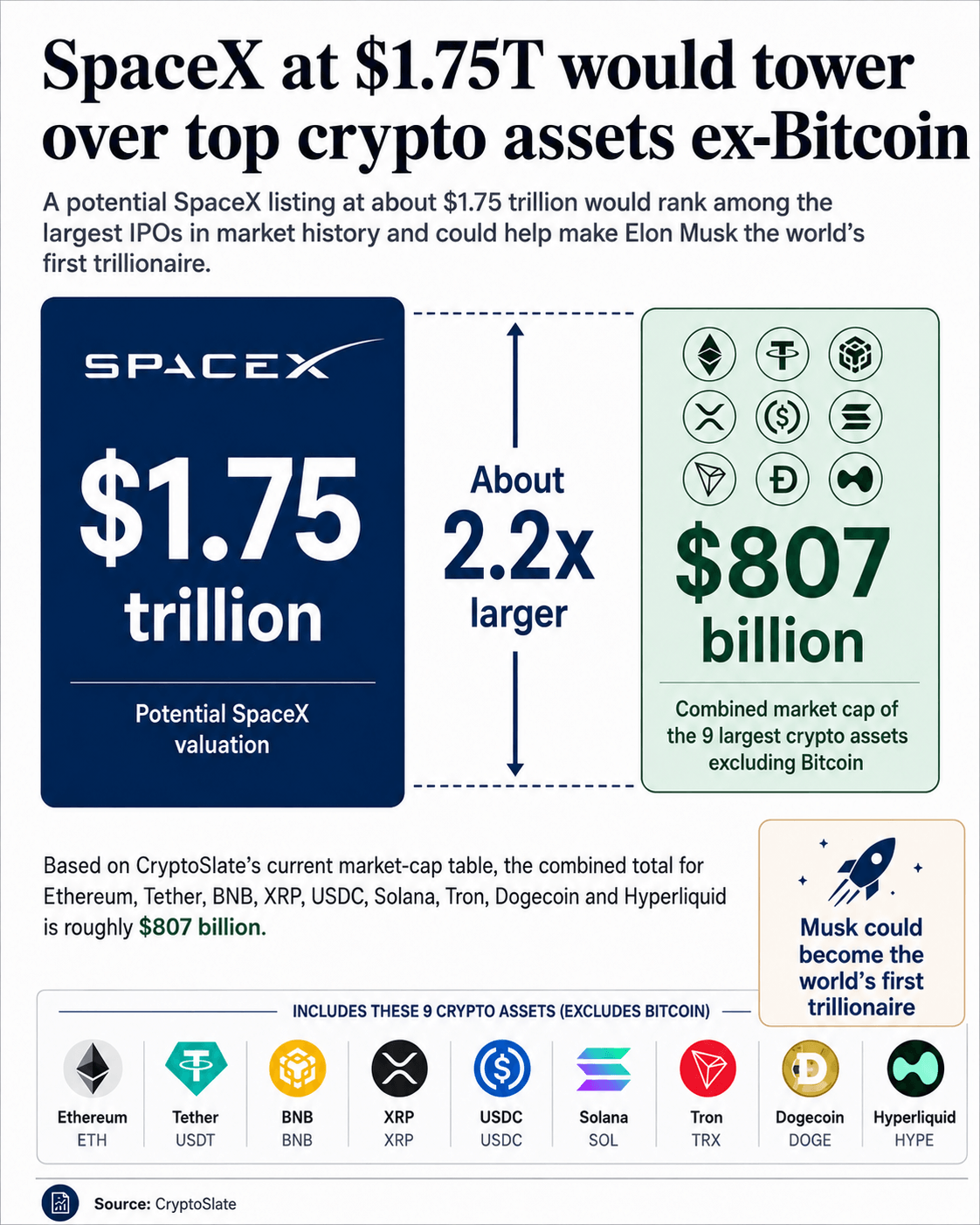
A potential listing could value SpaceX at around $1.75 trillion, making it one of the largest IPOs in market history. If that happens, Mr. Musk could become the world’s first millionaire.
With such a personal fortune, Musk’s wealth would be greater than the combined market capitalization of the 10 largest crypto assets, excluding Bitcoin, based on CryptoSlate’s current market capitalization table, which lists Ethereum, Tether, BNB, XRP, USDC, Solana, Tron, HyperLiquid, and Dogecoin at approximately $807 billion.
But the filing’s connection to cryptocurrencies goes beyond Musk’s wealth or SpaceX’s implied reputation.
The document provides traders with a clear look at three areas that overlap with the digital asset market, including SpaceX’s Bitcoin holdings, X’s expansion into payments and banking, and its data center strategy that could ultimately compete with the AI infrastructure narrative currently underpinning Bitcoin mining stocks.
SpaceX Bitcoin Balance Sheet
SpaceX’s most obvious crossover into the digital asset market can be seen on its balance sheet, resolving years of industry speculation driven primarily by wallet analysis and private management comments.
According to the S-1 filing, SpaceX held 18,712 Bitcoins as of March 31, 2026. The company disclosed that the fair market value of this position is approximately $1.29 billion, compared to a historical cost of $661 million. This means the average purchase price is approximately $35,324 per coin.
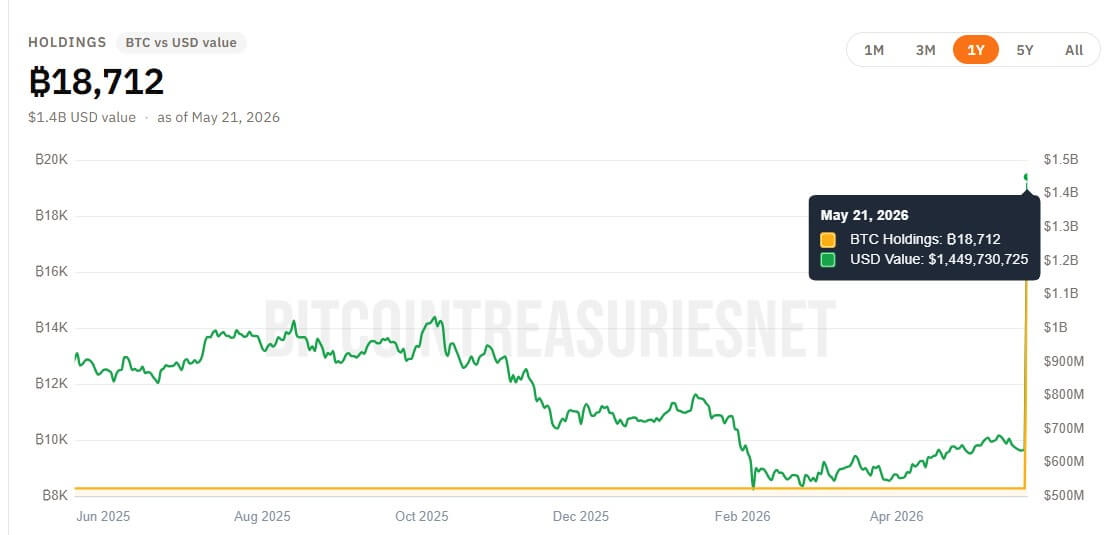
The disclosure firmly anchors SpaceX in the world’s top 10 corporate Bitcoin holders, reflecting a financial philosophy popularized by companies such as Strategy (formerly MicroStrategy), which has the largest corporate allocation at 843,738 BTC, and Musk’s sister company Tesla, which maintains a balance of 11,509 BTC.
Unlike dedicated corporate finance, SpaceX treats its digital asset holdings as a separate balance sheet exposure. However, public market accounting standards mean that these holdings will result in significant fluctuations in net income for future SPCX shareholders.
Current fair value crypto accounting guidelines require public companies to measure eligible digital assets at market price on a quarterly basis and reflect unrealized gains and losses directly on the company’s income statement.
The structural impact of this rule is highlighted in the company’s first quarter performance metrics. SpaceX reported that its nominal inventory of 18,712 Bitcoins remained unchanged from the end of 2025 to the first quarter of 2026.
However, as the Bitcoin price retreated from its historical peak above $126,000 towards the $70,000 level during this period, the reported fair value of the block shrank from $1.64 billion to $1.29 billion.
The decline wiped hundreds of millions of dollars from reported revenue without a single coin being liquidated.
The company said the coins are being held by an anonymous third-party custodian and there are no plans for further acquisitions or sales.
Goals for “All Apps” in X
The prospectus also outlines the corporate trajectory of Social Network
The filing describes X as a platform built for an everything app model that integrates real-time information, communications, media, payments, banking, commerce, and AI capabilities into a single consumer experience.
He also mentioned Money, a product that began in beta in November 2025 as part of an effort to expand the platform’s utility through payments and financial services.
This brings X closer to a competitive field dominated by stablecoin issuers, crypto wallets, and consumer finance apps.
Stablecoin companies are looking to capture payment volume by offering faster payments, lower costs, and programmable currencies. Wallet providers seek to become interfaces for balances, identity, token storage, creator payments, and peer-to-peer transfers.
X approaches the same activity from a distribution perspective, starting with social networks and layering financial tools into the user experience.
Regarding the digital asset ecosystem, this model presents a two-pronged structural outlook. If retail consumers can hold balances, settle transactions, and reward creators natively within mainstream social platforms, their immediate motivation to navigate the complexities of onboarding a standalone cryptocurrency wallet will be reduced.
On the contrary, infrastructure retains substantial options. If X eventually introduces digital asset rails or stablecoin payments within its existing regulated payment layer, it will instantly become one of the world’s largest distribution networks for digital assets.
SpaceX puts deeper capital into Bitcoin miner AI trading
Perhaps the most fundamental threat to the current cryptocurrency story lies in SpaceX’s artificial intelligence ambitions, which align directly with the “power and computing” axis that underpins Bitcoin mining stocks.
In the face of increasing mining difficulty and halving pressure, public Bitcoin miners have spent the past two years redesigning their facilities to host artificial intelligence workloads. Miners have consistently touted the value of surface land rights, high-voltage substations, and industrial cooling equipment to institutional investors.
Industry estimates from companies such as CoinShares suggest that public miners have secured more than $70 billion in GPU colocation and cloud contracts through early 2026, and could derive 70% of their top revenue from AI data hosting by the end of this year.
SpaceX’s prospectus challenges this narrative by investing significant amounts of money to enter the same market. The filing estimates that the specific global market opportunity for AI computing infrastructure will reach approximately $2.4 trillion, driven by an exponential growth in structural demand.
With this in mind, SpaceX is trying to capture the multi-trillion dollar infrastructure sector by offering its data centers to rivals.
SpaceX, in particular, is already monetizing this infrastructure at scale through its recent merger with xAI and the creation of large-scale computing clusters.
Regulatory documents reveal that AI developer Anthropic has signed a binding agreement to pay SpaceX nearly $45 billion over the next three years to secure dedicated computing power for Claude AI models.
The agreement provides for monthly payments of $1.25 billion through May 2029, with a short-term ramp-up discount from May to June 2026. Either company may terminate the agreement with 90 days’ written notice.
The filing indicates that SpaceX plans to enter into identical computing resource lease agreements with other third-party companies, build large internal GPU clusters in response to fluctuating internal training workloads, and lease excess capacity to outside developers.
This operational framework restructures the competitive dynamics of digital asset stock portfolios.
For Bitcoin miners, SpaceX won’t immediately replace ground-based data centers. Miners still have an advantage with existing grid access, developed sites, and short conversion timelines.
However, SpaceX brings another competitive advantage. The company has a larger capital base and broader technology platform, and has a long-term goal of using Starlink’s laser mesh satellite network to completely bypass traditional terrestrial power grid bottlenecks and deploy solar-powered data centers directly into orbit.
This creates a new pressure point for mining stocks. The situation for investors in miners is improving as AI customers require power and data center capacity outside of traditional hyperscaler pipelines. SpaceX shows that similar shortages are attracting companies with deeper balance sheets and larger technology ecosystems.
Miners must prove that they can offer cost, speed, or reliability advantages that larger competitors cannot easily match. Otherwise, the AI pivot that helped support their valuation could result in a more crowded trade.
