



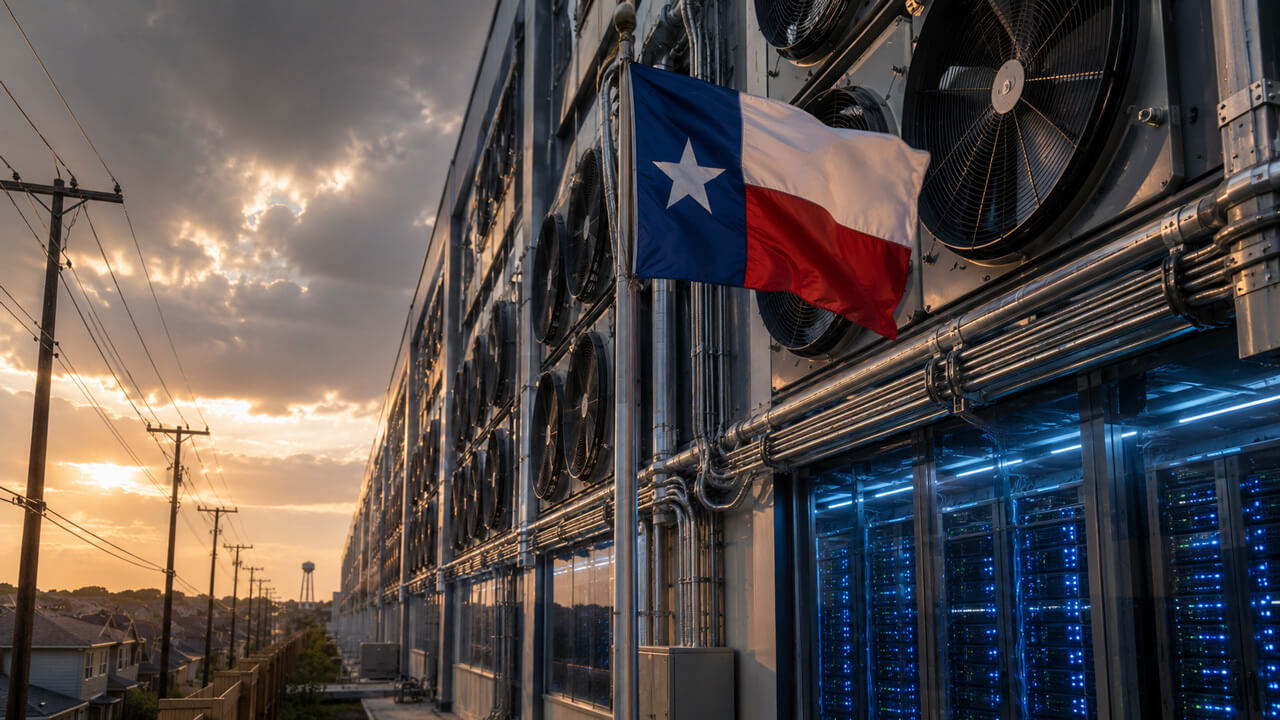
Texas has spent years touting cheap power, plentiful land and a sales tax exemption that has grown into one of the state’s most expensive incentive programs to AI companies, cloud providers and Bitcoin miners.
But now, Gov. Greg Abbott has directed state regulators to overturn that agreement and require funding for the electrical grid that data centers rely on, resulting in households “ending subsidy to one of the world’s fastest-growing industries.”
This rather sudden shift in sentiment could serve as a template for how the rest of the United States regulates AI augmentation.
The state has spent much of the past decade making it the easiest place in the country to build data centers, and it appears it’s paying for that hospitality.
About 6.5 gigawatts of capacity, about one-fifth of the nation’s pipelines, is currently under construction in Texas, and real estate firm JLL predicts the state could overtake Northern Virginia as the world’s largest data center market by 2030.
The state sales tax exemption for eligible facilities will result in about $3.2 billion in lost revenue over the next two years, of which about $1.3 billion will come in this year alone, according to the Comptroller’s Office.
Currently, 121 facilities are taking advantage of this hiatus, which exempts everything from servers and cooling systems to the vast amounts of electricity these facilities consume from the state’s 6.25% sales tax.
On June 10, Mr. Abbott sent a letter to the Public Utilities Commission and ERCOT instructing them to prevent all of the costs of that growth from being passed on to residential customers and to shift the burden to the companies that are generating demand.
What Abbott laid out could serve as a regulatory roadmap for other states. He said the PUC and ERCOT should require the power infrastructure built to serve data centers to be fully funded, ordered the commission to begin lowering residential transmission costs by the end of July, and asked the agencies to submit a joint memo by July 17 specifying what can be done under existing authority and that new legislation will be needed in 2027.
His directive also included water-efficient cooling, mandatory reporting on electricity and water usage, and a hard look at whether the high sales tax exemption should remain in place at all.
What changes when the meter moves in the opposite direction?
Demand of this magnitude explains why a state as industry-friendly as Texas decided to jump in. ERCOT set a record high of 85,508 megawatts in August 2023, and the grid operator’s preliminary long-term forecast now estimates peak demand at up to 367,790 megawatts by 2032, more than four times the record.
Even the conservative version of the figure shows a steady increase from about 98,000 megawatts in 2026 to 111,000 megawatts by 2032 before these large loads pile up. Interconnection queues show a similar acceleration, with large load requests increasing by about 270% in 2025; By the second half of this year, approximately 226 GW will be generated, accounting for 73% of that demand. From the data center.
Those numbers mean the new project will look much different once Abbott’s directive makes it through the rulemaking process. Developers should expect to cover the initial costs of substations, transmission equipment upgrades, and interconnection work that was previously distributed across a broad base of ratepayers. This will increase the capital needed to start construction and encourage more operators to generate or store their own electricity.
Behind-the-meter generation, co-located gas and solar, and large-scale battery installations all become more attractive if companies know they are funding their connections from day one. We’re already seeing this approach in projects like Fermi America’s Project Matador near Amarillo, which funds its own dedicated power grid, from which campuses can draw power while introducing new generations into the system.
Tighter water rules and annual usage reporting are also expected, and the long-standing sales tax exemption that made Texas affordable could be reduced or eliminated when the Legislature convenes in 2027.
Carriers already operating in Texas will have less to manage in the short term. This is because interconnection agreements entered into are contractual and difficult to restart, so the biggest impact will be on new construction and large-scale expansions.
But much still depends on what the PUC and ERCOT decide they can do without new legislation, and how aggressively the 2027 session moves forward. Abbott pointed to Senate Bill 6 of 2025, which already mandates large loads to provide backup power and curtail power during grid emergencies, as a sign that the state was already heading down this path before concluding it needed more power.
The response from many in the industry has been better than expected, with clear, pre-written rules ensuring developers and lenders get projects they like and avoiding the political backlash that follows AI wherever it goes.
Why Bitcoin miners may take the lead in Texas
One of the most overlooked parts of Mr. Abbott’s directive is the line Texas regulators continue to draw between flexible and inflexible demand. Because Bitcoin miners are on the winning side of this line.
Mining facilities can shut off power within minutes when prices spike, reducing mining output to near zero. That’s why ERCOT has spent years integrating miners into a controllable load resource program that it relies on to reduce reserves within seconds when reserves are low.
In general, AI inference and training requires continuous power to run at full capacity, so the more grid-aligned workloads are valued in future rulebooks, the better miners will be considered than hyperscalers. According to one estimate, ERCOT’s decision to consolidate miners as flexible loads after the 2021 power outages saved the state from spending about $18 billion in new gas speaker construction.
However, flexibility decreases in both directions. This is because miners seeking new interconnections will be meeting the same demand as other miners to fund their own infrastructure. And the bigger threat to the economics of mining is competition for cheap electricity itself.
As CryptoSlate has documented through 2026, AI operators are bidding power firmly to levels that will squeeze the thin margins that miners can survive on, and BlackRock is warning customers that data centers could consume 24% of US electricity by 2030, a number large enough to reorder where all types of computing are built.
Miners are already tasting an upturn in instability in Texas, with some regions seeing mine energy use increase by 31% and local electricity prices dropping by 80%. An open question is whether dispatchable demand can maintain its privileged position as grids tighten.
Texas is almost certainly not the last state to overcome this problem. Already facing strong domestic opposition, the San Marcos City Council recently rejected a $1.5 billion data center proposal after nearly nine hours of public comment. The plan is also being implemented nationwide, with a March Quinnipiac poll finding that 65% of Americans oppose the creation of AI data centers in their communities.
Virginia, Georgia and Arizona are also struggling with similar surges in demand and the burden of rising infections, making Texas’ approach an early test case for other parts of the country to look to.
We now have one of the most business-friendly states in the United States. The state was the first to base its data center boom on the most generous incentives ever, forcing the industry to pay for its own costs.
Abbott is betting that clearer rules and a fairer allocation of costs will keep investment flowing while easing the burden on household budgets. If that bet pays off, the next phase of the AI boom will be shaped by the politics of the power grid and the question of who pays for electricity.
