




Ethereum price is trading near the top of a descending wedge and approaching a key technical moment. ETH is slowly but steadily rising and is inches away from a breakout.
This momentum is largely due to the Fusaka upgrade published on December 3, which aims to improve scalability while reducing layer 2 costs, a long-standing challenge for Ethereum.
Sponsored Sponsored
These changes come as market participants position themselves for 2026, creating favorable conditions for network growth and price stability.
Ethereum holders show strength
Activity on the Ethereum network has increased rapidly over the past three weeks. Data shows a sharp increase in new addresses, defined as wallets interacting with ETH for the first time. This metric increased by approximately 110% during the period, indicating accelerating user adoption.
Ethereum is currently adding approximately 292,000 new addresses per day. This surge reflects a combination of seasonal factors and structural upgrades.
Optimism surrounding Christmas 2025, New Year positioning, and Fusaka upgrades appears to be driving new engagement across the ecosystem.
Want more token insights like this? Sign up for Editor Harsh Notariya’s Daily Crypto Newsletter here.
Increases in address creation are often preceded by increases in transaction demand. While not all of the new addresses represent long-term investors, sustained growth at this scale suggests an expansion of participation. A broader influx of users typically improves liquidity depth and strengthens price resilience during periods of market volatility.
Sponsored Sponsored
Forced to hold, but still beneficial for ETH
Macro indicators present a complex but useful picture. HODL Waves shows an increase in medium-term holders, defined as wallets that hold ETH for 3-6 months. These investors primarily entered positions between July and October 2025.
Those who bought in early July are now making a profit, but those who bought after mid-July are still underwater. This distribution creates forced holding behavior as many holders wait for prices to recover. Such positioning can provide temporary support by reducing selling pressure during pullbacks.
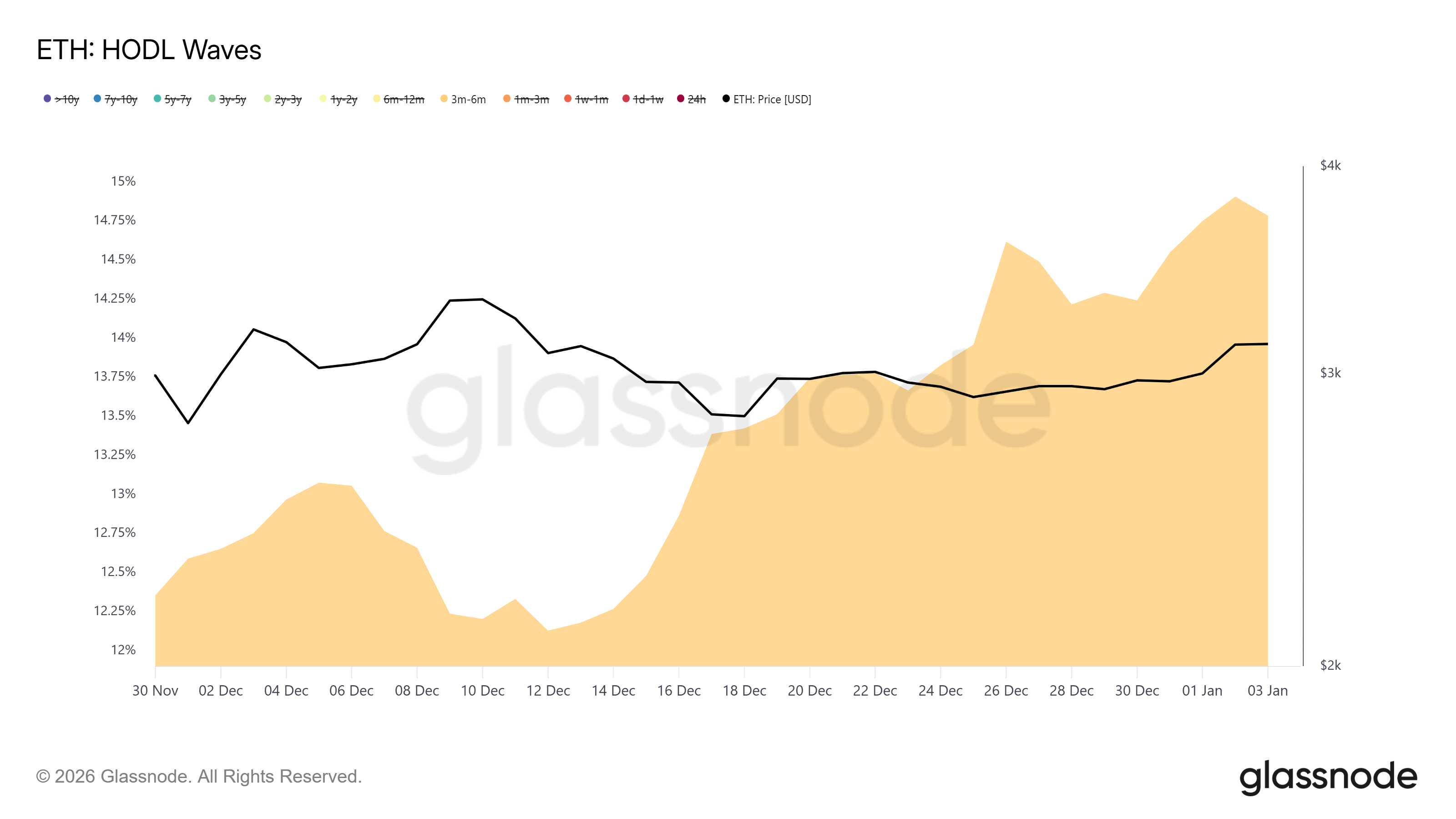
However, price increases may trigger distributions from these cohorts. As ETH approaches break-even levels for medium-term holders, the risk of selling increases. This dynamic could limit upside unless new capital offsets profit-taking from trapped supply.
ETH price is nearing a breakout
Ethereum price continues to move within the descending wedge that formed in early November. ETH is currently changing hands around $3,141, with a potential breakout on the horizon. This structure often shows momentum compression prior to directional expansion.
This wedge predicts a theoretical upside of approximately 29.5%, with a target price of $4,061. Although ambitious, such a move would require stronger buying pressure than currently observed. A more likely scenario involves ETH breaking out and topping out above $3,287, paving the way for a near-term path towards $3,447.
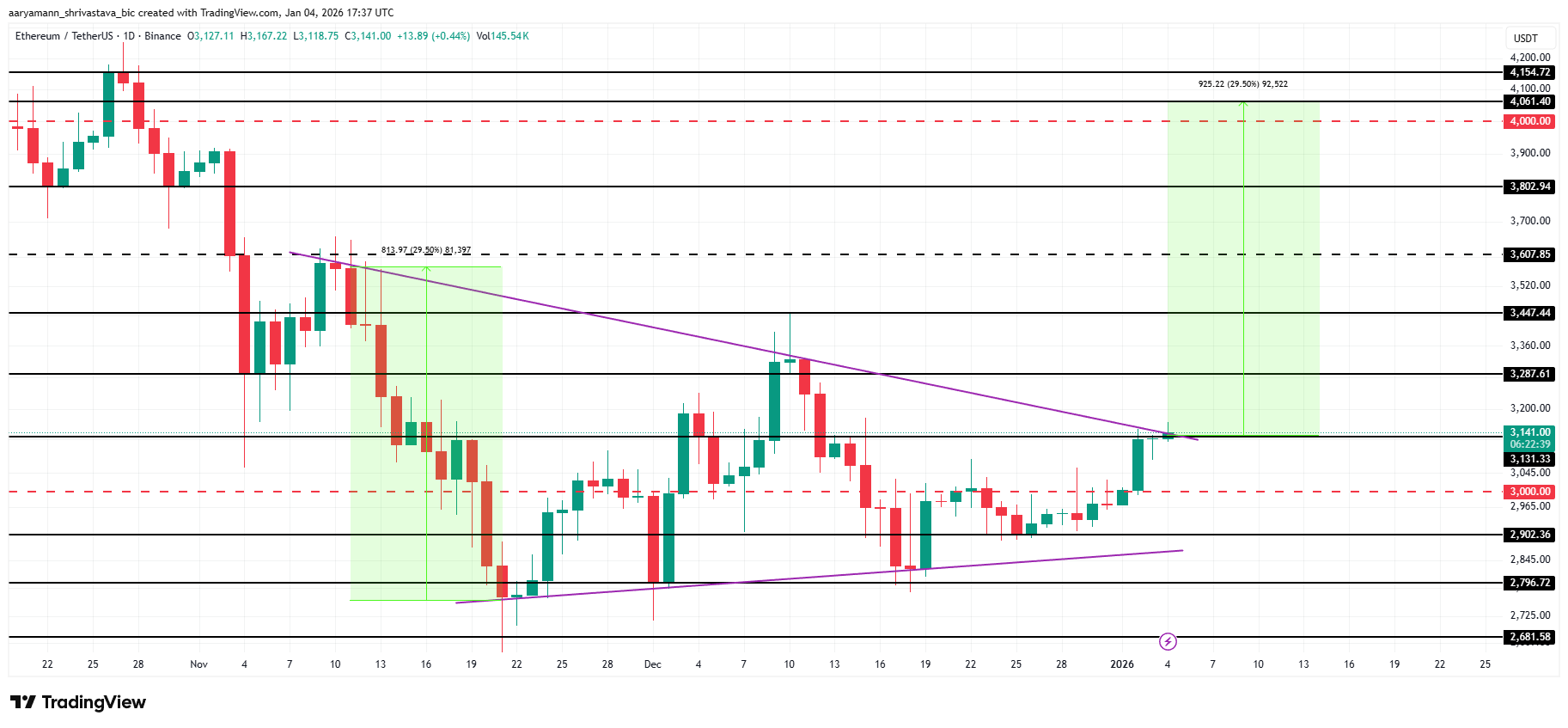
If the macro environment deteriorates or the breakout fails, downside risk remains. If rejected, Ethereum could drop back below $3,000. In that case, ETH could retest the $2,902 support level, invalidating the bullish theory and reinforcing range conditions.
