




Cryptocurrency markets are approaching 2026 after a year defined by steep volatility, new all-time highs, profit taking, and a visible stage of maturity.
While Bitcoin has strengthened its role as an institutional reserve asset, Ethereum and XRP have entered a correction phase following strong trends to date characterized by uncertainty and rapid price fluctuations.
On the macro front, the US Federal Reserve has begun its first rate cut, labor market data shows early signs of cooling, and capital flows into digital assets are becoming increasingly selective.
As a result, Bitcoin, Ethereum, and XRP are currently near technically significant levels. The central question in 2026 is whether global liquidity will expand or pause, and whether that liquidity will decisively flow into crypto assets.
Sponsored Sponsored
Bitcoin (BTC) price analysis and outlook for 2026
Bitcoin reached an all-time high of over $126,000 in 2025, largely due to continued adoption by institutional investors. Corporations and sovereign entities continued to add BTC to their reserves.
MicroStrategy accumulated approximately 660,645 BTC, while El Salvador increased its holdings to 7,502 BTC.
Meanwhile, spot Bitcoin ETFs continued to absorb supply, reinforcing Bitcoin’s role as a long-term macro asset.
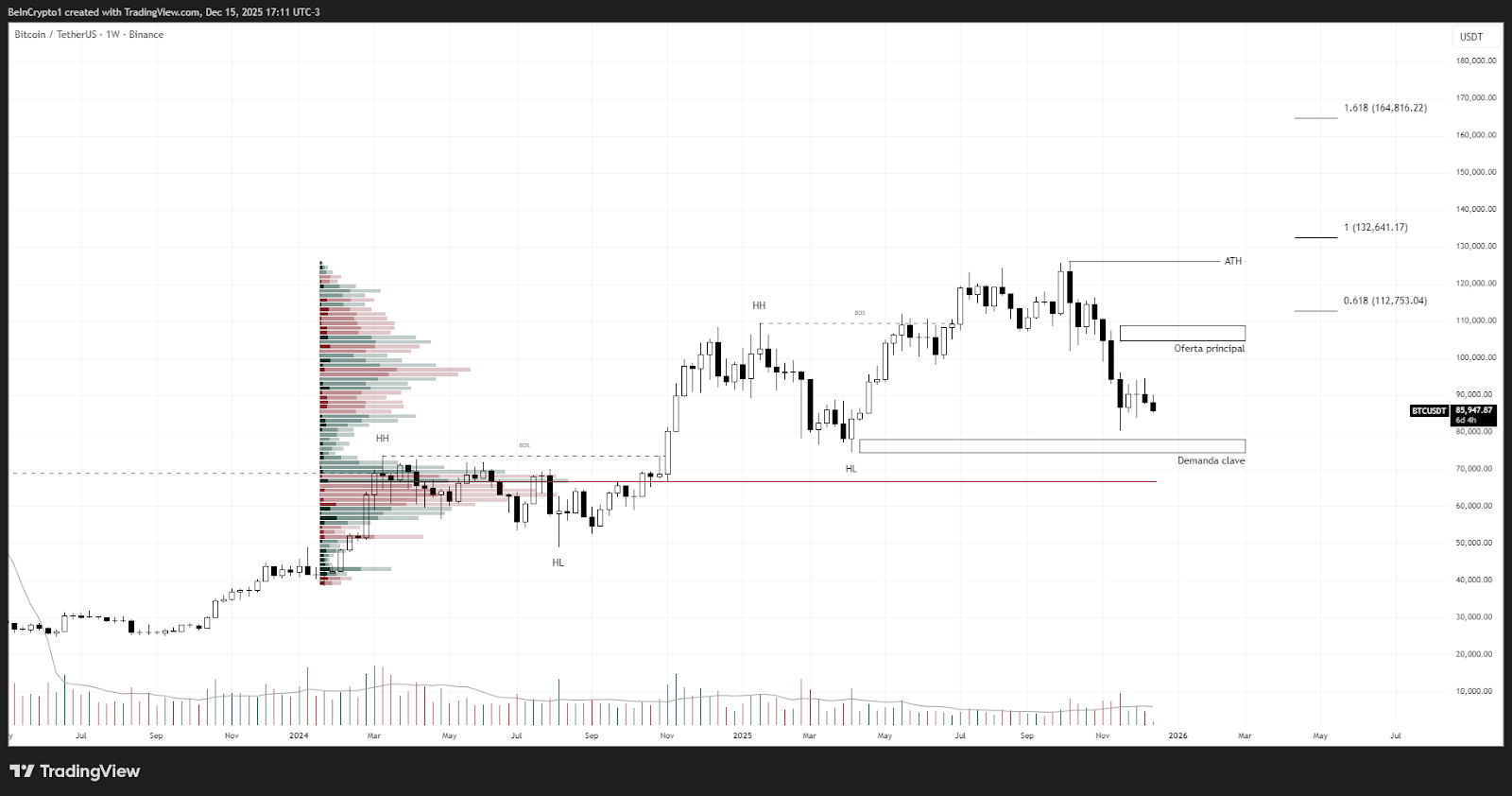
From a technical perspective, Bitcoin’s broad bullish structure remains intact despite losing the ascending channel that guided its price action from March 2024 to November 2025.
After setting the latest ATH, BTC has corrected to a major demand zone near $80,000.
Resistance near $110,000 continues to limit any upside attempts. Trading volumes are slowing, and this pattern is typically associated with corrections rather than trend reversals.
bullish scenario
A strong reaction from the cumulative demand zone around $75,000 could set the stage for a new long-term advance towards $150,000-170,000.
A sustained break above the $100,000-$115,000 resistance cluster would confirm the continuation of the trend, supported by new retail and institutional participation.
Limited scope scenario
If upward momentum remains limited, Bitcoin could trade between $70,000 and $110,000 for most of 2026.
This would represent a prolonged accumulation phase within a broader cycle characterized by choppy price movements and false breakouts while the market waits for a clearer financial catalyst.
Sponsored Sponsored
bearish scenario
A definitive loss of the $75,000-$80,000 demand zone would open the door to further correction.
In that case, $60,000 to $40,000 could act as a rebalancing zone without invalidating Bitcoin’s long-term macro structure.
Ethereum (ETH) price analysis and outlook for 2026
Ethereum had a pivotal year in 2025, hitting a new all-time high near $4,955.
Spot Ethereum ETFs began to gain traction as network upgrades such as Pectra and Fusaka improved scalability and efficiency. Staking activity and DeFi usage continued to support Ethereum’s fundamental value.
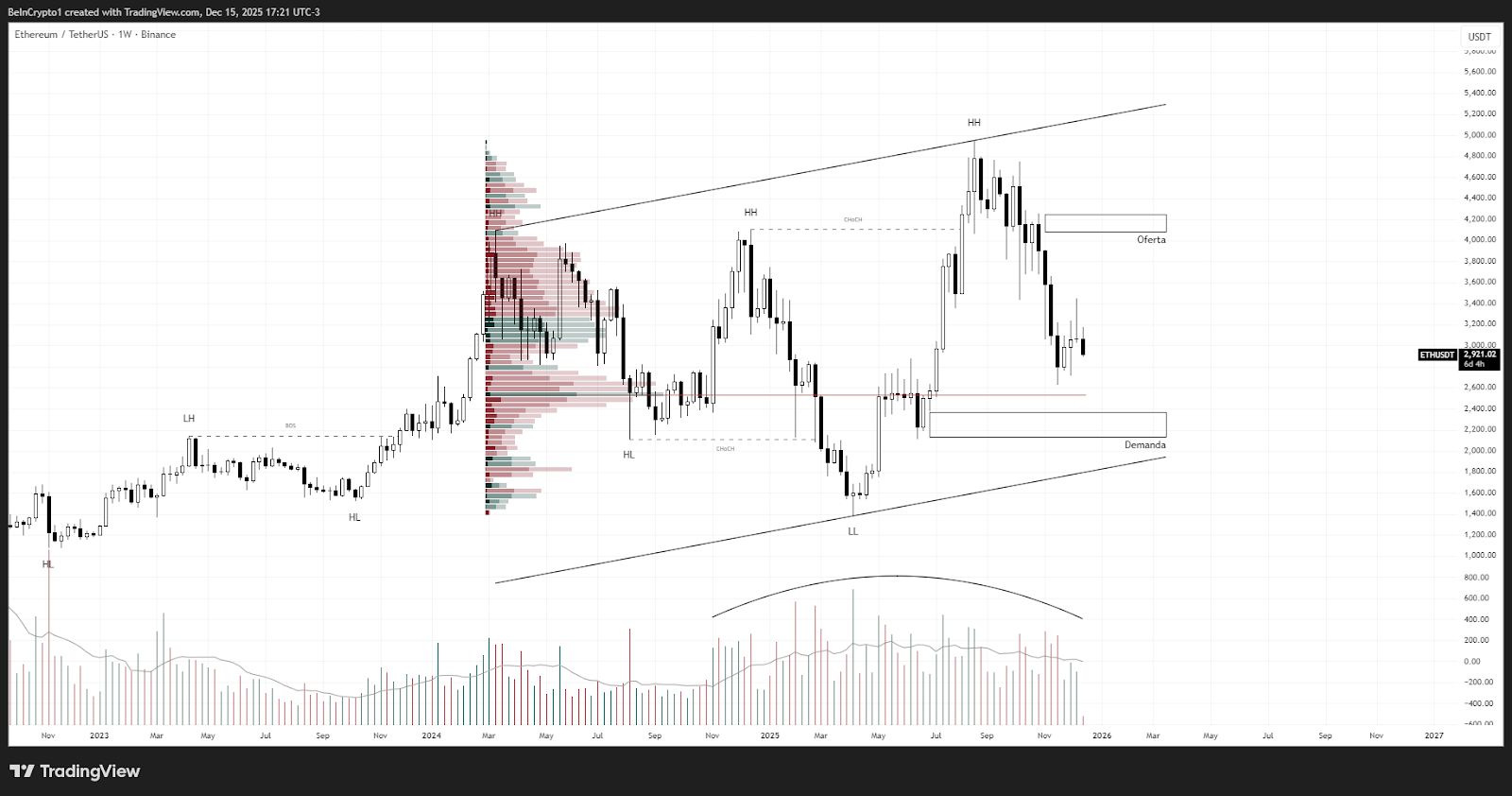
On the weekly chart, ETH remains within a long-term broad ascending channel. After hitting a new high in August 2025, the price has corrected towards a relatively weak demand zone around $2,900.
The long-term structure remains constructive, but the momentum has slowed compared to the previous expansion phase. Short-term and medium-term structures remain bearish.
bullish scenario
A sustained recovery could allow Ethereum to target $5,700 and even $6,100 based on past cycle extensions.
Sponsored Sponsored
A clean break above the channel resistance around $5,200 would strengthen Ethereum’s position as a leading asset in 2026.
Integration scenario
If demand remains moderate, ETH could stabilize between $4,300 and $2,200. This range would indicate an equilibrium between buyers and sellers, positioning 2026 as a transition year rather than a breakout phase.
bearish scenario
A breakdown below channel support could send Ethereum deeper towards $2,250 and $1,600, an area that coincides with historical demand levels that are important to sustaining the long-term structure.
XRP price analysis and outlook for 2026
Ripple ended 2025 with significantly improved regulatory clarity following a favorable resolution to its legal dispute with the SEC.
This result has revived institutional investor interest, restarted discussion of XRP ETF products, and improved its standing within traditional financial markets.
A large-scale institutional implementation could cause a demand shock that could push XRP to new highs.
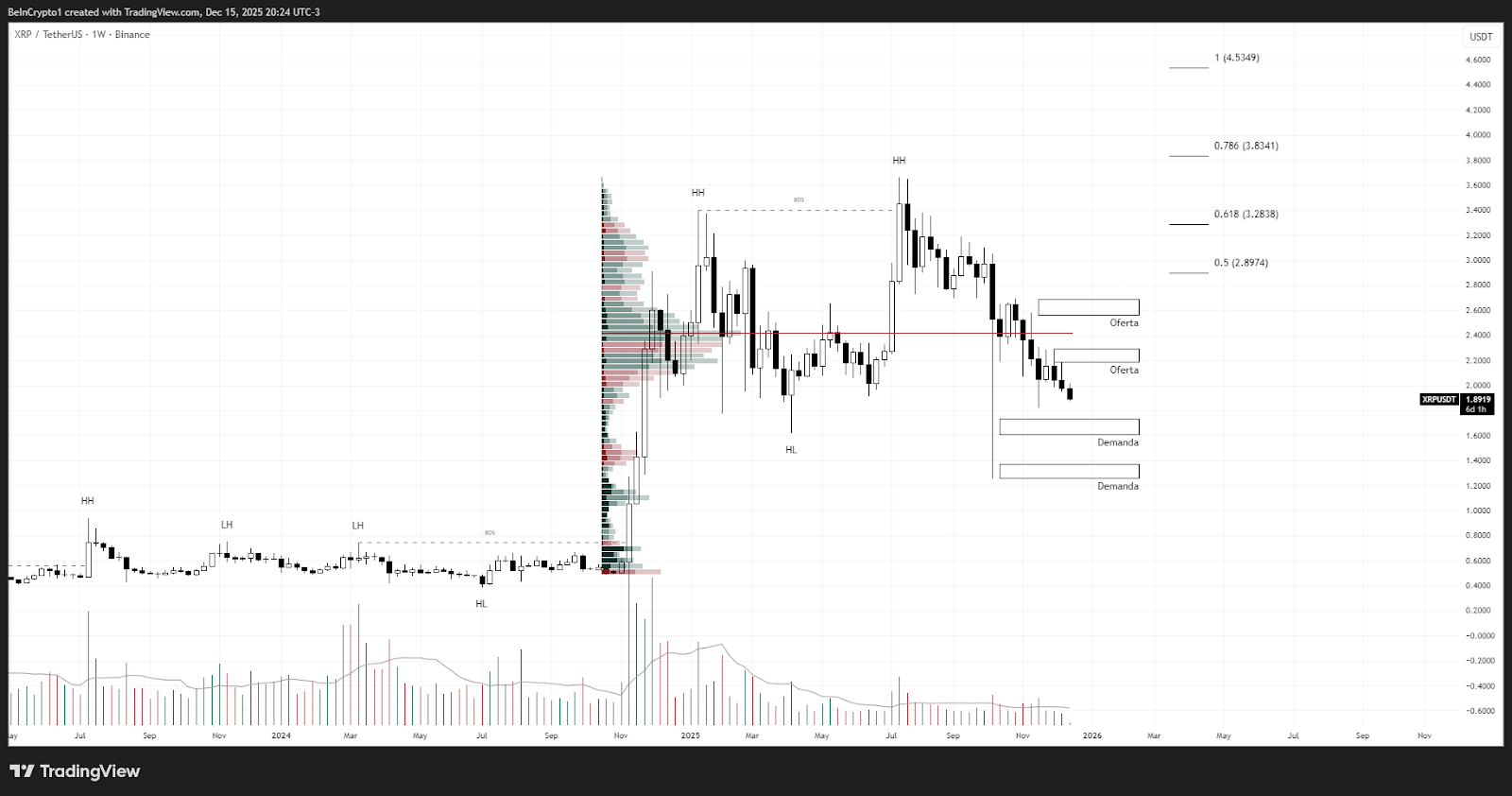
Technically speaking, XRP is in a correction phase after a strong rally that peaked around $3.60 in mid-year. Prices have since returned to the major demand zone, but multiple supply areas continue to limit any short-term rebound.
Sponsored Sponsored
This behavior is consistent with a broader trend regression phase.
bullish scenario
If 2026 proves favorable for Ripple’s institutional adoption, XRP could move towards $3.83-$4.53. To achieve this, the price needs to return to the $2.40 level and sustain purchasing volumes, supported by positive regulatory developments.
Limited scope scenario
If the uncertainty continues, XRP could trade sideways between $3.00 and $1.60. While this may reflect hesitance towards bank adoption, it may also represent a healthy consolidation phase ahead of future cycles.
bearish scenario
A breakdown below key support could see XRP heading towards $1.20 to $0.90. Such a move, along with a cooling of speculative interest, would mean losses at important levels, including the psychological level of $1.60.
Final Thoughts: Will 2026 be a lost year or a launching pad?
The price forecast for 2026 shows the market to be in close equilibrium. Bitcoin continues to show the strongest structural resilience, while Ethereum and XRP remain highly dependent on specific catalysts.
Upside potential exists, but it requires clear technical confirmation and fundamental follow-through.
One trend is undeniable. It means that the cryptocurrency market is moving to a more mature stage. Volatility has been compressed compared to previous cycles, and both gains and drawdowns are now more controlled.
A new bull market will depend on a more accommodative macro environment, deeper institutional adoption, and consistent regulatory clarity.
If these forces align, 2026 may ultimately be remembered not as a year of stagnation, but as the basis for the next wave of highs.
