



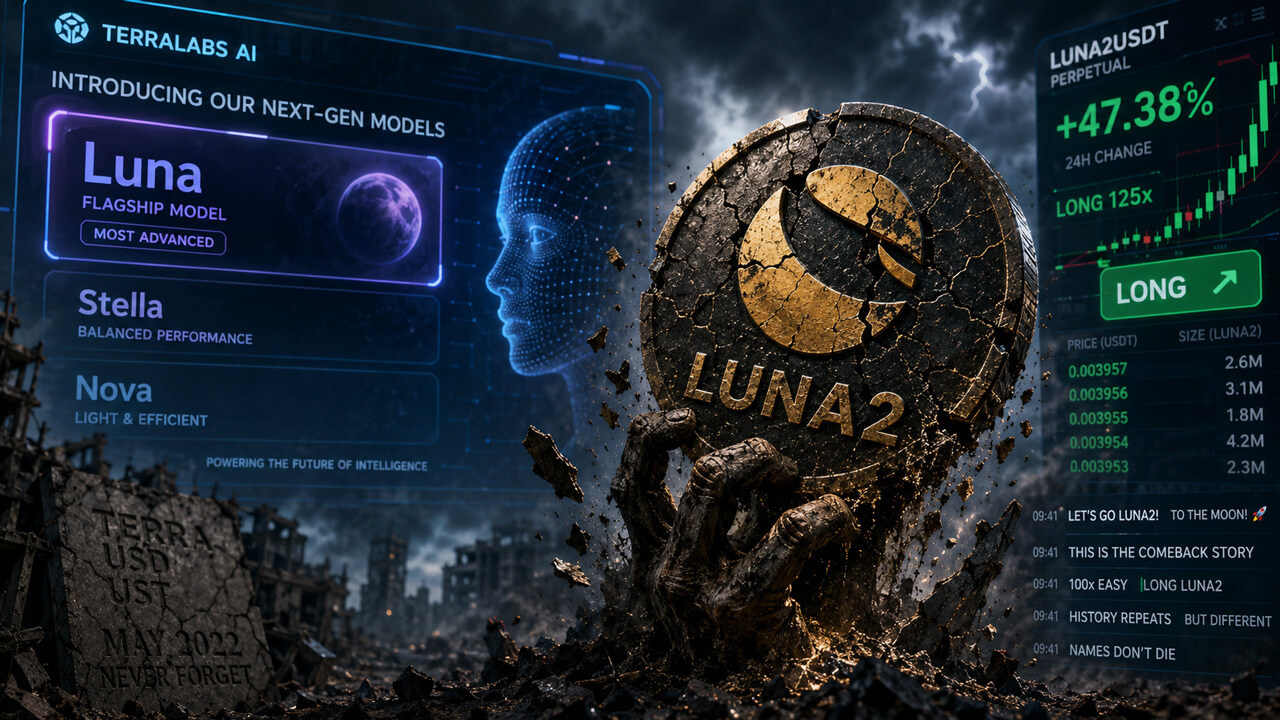
OpenAI introduced GPT-5.6 on June 26th as a limited preview family of Frontier models with three tiers: Sol as the flagship, Terra as a balanced midrange option, and Luna as a fast and low-cost tier.
According to OpenAI, Sol uses about 33% of output tokens, costs $5 per million input tokens and $30 per million output tokens, and performs competitively with Anthropic’s Mythos Preview on ExploitBench.
While this rollout will initially be limited to a small group of partners vetted via API and Codex at the request of the U.S. government, OpenAI is addressing cybersecurity and release process questions regarding the model’s capabilities in biology, coding, and offensive cybersecurity.
Despite this background, crypto traders found another trigger in the product name.
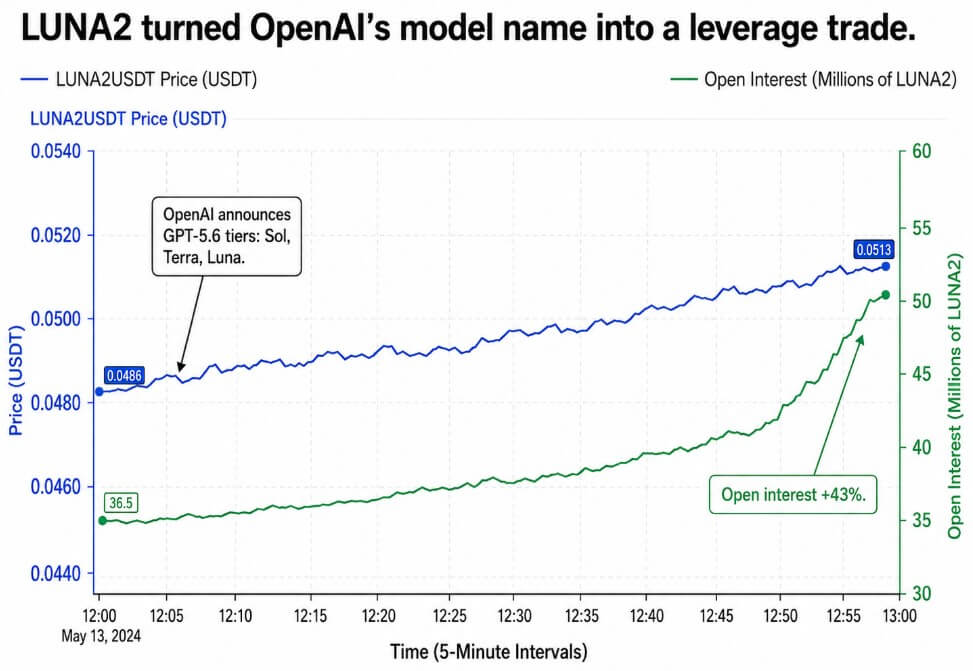
Within minutes of the announcement, Binance’s LUNA2 futures moved, with the price on the 5-minute chart of LUNA2USDT increasing from approximately $0.0486 to a high of $0.0513.
Open interest jumped from approximately 36.5 million LUNA2 to 52.3 million LUNA2, expanding the position by 43% and funding turned positive by 0.01%.
Coinbase’s premium panel showed no symbol matches and the action took place entirely in crypto-native criminal venues, with no US spot market involved.
LUNA2’s market cap is nearly $36 million, with a 24-hour trading volume of about $8.5 million, but it’s thin enough that it fluctuates based on attention and borrowed funds before fundamentals become important.
This token is a post-collapse Terra governance token, its name rhymes with one of OpenAI’s new GPT layers, and transactions were executed entirely on that overlap.
what traders were buying
Terra/Luna went bankrupt in three days in May 2022, wiping out its valuation of about $50 billion.
The SEC subsequently charged Terraform Labs and Do Kwon with multibillion-dollar crypto securities fraud related to UST, LUNA, and related assets.
Terra 2.0 survived as a post-collapse residual blockchain, with LUNA2 as its governance token, still listed on dozens of markets, and still bearing the cultural weight of one of cryptocurrencies’ most catastrophic failures.
When OpenAI named its cheapest model tier “Luna,” traders bet that everyone else would react to the word before the joke was over. Enough bots, headline scanners, chart chasers, and social accounts will recognize “Luna” that the ticker could move on name recognition alone, and it won’t cost anything to hold a 5-minute perp position while that cascade forms.
Open interest expanded 43% faster than price, confirming that trades were leveraged to position around expected attention, rather than spot accumulation driven by new information about LUNA2’s fundamentals.
Cryptocurrency researchers call this semantic arbitrage. Traders buy in the hope that recognizable words will move through the cryptocurrency’s attention economy fast enough to generate returns before the cascade collapses.
The moment OpenAI said “Luna” in a press release, LUNA2 had it all.
The pattern behind the joke
The same mechanism has been in operation for years, and in 2025 and 2026 will produce the most industrialized form ever. TRUMP soared more than 50% in April 2025 after the project announced it would invite top holders to a special celebration.
Penguin reportedly rose about 564% after a White House post featuring President Donald Trump and Penguin side by side went viral. GORK soared over 520% after Elon Musk posted the single word “goke” on X, but the post itself had no utility or project.
A 2026 academic paper on the Solana meme coin found that Launchpad processed over 40,000 migrated tokens and over 180 million post-migration transactions. This number reflects how thoroughly industrialized the infrastructure for converting words into markets has become.
TRUMP trades on political access, PENGUIN trades on presidential adjacency, GORK trades on Musk keyword proximity, and LUNA2 trades on collapsing blockchain and OpenAI model naming conflicts.
Markets are formed around the speed at which everyone notices that everyone else has seen the same word. All a token needs is enough cultural surface area with a catalyst to trigger a short-term attention cascade and become tradable.
In this case, the crypto trader extracted two hours of fraudulent transactions from the product name and moved on.
Token/Trade What Catalyst Traders Actually Bought Why Fits the Pattern LUNA2OpenAI Names GPT-5.6 Layer ‘Luna’ Name Clash with Terra/Luna Collapsed Blockchain Ticker Became AI Announcement Trade Trump Top Holder Access to Celebrations Political Proximity and Status Tokens Exchanged Attention, Access, and Spectacle Penguin Viral White House Penguin Post Keyword Adjacency Traders Bought Memes Before They Made Meaning Gokeron Musk Posted ‘Gork’ Mr. Musk’s keyword reflection utility was not needed. Words themselves were catalysts for Solana Meme Coin Launchpad led token issuance Industrialized meme creation infrastructure turns cultural fragments into tradable assets
Arbitrage has an expiry date
In the bullish case for semantic arbitrage as a permanent cryptocurrency trade, the LUNA2 movement provides a template.
Traders will begin to systematically screen AI model names, celebrity product announcements, political speeches, and viral cultural moments to detect ticker shape collisions with low-float tokens with derivative access.
The trade is specialized in a dedicated desk that monitors real-time announcements on name duplicates, builds positions before social velocity peaks, and exits before funding rates become punitive.
A culturally recognizable word attached to an illiquid token with permanent access becomes a temporary market structure.
Solana launch pad data already shows that as the supply side becomes industrialized and the more codified and legible the edge becomes, the demand side will follow.
In the bearish case, the LUNA2 move is a one-session oddity that strengthens its own edge. Exchanges will increase margin requirements for tokens that show a sudden spike in OI regardless of fundamentals.
Funding costs in crowded semantic transactions rise quickly enough to punish late entrants. The first mover extracts the spread. Everyone you follow is chasing a chart that already has a joke price on it.
Imitation trades on the following AI model name collisions will be squeezed out before a cascade can form. This is because too many traders learn the playbook and are positioned in front of the catalyst, even when it lands.
Arbitrage is compressed to the point that only the fastest performing infrastructure can capture it.
Scenarios What Happens Next Who Wins Who Loses Market Impact Bull Case Traders Codify Name Clash Trades Across AI, Politics, Celebrities, Viral Posts Fast Desks, Bots, Early Scanners Retail Chasers Late In The Base Case Cultural Keywords Become Official Trading Signals These trades continue to emerge, but mostly held in the final minutes or hours after the peak of early mover jokes Semantic Trading Becomes a Temporary Attention Rental Bear Cases Edges become Crowded, Funding Faster and Punitive Exchanges, Market Makers Momentum Traders As Everyone Learns the Strategy Strategies Self-Compress Black Swan Crowded Semantic Trading Causes Liquidations and Forex Interventions Short or Early Exit Leverage Long Ticker Collisions Become Recognized Purps Market Risk
In both cases, cryptocurrencies perform market tiers more quickly based on cultural relevance than they do based on fundamental values. OpenAI aimed to establish a frontier AI benchmark and win an exemplary war with Mythos.
By the time this announcement spread, crypto traders had already begun placing, riding, and unraveling leveraged bets on certain words.
