




PICoin (PI) is trading around $0.203, up about 1% in the past 24 hours and roughly flat for the week. This usually happens right after a major fraud shock that causes panic selling. Instead, the price of Pi Coin remains stable.
This raises a real question. Is Pi Coin being held because the support is really strong, or is the market just being slow to react?
Bearish channel encounters various money flow signals amid fraud shock
Recently, a large-scale organized fraud affected Pi Network’s payment request functionality, resulting in over 4.4 million PI being compromised.
The Pi Core team emphasized that this is not a protocol flaw, but a case of social engineering, as the transfer only occurs with user approval. As losses increased and one wallet associated with 700,000-800,000 PI was being stolen each month, the team temporarily disabled payment requests to prevent further abuse.
This kind of security concern usually causes a sharp decline. Instead, Pi Coin hovered around $0.204, barely moving as the market absorbed the news, even as the price traded within a bearish channel.
Pi Coin has been trading within a descending channel since October 27th. Both trendlines are weak due to limited touchpoints, but the lower trendline is the focus right now. The PI price is near that boundary and often acts like the lower bound of a downtrend. If this floor collapses, the structure will collapse. Until then, it acts like an anchor.
The Money Flow Index (MFI), which measures buying pressure through price and volume, explains why Pi Coin did not fall on the scam news. From December 19th to December 29th, prices were on a downward trend, while MFI was on an upward trend. That’s a bullish divergence.
This indicates a bullish buy and suggests that retail support is helping Pi Coin respect the lower trendline of the channel.
Want more token insights like this? Sign up for Editor Harsh Notariya’s Daily Crypto Newsletter here.
However, its support is not yet stable. On December 29th, MFI broke through the uptrend line. Currently it is located near the 46 zone. If the price falls below 37 and breaks to the lows, the demand to buy on the downside will weaken. A failure here would remove the cushion that protected Pi Coin through fraudulent headlines.
For now, big money still helps
Chaikin Money Flow (CMF), which uses volume-weighted pressure to track large capital flows, was also helpful. It is starting to rise and is still above zero. Furthermore, it rose even when the price was on a downtrend from December 20th to December 31st, suggesting bullish (behind the scenes) accumulation.
This usually indicates that large companies are absorbing selling pressure. The last time CMF rose above zero and stayed above zero for multiple sessions in November, Pi Coin rose about 31% before losing momentum.
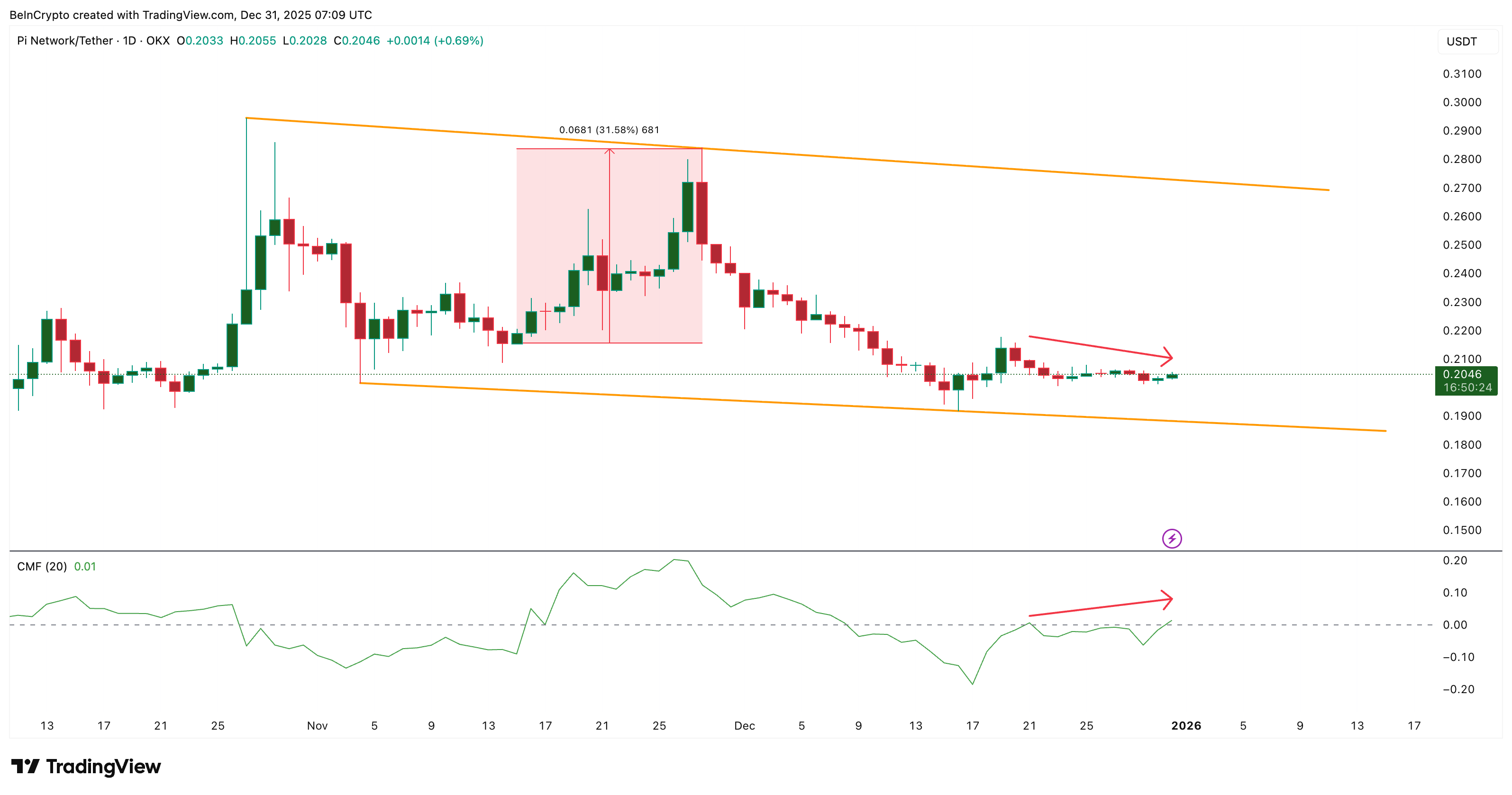
Therefore, the indicators are no longer aligned. MFIs say that market buying has cooled down. CMF says the buildup still exists.
As long as CMF remains above zero, Pi Coin has reason to maintain its current range. If CMF returns below zero, the descending channel becomes more dangerous and primes for a delayed reaction to fraud.
That’s why the market hasn’t moved yet. There is still enough support in the technical structure to delay panic, but the signals are starting to split. This is often how delayed reactions form.
Pi Coin’s key price levels will decide whether to maintain support or not
It all comes down to price levels that are within a descending channel.
If Pi Coin regains $0.217, it will return to the midrange of the channel. This is the first sign that the support is not just emotional. If this level holds, it could open up space to $0.236. Above $0.283, the channel is rejected and the structure shifts from bearish to neutral. However, given current market conditions, such an increase is unlikely.
Downside risks appear more pronounced.
Once Pi Coin loses the major support at $0.195, the lower trendline of the channel will break. This level is the backbone of support and the reason whales may be accumulating.
If you lose, you will incur a loss of $0.182. A break above $0.182 will see a channel breakdown and $0.160 will be in play.
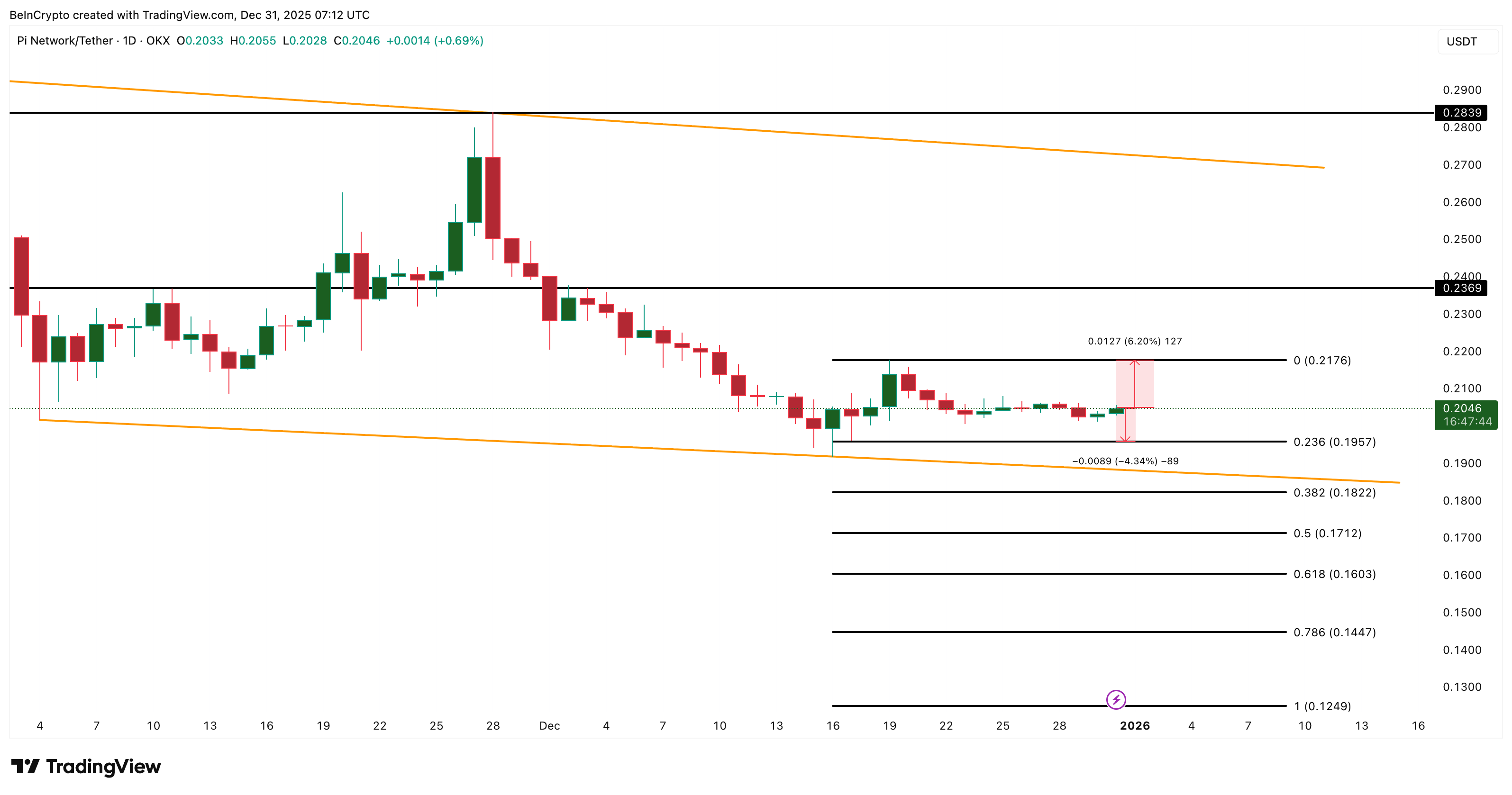
This creates two distinct paths.
If MFI stabilizes and CMF continues to rise, Pi Coin may repeat the November move and attempt a rebound towards $0.217 and $0.236.
When MFI falls below 37.8 and CMF falls below zero, whales will stop absorbing supply and a fraud shock may eventually appear in prices. This scenario would lift the delayed correction towards below $0.182.
At the moment, the chart explains why prices didn’t crash on the news. But the same graph also explains why reactions can be delayed.
The post Pi Coin Price Unwavering Despite Fraud Shock — Strong Support or Delayed Reaction? appeared first on BeInCrypto.
