



By 2025, decentralized derivatives will become a major segment of DeFi, positioning dYdX as one of its most influential platforms. With over $1.5 trillion in cumulative trading volume and a revamped tokenomics model that aligns the protocol’s success with token holders, the protocol is no longer just a DEX, but has evolved into a complete market infrastructure layer.
2025 will be remembered as the moment when decentralized finance (DeFi) moved from the experimental stage to the realm of permanent institutional participation. According to the newly released dYdX 2025 Annual Ecosystem Report, the protocol has successfully transitioned from pursuing ephemeral volatility to building programmatic and sustainable liquidity.
As on-chain perpetual volume approaches the $10 trillion mark globally, dYdX’s deep integrations, professional-level execution, and strategic pivot to a robust buyout model suggest that the vision of a “decentralized Wall Street” is finally reaching maturity.
Numbers that matter: $1.55 trillion and the story of recovery
The protocol recorded $1.55 trillion in total trading volume across all versions of the protocol. The report also shows a U-shaped recovery throughout the year.
After a relatively quiet second quarter in which trading volume dipped to $16 billion amid widespread market consolidation, the protocol saw renewed excitement in the final quarter. Volume in Q4 2025 soared to $34.3 billion, making it the strongest quarter of the year.
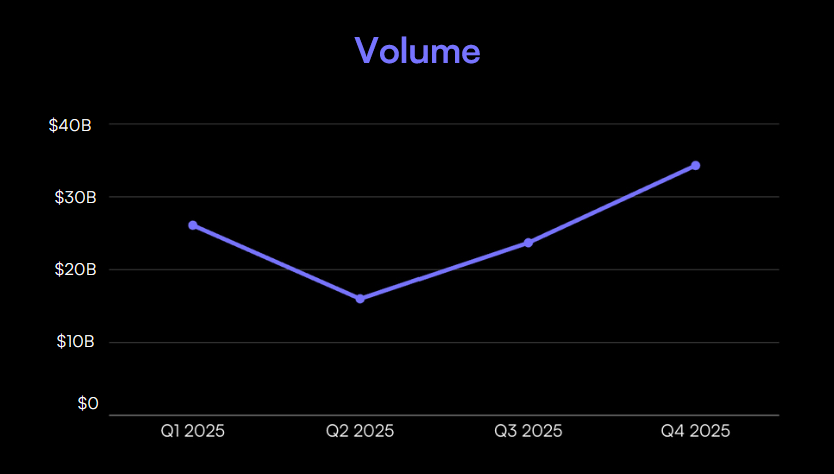
This recovery was not just a byproduct of market beta, but was driven by the launch of a community-driven market mapper and a series of fee holidays that saw the liquidity of flagship pairs such as BTC-USD and SOL-USD reach parity with top centralized exchanges (CEXs).
Key protocol metrics for 2025 include:
Protocol Revenue: Since the launch of dYdX v4, we have generated $64.7 million in fees. Staking Security: $48 million in rewards will be distributed to users who secure the dYdX chain. Market expansion: Total number of markets increased to 386 and asset availability increased by 200%. User Adoption: DYDX holders have increased nearly 85% year-over-year and now total over 98,100 unique addresses.
Tokenomics 2.0: The repurchase flywheel in motion
For years, the usefulness of DeFi governance tokens has been hotly debated. In 2025, dYdX gave a concrete answer by expanding its DYDX buyback program. What started as a pilot has evolved into a protocol-level buyback mechanism that is systematically implemented and managed by the Treasury SubDAO.
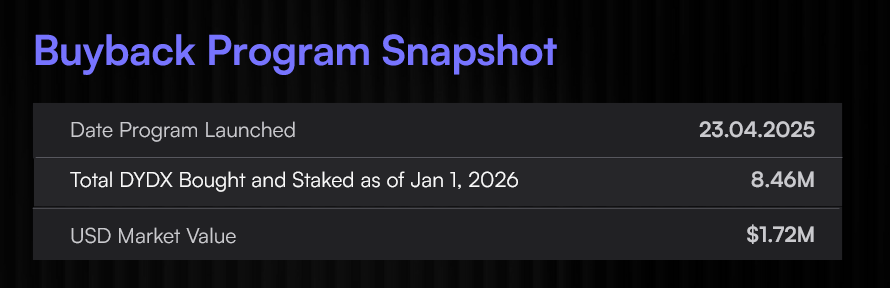
Through a series of governance-driven upgrades, most notably Proposition #313, the community voted to direct 75% of net protocol revenues to systematic buybacks of DYDX from the open market. These tokens are not just burned, but staked to make the network even more decentralized and secure, creating a flywheel effect.
As the volume increases, so will the fees. Higher fees result in larger share buybacks. Share buybacks increase the amount of DYDX staked, strengthen network security, and reduce liquid supply.
As of January 2026, the program has already bought back and staked 8.46 million DYDX, with a total market value of $1.72 million at the time of purchase. This mechanism contributes to a stable median annualized staking rate of 3.3%, providing long-term holders with a predictable yield in a volatile market.
UX not bundled with Solana Spot
One of the most important technological milestones in 2025 was the introduction of native Solana spot trading. Historically, dYdX has been synonymous with eternity. By expanding its product coverage to include spot markets, the protocol now incorporates a wider range of institutional strategies such as intermarket hedging and cash-and-carry trading.
The report also highlights major changes in the way users interact with the protocol through Telegram’s native trading interface, Pocket Pro Bot. dYdX has significantly lowered the barrier to entry by meeting traders where they reside (social apps). This unbundled approach allows users to manage positions, track leaderboards, and execute trades without leaving their social workflow.
Additionally, the Market Mapper initiative has decentralized the listing process. Instead of waiting for the central committee to list their assets, communities can now propose new markets without permission. This has enabled dYdX to capture the long tail of crypto assets and ensured that it remains a prime destination for emerging tokens.
Institutional-level infrastructure: bridging the gap
To compete with the likes of centralized exchanges (CEX), sub-second latency and fairness of execution are non-negotiable. The 2025 report marks a major overhaul of protocol plumbing.
The implementation of the Order Entry Gateway Service (OEGS) and designated proposer has significantly improved block time consistency. By moving critical infrastructure to “bare metal” servers, Ops SubDAO was able to reduce monthly operating costs from $35,000 to just $6,000 while reducing latency for high-frequency traders.
Tight integration with professional-grade tools such as CoinRoutes, CCXT, and Foxify Trade further enhances institutional adoption. These integrations allow hedge funds and market makers to treat dYdX as a programmatic endpoint, allowing them to seamlessly route order flow between centralized and decentralized venues.
Governance and the SubDAO era: Sovereign machines
In 2025, the ecosystem processed a record 135 governance proposals, demonstrating a level of community engagement rarely seen in DeFi. The SubDAO model is now fully operational, with specialized entities managing various aspects of the protocol.
dYdX Foundation: Focuses on strategic alignment and regulatory clarity. In 2025, the Foundation published a MiCA-compliant white paper outlining compliance considerations in the evolving European regulatory environment. SubDAO Operations: Responsible for the technical health of the dYdX chain, managing protocol upgrades (v8.1) and public validator dashboard. Treasury SubDAO: Managed the expansion of Treasury assets from 45 million to over 85 million DYDX while overseeing the stock repurchase program. dYdX Grants Ltd: Relaunched with 13.1 million DYDX to fund high-impact research, developer tools, and ecosystem growth initiatives.
dYdX Surge: $20M Catalyst
To accelerate this year’s momentum, the ecosystem launched the dYdX Surge, a massive $20 million trading competition. Unlike traditional trading contests that favor whales, Surge is designed to reward consistent liquidity provision and volume of sustained flows across a wide range of markets.
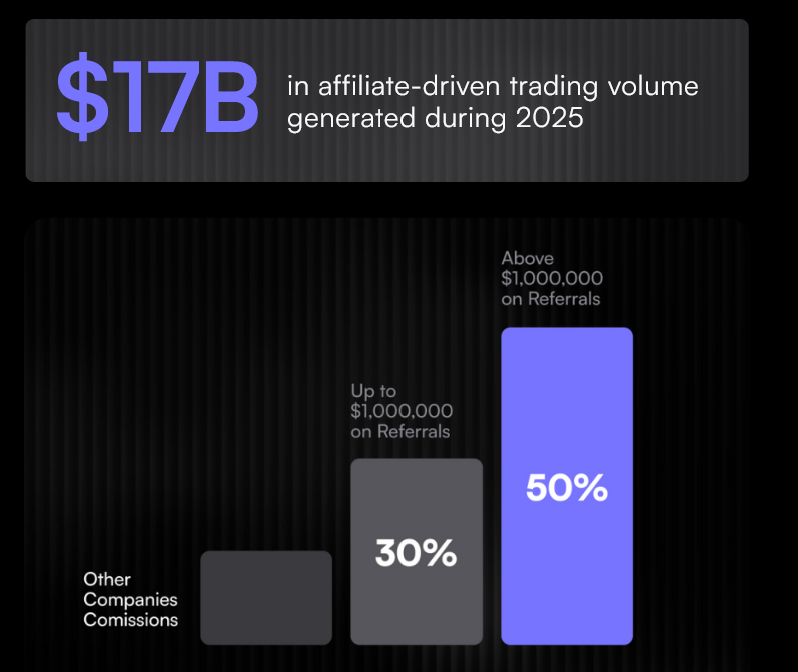
The program was a huge success, contributing $17 billion in increased sales through affiliate channels alone. By the end of 2025, the affiliate program has been revamped to offer up to 50% revenue sharing to top-level partners, ensuring that the growth of the protocol is shared with the influencers and platforms that drive it.
Looking ahead to 2026, the dYdX Foundation’s message is clear: the focus is shifting from “growth at all costs” to “sustainable market domination.”
On-chain PERP volume is expected to exceed $10 trillion next year, and dYdX is doubling down on its distribution strategy. This includes increasing the route of flow through mobile bots, increasing API support for institutions, and a continued focus on regulatory compliance. dYdX enters 2026 with a leaner cost structure, a more aggressive token adjustment model, and a technology stack that will ultimately match the performance of large, centralized companies. For those watching the “DeFi vs. CeFi” war, the 2025 report ensures one thing: on-chain dominance is no longer a theory, but a $1.5 trillion reality.
