




War scenarios don’t reward pretty stories. Markets usually do two things at the same time. They sprint to safety and reprice the world after the initial shock has passed. Bitcoin is exactly on that fault line.
That’s why “World War III trade” is not a one-time bet. It’s a sequence. For the first few hours, Bitcoin often behaves like a high-beta risk asset. Depending on what the government does next, it could start acting like a portable, censorship-resistant asset in a matter of weeks.
Is the fear of “World War III” now a reality?
Given the current geopolitical escalation, conversations in World 3 are more real than ever. Some might even say we are in the middle of a world war, but its functioning is different than it was 90 years ago.
Over the past few weeks, multiple flashpoints have occurred and the margin for error has narrowed.
The debate about European security is moving from theory to operational planning. Officials have been discussing postwar security around Ukraine, which Russia has historically treated as a red line.
In the Indo-Pacific region, Chinese military exercises around Taiwan increasingly resemble blockade rehearsals. In a blockade-type crisis, invasion is not necessary to destroy the market. All that is needed is transportation disruption and accidents at sea.
Sponsored Sponsored
Add in the broader stance of the United States. Trump basically said he was “running Venezuela” in his own comments after the president was captured from his home.
And now the US government is discussing with Denmark the purchase of Greenland, a sovereign nation that is part of the European Union.
There are also sanctions enforcement, riskier military signals, and sharper geopolitical messages. Add these together and you have a global environment where one mistake can lead to another.
This is exactly how crises are chained together.
Meaning of “WW3” in this model
This analysis treats “World War III” as a specific threshold.
direct and continuing conflict between nuclear-weapon states;
Expansion beyond one theater (Europe and the Indo-Pacific are the most obvious routes).
This definition is important because markets react differently to regional and multi-theater conflicts.
How key assets behave before and after war
The most useful lessons from past conflicts are structural. Markets typically sell uncertainty first and then trade policy responses.
stock
Stock prices often fall before and after the initial shock, but can then recover as the path becomes clearer, even while the war continues. Market research on modern disputes shows that when investors stop speculating and start bidding, “clarity” can become more important than the dispute itself.
The exception is when war causes permanent macro-regime changes, such as energy shocks, sustained inflation, rationing, or deep recessions. After that, the slump in stock prices will continue for a long time.
gold
Money has a long history of inciting fear. It also has a track record of returning profits when war premiums fade and policies become more predictable.
The gold edges are simple. There is no risk to the publisher. Its weakness is also simple: it competes with real yields. Gold often faces pressure when real yields rise.
Sponsored Sponsored
silver
Silver behaves like a hybrid. Sometimes they use gold as a hedge against fear and go up, but then they sometimes go wild because industrial demand is important. It is more of an amplification of volatility than a pure safe haven.
oil and energy
Energy becomes a major hinge when supply routes are threatened by conflict. Rising oil prices could cause inflation expectations to change rapidly.
This forces central banks to choose between growth and suppressing inflation. That choice drives everything else.
Bitcoin in World War: Bulls or Bears?
Bitcoin has no single war identity. There are two of them and they fight each other.
Bitcoin with liquidity risk: behaves like a high-beta tech asset during deleveraging.
Portability Bitcoin: behaves like a borderless asset that is censorship-resistant even in the event of increased capital controls or currency stress.
Which one becomes dominant depends on the phase.
Phase 1: Shock Week
This is the forced sales phase. Investors raise cash. Risk desk reduces leverage. Correlation jumps.
At this stage, Bitcoin typically trades with liquidity risk. Particularly if derivatives positioning is crowded or stablecoin liquidity is tight, it could line up with equities.
Gold tends to get the first safety bid. The US dollar often appreciates. Credit spreads widen.
Phase 2: Stabilization Attempt
The market will no longer ask, “What happened?” And we start asking, “What’s next for policy?”
Sponsored Sponsored
This could be a turning point for Bitcoin.
When central banks and governments respond with liquidity support, backstops, or economic stimulus, Bitcoin often rebounds along with risk assets.
As policymakers tighten regulations on capital, banking rails, crypto adoption, etc., Bitcoin’s rebound could become uneven, leading to increased volatility and regional fragmentation.
Phase 3: Protracted conflict
At this point, the conflict becomes a macro regime. Here, Bitcoin performance depends on four switches.
Dollar Liquidity: Tight conditions in the US dollar negatively impact Bitcoin. Easier conditions would be helpful.
Real Yields: Rising real yields will put pressure on Bitcoin and gold. The decline in real yields confirms both.
Capital controls and sanctions: Demand for portability will increase, but access may also be restricted.
Infrastructure Reliability: Bitcoin requires electricity, internet, and functioning exchange rails.
This is where “Bitcoin as digital gold” may come into play, but it is not guaranteed. It requires available rails and a policy environment that does not impede access.
Below is a simplified stress table that the reader can use in practice. This summarizes directional expectations across three stages of two World War III-style bifurcations: European-led and Taiwan-led.
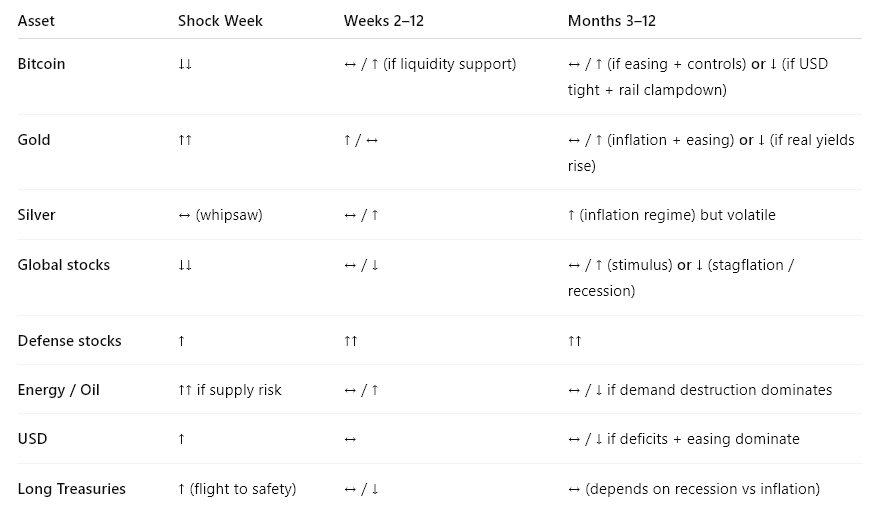
The important point is that it is unpleasant but beneficial. Bitcoin’s worst window is the first window. The best timing is often later, if policy and rails permit.
What is most likely to determine the outcome of Bitcoin
“Real yield” system
Bitcoin tends to struggle when real yields rise and USD liquidity tightens. War can lower yields (recession fears, easing) or raise them (inflationary shocks, fiscal stress).
Who wins is more important than the headline.
Sponsored Sponsored
rail problems
For some participants, Bitcoin may be valuable and unavailable at the same time.
If governments tighten access to exchanges, strengthen banking operations, or strengthen redemption routes for stablecoins, Bitcoin could become more volatile, not less.
Networks can function even as individuals struggle to move capital through regulated chokepoints.
Capital controls and exchange stress
This is an environment where Bitcoin portability becomes more than a slogan.
When conflicts lead to increased sanctions, restrictions on cross-border remittances, and local currency instability, demand for transferable value increases. This supports the medium-term case for Bitcoin, even if the first week looked ugly.
Energy shock and growth shock
Rising oil prices accompanied by persistent inflation can be detrimental to risk assets. Growth shocks accompanied by aggressive mitigation could provide support.
War could result in either. Markets will evaluate the macro path, not the moral narrative.
Simple prediction structure
Instead of asking, “Will Bitcoin be pumped up or dumped in World War III?” ask these three questions in sequence:
Will there be a shock event that will force us to deleverage? If yes, first predict the downside of Bitcoin.
Is policy responding with liquidity and a backstop? If so, Bitcoin is expected to recover faster than many traditional assets.
Will capital controls and sanctions expand while the railroad remains available? If so, Bitcoin’s portability premium could rise over time.
This framework explains why Bitcoin ultimately appears to be resilient by month 6, even though it falls sharply on the first day.
conclusion
World War III or a major geopolitical escalation shock is likely to hit Bitcoin first. That’s what happens in a liquidity crisis. The more important question is what happens next.
Bitcoin’s medium-term performance in large-scale geopolitical conflicts will depend on whether the world moves to a regime of easier financing, tighter controls, and fragmented finance.
Although this regime may strengthen the case for portable and scarce assets, asset volatility remains high.
If you want readers to remember one sentence: Bitcoin will probably not start a war as “digital gold,” but it could end up being traded like one if the conflict drags on.
