




Gold prices soared past the $5,000 per ounce level, setting a historic benchmark for the precious metal.
The move suggests investors are increasingly concerned about the continued decline in the US dollar, while Bitcoin and Ethereum remain well below key levels.
Sponsored Sponsored
Gold tops $5,000 amid dollar collapse
As of this writing, gold is trading at $4,987 after hitting an intraday high of $5,009 on January 24th. The precious metal is up almost 20% in the past 24 hours.
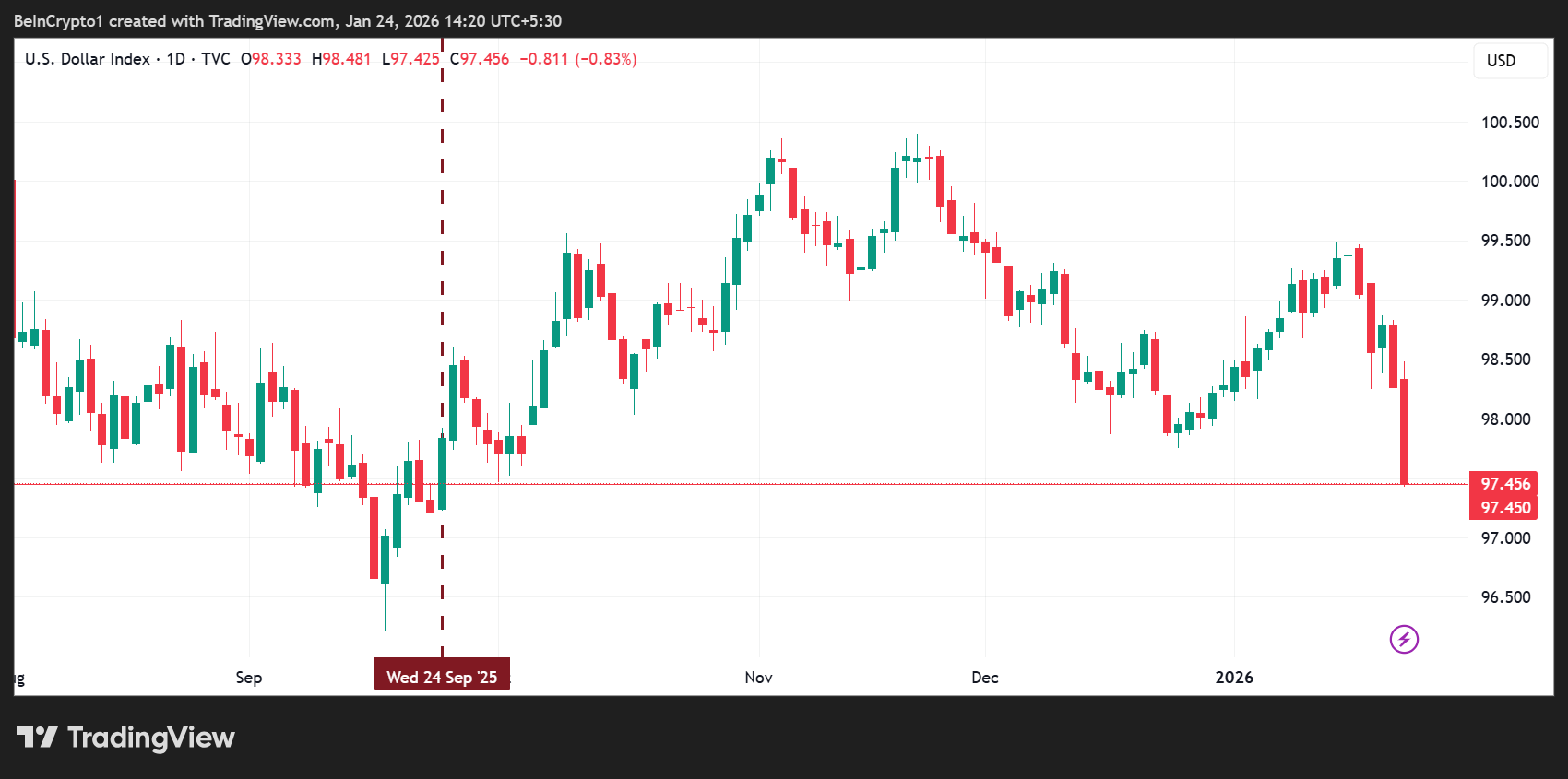
Meanwhile, the U.S. Dollar Index (DXY) plunged to 97.45, its lowest level in months since the last time this level was tested in September 2025.
This milestone coincides with impressive on-chain activity in which a single trader on the Bybit exchange deposited 7 million USDT and withdrew 843 XAUT worth $4.17 million, highlighting the growing interest in tokenized gold as a hedge against fiat volatility.
Lookonchain, which monitors blockchain transactions, flagged the activity, noting that this large-scale XAUT purchase was one of the largest tokenized gold movements in recent months.
This trade could signal a potential profit-taking or reallocation strategy as gold reaches unprecedented levels.
While cryptocurrencies have traditionally been considered an alternative to fiat currencies, the latest price trends highlight the resilience of gold compared to digital assets.
Gold’s gains have outpaced those of major cryptocurrencies in recent weeks, with Ethereum trading at $2,958 and Bitcoin trading at $89,615. This divergence reflects gold’s continued role as a safe-haven asset during times of macroeconomic uncertainty.
The depreciation of the US dollar has been a central factor in the surge. According to recent market commentary, the dollar has lost nearly 50% of its value relative to gold over the past year. Notably, this is the largest decline in U.S. history.
Sponsored Sponsored
Is it possible that a weaker dollar and commodity pressure will propel gold towards $6,500?
Analysts have warned that a sustained weakness in the dollar is fueling a widespread rush into precious metals and other inflation-resistant assets.
Against this backdrop, general sentiment towards gold remains bullish, particularly regarding the precious metal’s near-term trajectory.
“Gold’s price movement is likely in the coming weeks and months. We expect the current rally in gold to continue to $5,400-$5,600, followed by a 10% correction, consolidation, and continued rally towards $6,500 by summer 2026. If that happens, it would be a 30% upside from current price levels…” said Rashad Hajiyev, investment manager and financial analyst.
This prediction is consistent with Goldman Sachs’ theory that gold prices could rise to $5,400 in 2026. Also, according to reports, Bank of America expects the price of gold to reach $6,000 by spring 2026.
Gold attracts attention as a safe-haven asset due to copper shortage and weak dollar
The rise in gold prices also reflects broader commodity pressures. Billionaire mining magnate Robert Friedland recently highlighted the structural constraints of the copper market. He warned of impending supply shortages needed to sustain global GDP growth and electrification efforts.
“We consume 30 million tonnes of copper a year, but only 4 million tonnes of that is recycled…We have to mine as much copper in the next 18 years as we have mined in the past 10,000 years combined,” Friedland said, highlighting the scarcity pressures affecting multiple commodity markets, including precious metals.
The convergence of a weak dollar, supply chain stress, and historic gold rally presents both opportunities and risks.
The $4.17 million XAUT trade on Bybit could foreshadow further institutional movement into tokenized gold.
Meanwhile, the broader macro environment suggests that gold may remain an important hedge for wealth protection amid heightened volatility in cryptocurrencies and fiat currencies.
