



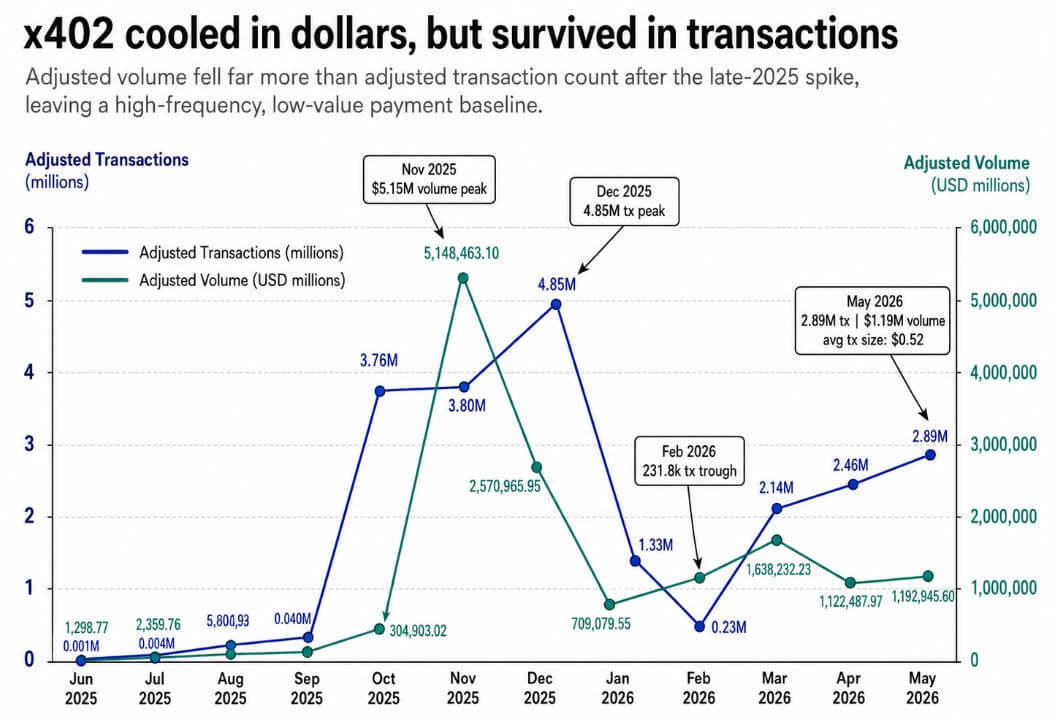
Agent payment protocol x402’s trading volume decreased by approximately 77% from its November 2025 peak of $5.15 million to $1.19 million by May 2026.
Meanwhile, the number of transactions decreased by just 41% from the peak of 4.85 million in December 2025, but recovered in May to 2.89 million, 12.5 times from February’s lows, with an average transaction size of $0.52.
Market recovery manifests itself in high-frequency, low-value usage, with agents paying less than $1 for APIs, data, and compute over HTTP, and relying on automation to function.
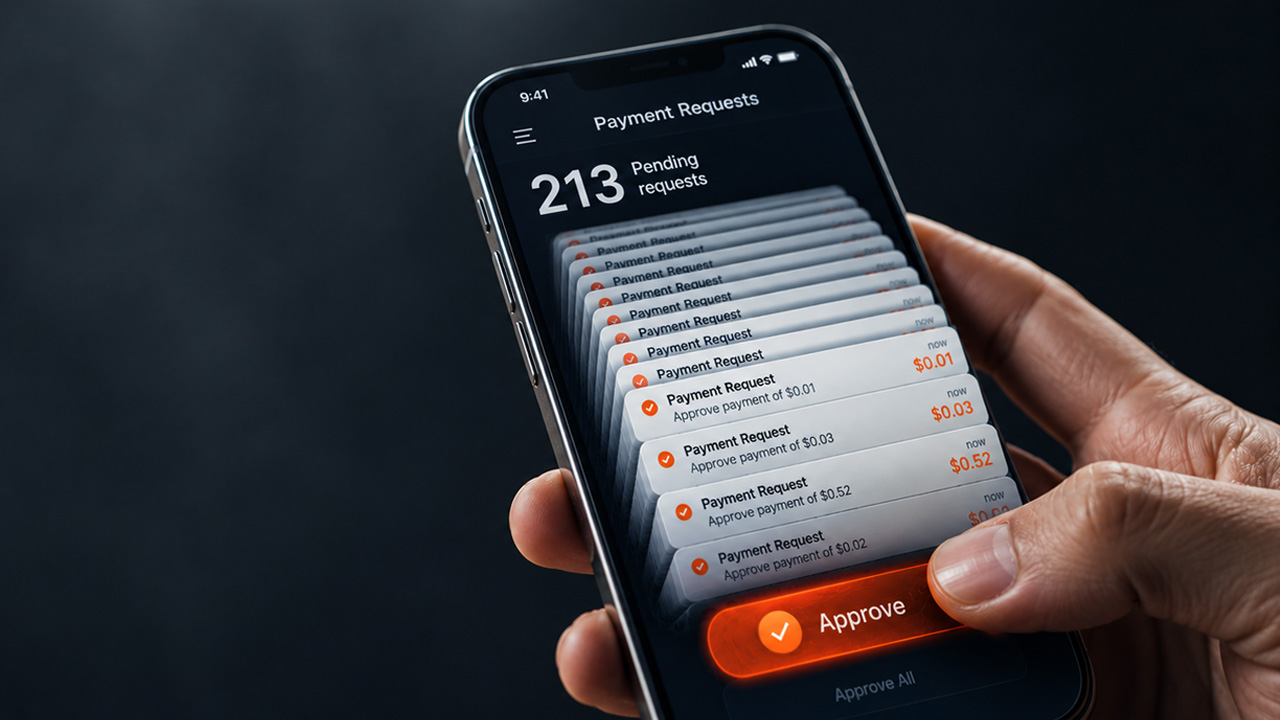
A conservative 5-15 second wallet check for each of these 2.89 million x402 transactions per month could result in 4,000-12,000 user-hours of approval effort per month.
At a time value of $25 per hour, each manual review costs between $0.03 and $0.10. While this is important for a $0.52 transaction, it is economically unreasonable for a $0.01 API call.
When the payment size is less than 1 cent, the friction cost exceeds the transaction amount itself, and the smaller the payment, the wider the distance.
This logic explains why the primary actors building agent payment infrastructure are currently focused on authorization frameworks.
Industry players building a delegation layer
Google developed AP2 as an authorization framework for delegated AI tasks and then contributed it to the FIDO Alliance in April 2026.
AP2 uses cryptographically signed “mandates,” or instructions that define under what conditions and within what limits an agent can perform.
For user-absent tasks, AP2 supports pre-approval rules covering price caps, time frames, and action scopes. Contributing to FIDO helps propel AP2 toward a cross-platform standard, and FIDO frames AP2 as enabling secure delegation, verifiable authorization, and trusted transaction execution.
Mastercard’s Verifiable Intent creates a tamper-proof record of what the user authorized and what the agent did, an audit trail that travels with the transaction and answers whether the agent did what the user asked.
Stripe and Tempo’s implementation of model context protocols for payments address an on-chain friction version of the same challenge.
A Tempo Machine Payments Protocol (MPP) session requires only two on-chain transactions (one open and one settled) regardless of the number of payments that occur during it, allowing agents to make high-frequency, low-value payments without paying on-chain costs for each request.
Stripe’s Machine Payments documentation describes a pay-as-you-go model starting at 0.01 USDC per agent call, recurring payments, and programmatic API calls. All of these are designed for agents to operate without human intervention.
Cloudflare treats x402 and MPP as HTTP infrastructure, where the agent discovers the service, receives a 402 Payment Required challenge, and programmatically retries with payment credentials.
Visa’s Intelligent Commerce Connect, already piloted with AWS, Diddo, Highnote, Mesh, Payabli, and Sumvin, adds tokenization, spend management, and authentication to the same stack.
Across all of these, a common architecture places authorization at the policy level, where a single user’s decisions control the actions of many agents.
Player/Protocol Delegation Mechanism Controls What Matters Why Google AP2 Signed Delegation Price Caps, Time Frames, Action Scope Agents can act based on pre-approved rules Mastercard Verifiable Intents Tamperproof Intent Records Whether actions matched user authentication Create an audit trail between intent and execution Stripe/Tempo MPPS sessions Many payments in one open/payment flow Reduce friction for high-frequency payments Cloudflare x402/MPPHTP 402 Challenge Flow Programmatic paywalls and retry logic Turn web resources into machine-payable services Visa Intelligent Commerce Connect Tokenization, Spend Control, Authentication Agent-initiated Commerce Protection Guard Introduce payment network controls to agent commerce Base MCP Wallet Authorization Gate Swaps, Transfers, Contract Calls, x402 Payments Show the gap between “Agent Suggestion” and “Agent Spend”
both sides of the contradiction
Base expands the functionality agents can perform by enabling them to balance checks, transfer funds, exchange tokens, sign messages, make contract calls, and make payments through x402-enabled APIs, but all write actions still require user approval through the Base account.
For swaps, lending positions, and larger wallet actions, that gate is a safety feature. For recurring micropayments of $0.52 or less, you will have the same approval wall as the wallet tier.
Base MCP, released on May 26th, exposes the disconnection of delegation. In other words, an agent that can propose x402 payments but cannot do so without a wallet pop-up cannot function autonomously in the micropayments economy.
The distance between “agents can propose” and “agents can spend” is what AP2 obligations, MPP sessions, and verifiable intents aim to close.
Infrastructure over trust
As delegation frameworks mature and become widely adopted, x402 coordinated transactions could grow from 2.89 million per month to 10-30 million, with average transaction sizes remaining mostly below $1.
The growth driver is an increase in the pay per user authentication ratio. In this case, the user sets a budget and defines an allow list, and the agent executes thousands of microtransactions within those parameters.
McKinsey estimates that by 2030, agent commerce could drive up to $1 trillion in B2C retail revenue in the U.S. and $3-5 trillion globally.
This number relies on agents operating reliably within their delegated authority across machine-readable transactional objects at a frequency that human approval loops cannot support.
In the bearish case, institutional adjustments will be needed, and confidence will build more slowly than infrastructure. Gartner predicts that more than 40% of agent AI projects will be canceled by the end of 2027 due to cost, unclear value, and weak risk management.
If wallets default to human participation for liability reasons, if merchants add friction to agent-initiated payments because they can’t verify intent, or if one high-profile exploit forces regulators to get involved before standards are tightened, x402 reconciled transactions could remain in the range of 1 million to 3 million per month.
Scenario Delegation Results x 402 / Agent Payment Signal ImplicationsBare Case Wallets Remain Human 1-3 Million per Month x402 Payments Remain Niche as TX Approval Friction Continues Base Case Budgets and Whitelists Become Common 3-10 Million per Month TX Agents Securely Process Routine API/Tools/Data Payments Blue Case Policy-Level Approval Size is 1,000 per Month 10,000 to 30,000,000 tx Authorization density will be the key adoption metric Trust shock Exploitation or impersonation events will delay adoption Activity will be reduced or noisy Standards will be tightened before growth resumes
Standards such as AP2 and Verifiable Intent require widespread adoption to serve as trust signals, and that adoption depends on wallets, merchants, and platforms converging on a common authentication model.
MPP is routed through the Tempo stablecoin, Stripe-enabled cards, Lightning, and custom payment methods, so on-chain Artemis data only covers a portion of its activity.
As measured by agent calls per authorized session, MPP’s footprint extends to the basic plumbing layer of machine payments.
This difference in measurement determines how categories are evaluated, and incorrect evaluations can affect where capital goes and which standards win the race for adoption.
The next stage of a payment on behalf is to prove that the payment on behalf has the authority to spend and that the person on the other end of the transaction, the wallet, or the merchant, is willing to grant that authority upfront.
