




World Coin announced earlier this year that under the existing schedule, the WLD unlock rate would drop by 43% on July 24th.
He also said that 4.9 billion WLD, or 49% of the total supply of 10 billion tokens, had already been unlocked as of April 10, and 3.3 billion WLD was in circulation. So the coming July cuts will not be so much a new supply shock as the market will check whether new emissions reductions matter when nearly half of supply has already been released.
WLD is currently testing whether lower emissions will match sustained demand after large amounts of supply have already been released.
According to CryptoSlate’s WLD market page, the token was trading around $0.38 on July 9th, with a market capitalization of approximately $1.34 billion and a 24-hour trading volume of approximately $192 million.
At that level, the market is pricing in whether World ID can become a source of regular token utility.
Changes for July 24th
World’s scheduled drop will reduce the daily rate at which WLD unlocks both community and insider assignments, with daily unlocks occurring on a linear schedule and no cliffs.
Allocation Before July 24th Changed after July 24th World Community Tokens 3.2 million WLD per day 1.6 million WLD per day 50% reduction TFH investors and team tokens 1.9 million WLD per day 1.3 million WLD per day 32% reduction Total unlock rate Approximately 5.1 million WLD per day Approximately 2.9 million WLD per day 43% reduction
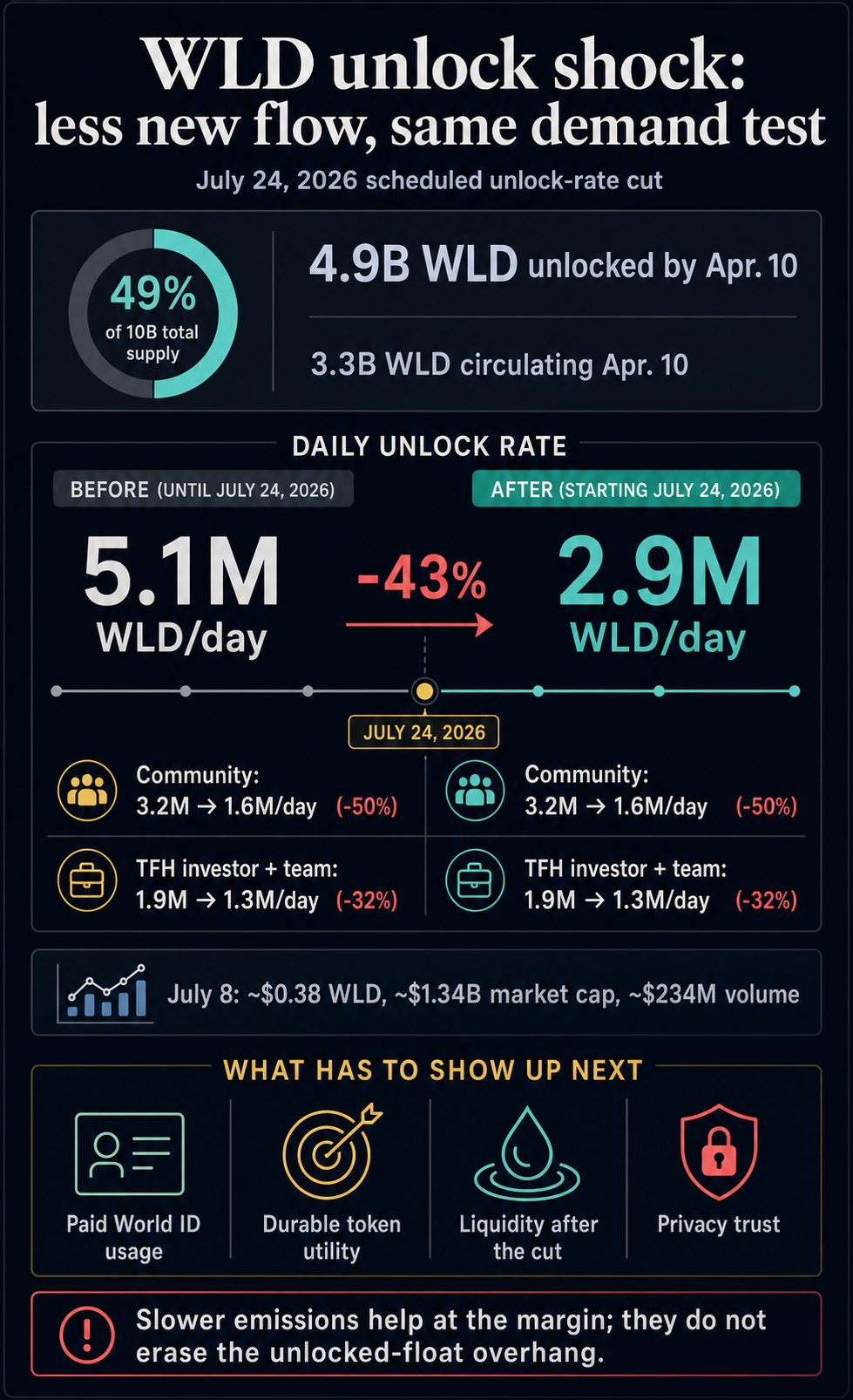
This reduction equates to approximately 2.2 million WLDs per day, or approximately 803 million fewer WLDs entering the unlock schedule over a one-year period.
If the total supply is 10 billion tokens, the change is large enough to change the daily supply pressure.
Daily emissions determine how much fresh supply buyers, market makers, and long-term holders have to absorb, and as future unlock rates decrease, already unlocked supply remains intact.
The world’s own April 10 statistics put unlocked supply at WLD4.9 billion before the July slowdown arrived, creating tensions between future supply slowdowns and an already large unlocked base.
CryptoSlate market data shows that as of July 8, there was approximately 3.52 billion WLD in circulation, and World’s April 10 announcement said that 3.3 billion WLD was in circulation at that time.
A larger unlocked pool is outside the most restrictive framework of circulating supply, reducing future pressure on the margins. Therefore, we need proof of demand before the July 24th supply cut can be treated as bullish.
The next step is to change the long-term demand curve by answering who buys WLD, why they hold it, or what periodic activity creates demand for the token after flows slow down.
For now, World’s answer is taking shape, and the protocol claims that World ID can become the infrastructure for the Internet’s human proof problem.

Proof that humans can become paid infrastructure
The most powerful demand-side argument in the world right now is that applications may end up paying for human proof infrastructure by sending value back through protocols.
In an April 16 post about World ID’s revenue potential, World said that applications can pay for World ID while it remains free for end users.
He also said that the tokens will ultimately be used to pay for all fees, and that protocol fees could be allocated to network operations and token burn, which are the most important bridge between identity deployment and WLD demand.
Once a platform pays a fee for World ID certification, and that payment is settled through a token-based mechanism, and fees become recurring, the token could see demand beyond emissions, subsidies, and speculative positioning.
In an April 17 post introducing the new World ID, it said World Network participants span 160 countries and approximately 18 million people have proven their humanity with the orb.
In the same post, we framed World ID as a human attestation infrastructure for consumer platforms, enterprise applications, and AI agents.

In a separate post on April 17, World said Zoom and DocuSign are integrating human attestation use cases, and also cited betas related to Outtake and VanEck.
These integrations shift the narrative from crypto-native distribution to proving that there are real people behind actions in a world of deepfakes, bots, and AI agents.
The evidence required after July 24th is clear disclosure that fee amounts, token payment usage, recurring application demand, or World ID activity is reducing the effective supply of WLD through burn or other mechanisms.
Once emissions reductions improve the environment and evidence of human adoption becomes economically visible, markets will begin to treat WLD as a token with real utility.
Privacy scrutiny remains part of demand testing
Another limitation of World’s ID’s pitch is that the product relies on the reliability of processing biometric data.
Spain’s Data Protection Authority (AEPD) ordered Tools for Humanity in March 2024 to stop collecting and processing personal data in Spain as part of Sam Altman’s World Coin project, citing complaints including lack of information, data collection of minors, and restrictions on the ability to withdraw consent.
It also said that biometric data is highly sensitive and therefore receives special protection under the GDPR.
In February 2026, AEPD announced that it had alerted Tools for Humanity to its plans to restart World activities in Spain and informed it of its intention to temporarily postpone the restart to consider the issues raised.
The regulator said the intended processing appears to include biometric data for iris identification and facial recognition and would require justification with a data protection impact assessment.
Germany’s Bavaria Data Protection Supervisory Authority also announced in December 2024 that it had closed its investigation into WorldCoin’s biometric data processing with corrective measures taken.
The agency said the company must provide GDPR-compliant deletion procedures and must follow its consequences across Europe when processing personal data.

Regulatory frictions impact the demand case as the world relies on platforms, users, and jurisdictions to embrace human proof infrastructure at scale.
World highlights privacy architectures to address regulatory challenges, with an April product post describing zero-knowledge proofs, single-use revocation capabilities, and systems to avoid exposing or storing personal data.
The market question is whether these guarantees, product changes, and corporate consolidation will be enough to change the world’s public discourse from biometrics controversy to paid ID infrastructure.
The next challenge for World Coin is demand.
The July 24th change lowers WLD’s daily unlock rate, clarifies the lack of a cliff, gives traders a less noticeable date, and makes demand gaps easier to see.
If WLD strengthens after the rate cut, a more convincing signal would be a combination of stable liquidity, better price action, and evidence that the use of World ID is becoming a fee-generating infrastructure.
If the token were to disappear, the market would effectively be arguing that the already freed supply base and uncertainty around actual token demand still outweigh the reduction in emissions.
The July 24 reduction is significant and demand still needs to be confirmed.
The tougher test for WorldCoin will begin after the supply headline passes, at which point investors will be able to determine whether human proof adoption is turning into permanent WLD demand, or if the token is already carrying the weight of a large unlocked float.
