




Circle launched cirBTC on Ethereum, but the larger goal is to showcase Bitcoin wrapped for collateral infrastructure institutions to route through DeFi, OTC desks, lending markets, treasury systems, market makers, and payment flows.
According to Circle’s launch materials, cirBTC runs on Ethereum and is backed 1:1 by native BTC. The company says the underlying Bitcoin is held through the Circle entity, segregated from corporate assets, and designed to provide visibility into on-chain reserves.
This product also resides within Circle’s existing stack. Circle is positioning cirBTC around Circle Mint, USDC workflows, Ethereum DeFi, and planned support for Arc and other chains.
This moves Wrapped Bitcoin into a trust issue. Since BTC itself does not move natively through Ethereum contracts, the wrapped version asks users to trust a claim for their Bitcoin held somewhere else.
For retail DeFi users, it could be a bridging decision. For financial institutions, it is ancillary decisions: who holds the keys, how reserves are checked, what happens during redemptions, and whether operational processes can withstand internal risk reviews.
Circle sells storage before giving away
Circle’s cirBTC proposal starts with the same basic promise as other wrapped Bitcoin products: one token for every BTC. The difference is the operational package around that promise.
According to the document, cirBTC is backed by native BTC, reserves are separated from corporate assets, and trading partners can view reserves on-chain. Circle also ties the product into the same institutional interface that many companies already use to issue and redeem USDC.
Desks that already move USDC through Circle Mint could theoretically add BTC collateral to the same account and payment relationship instead of stitching together separate custodians, wrappers, exchanges, bridges, and DeFi access points.
The proof of reserve component supports that positioning. Proof of Reserve systems help tokenized assets and DeFi protocols monitor on-chain backing data and build safeguards against lack of collateral.
In the case of cirBTC, the next live signal is a preliminary feed or dashboard available to trading partners for the token itself.
This maintains the trust of your trading partners. cirBTC still relies on users’ trust in storage, redemption, reserve management, and Circle’s processes.
The institutional pitch is that the relationships between BTC claims, reserve visibility, and Circle accounts can point in the same direction, allowing these assumptions to be packaged in a clearer way.
The most obvious comparison is between cbBTC and WBTC.
Coinbase’s cbBTC is also a 1:1 BTC-backed wrapped asset, stored under Coinbase custody and available on Base, Ethereum, Solana, and Arbitrum.
Coinbase also maintains a Proof of Reserve page that provides users with public reserve and supply references for products. Availability and terms may vary by jurisdiction.
WBTC remains the current Bitcoin wrapper in Ethereum DeFi. On its own site, WBTC is exposed as being 1:1 backed by Bitcoin, with a public reserve dashboard and reserve proof context.
Circle’s opportunity lies in the trust bundle it can offer, including USDC issuer Circle Mint, reserve transparency, access to Ethereum, and future Arc support under one institutional brand.
Products Main Trust Promise What we know now Open testing cirBTC Circle-backed for institutional workflows BTC-backed Runs on Ethereum, backed 1:1 by native BTC, Circle shows reserve separation and on-chain visibility Liquidity, protocol list , can be used as collateral at scale by reserve feed cbBTC Coinbase Custody and Exchange Account Workflow Backed 1:1 by Coinbase-held BTC, with listed support across Base, Ethereum, Solana, Arbitrum Whether Circle can compete with Coinbase’s distribution and Base native lending activities Existing DeFi collateral with WBTC public reserves 1:1 backing with BTC with public reserve dashboard and margin proofing context Will institutions prefer existing DeFi assets or a Circle-managed operating model?
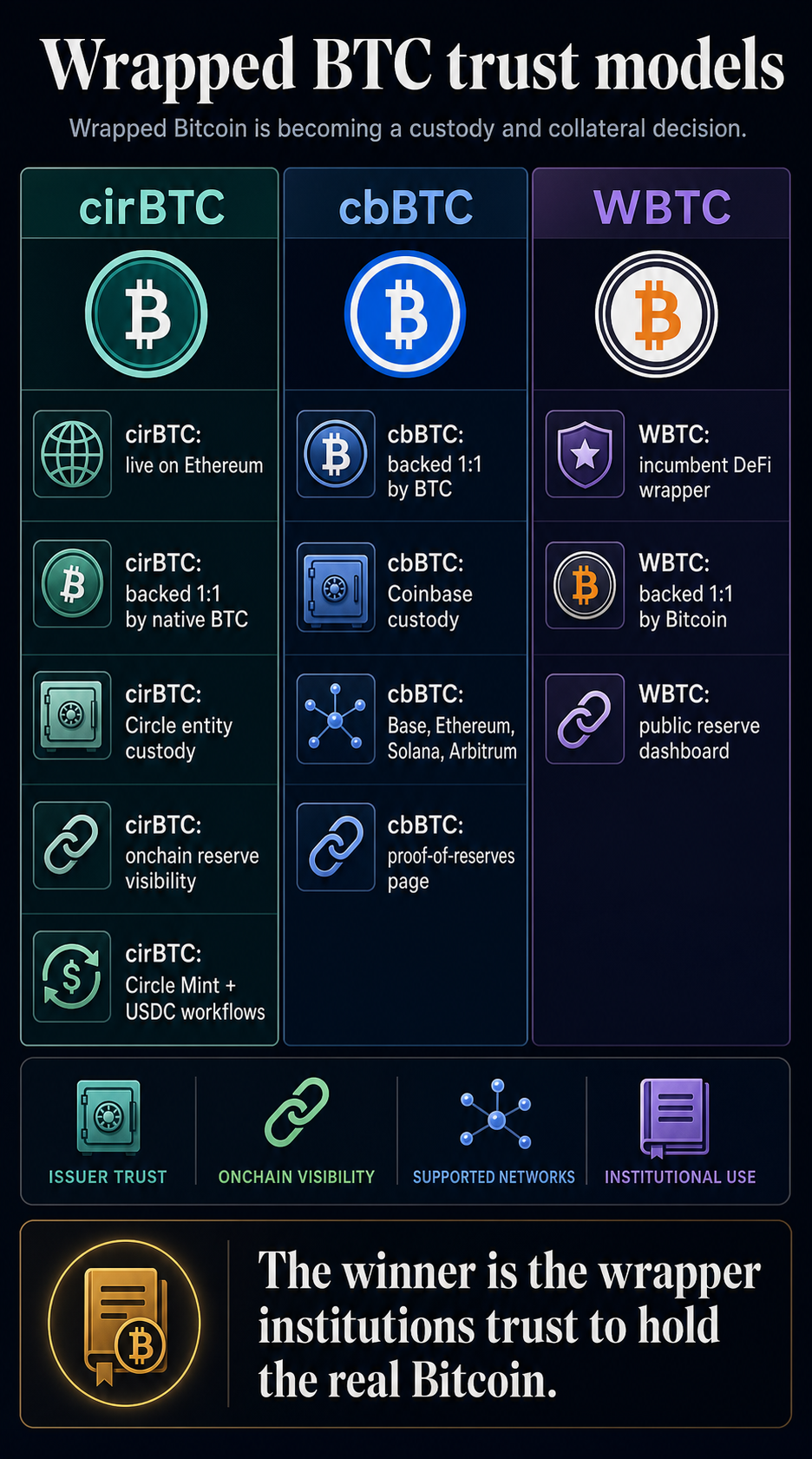
This comparison shows why cirBTC is more than just a token launch. Wrapped Bitcoin products are increasingly competitive over the issuer’s legal and operational identity, the visibility of reserves, and the route through which collateral enters the lending market.
Coinbase has already linked cbBTC to loans through Base. CryptoSlate reported that Coinbase and Morpho have introduced Bitcoin-backed loans on Base using cbBTC and USDC in consumer borrowing flows.
This comparison shows that in order for cirBTC to become more than other Ethereum assets, the distribution circle must challenge itself.

Arc gives big role to cirBTC
Circle’s Arc ambition gives cirBTC a second layer of meaning.
Arc is pitched as a stablecoin financial infrastructure with institutional use cases for USDC fees, payment tools, privacy controls, payments, foreign exchange, tokenized assets, and capital markets.
Circle describes Arc as a chain built specifically for stablecoin finance, and CryptoSlate previously reported how the network is pushing Circle deeper into the space occupied by Coinbase and Base.

In that context, cirBTC could become the Bitcoin leg of the broader Circle stack. USDC provides dollar assets. Circle Mint provides access to issuance and redemption. Ethereum offers the current DeFi reach.
If Arc develops as planned, it could potentially provide Circle with a place for tokenized dollars, BTC collateral, and payment workflows to operate with fewer handoffs.
Records remain from an early stage. Circle notes that cirBTC runs on Ethereum, with Arc and multichain support planned. Its announcement materials stopped short of indicating widespread DeFi protocol adoption, cirBTC’s live Arc usage, or supply volumes that would indicate market depth.
A token may not be senior collateral even if it is fully backed.
Institutions and DeFi protocols still need liquidity, risk parameters, redemption reliability, oracle support, and a clear reason to add another BTC wrapper on top of their existing options.

Broader market conditions are already moving in that direction. CryptoSlate recently framed the deal between Morgan Stanley and Galaxy as part of Bitcoin’s next institutional test in collateralized lending.
The same issue applies to the launch of cirBTC. Bitcoin can be a useful collateral for institutions if the management and risk management of the token is strong enough to satisfy the custodians of physical BTC.
Arc also focuses more on Coinbase comparisons. Coinbase can route cbBTC through Base and its own account system. Circle seeks to offer parallel routes built around USDC, Mint, and Arc.
The implementation competition focuses on which issuers can transform custodial relationships into liquidity.
Acceptance determines whether the wrapper becomes infrastructure or not
Circle has the right ingredients for a bank-grade wrapper, including known issuers, booking language, on-chain validation, institutional access, USDC proximity, and Arc roadmap.
Collateral infrastructure is provided later when trading partners use those materials in production.
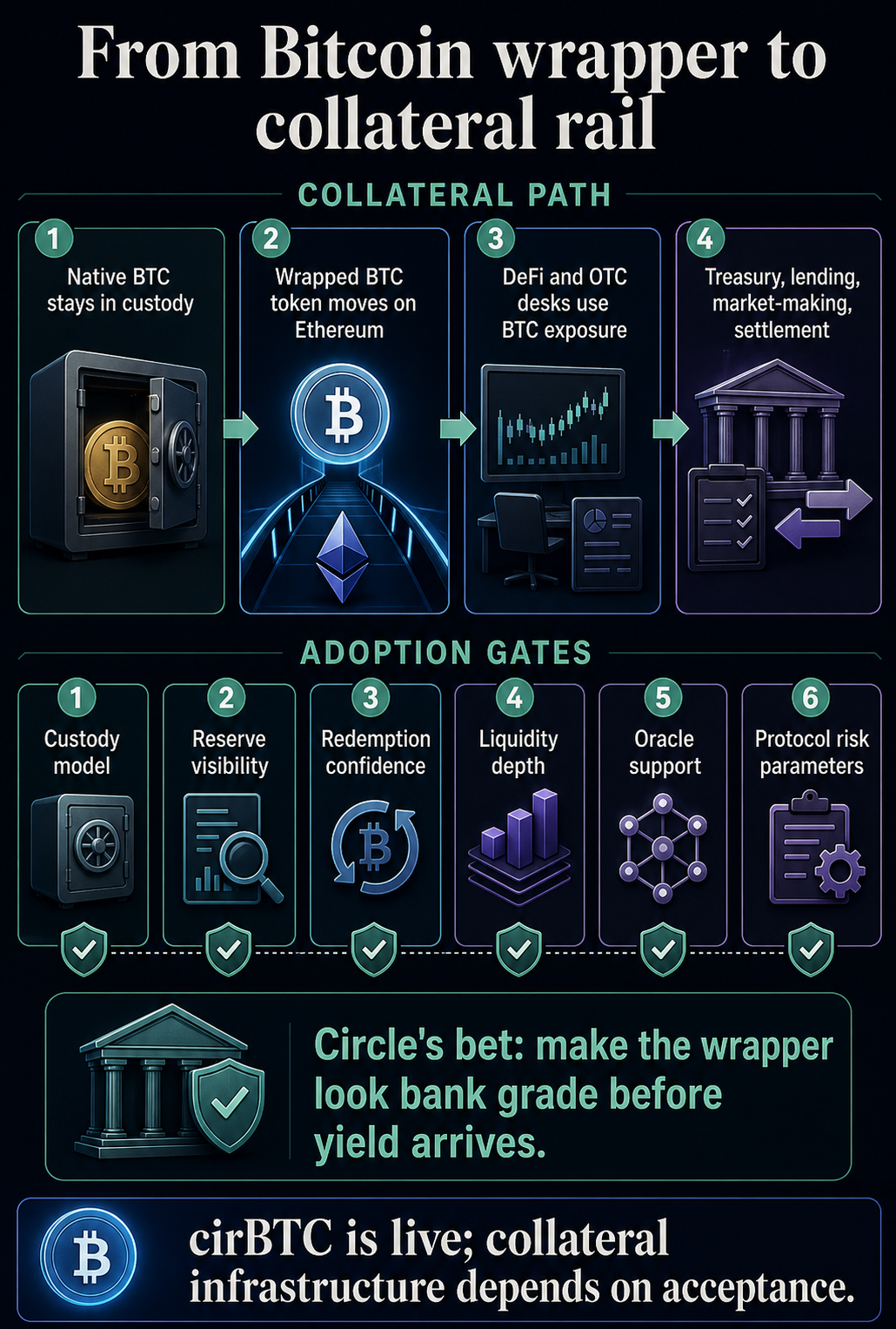
This means lenders need to accept assets, market makers need to quote assets, treasury teams need clean redemptions, DeFi protocols need collateral parameters, and risk desks need trust in the preparation process.
Users also need to move between BTC exposure and dollar liquidity without worrying about where their real Bitcoin is.
There, cirBTC will face off against WBTC and cbBTC. WBTC is familiar with existing DeFi. Coinbase has a distribution, storage, and base workflow.
Circle has the credibility of USDC, Mint, and compliance, and has ambitions to own more of the payments stack through Arc.
If CirBTC becomes the wrapper of choice for institutions, Circle will be able to turn wrapped Bitcoin into institutionally backed infrastructure. This is because the custodial, reserve, and redeem model reduces operational friction.
If liquidity remains elsewhere and Arc remains in a future context, cirBTC will still be interpreted as a product launch rather than infrastructure.
For now, Circle has changed the frame regarding wrapped BTC. The current debate focuses on who should be trusted to hold Bitcoin while the tokens move through programmable finance.
