




BlackRock’s 1% to 2% Bitcoin allocation range reads like a bullish nod to advisor adoption, but it also serves as a boundary. Once Bitcoin is incorporated into a model portfolio, upside is generated through rebalancing bands, tax residences, and possibly loans to maintain the position.
BlackRock Investment Institute considers 1% to 2% to be a reasonable multi-asset range, provided investors believe in continued adoption and can withstand sharp declines.
The firm determines positions based on the overall portfolio’s contribution to risk, and that risk rises quickly in a standard 60/40 combination. A 1% Bitcoin allocation adds about 2% to your overall portfolio risk, a 2% allocation adds about 5%, and a 4% allocation adds about 14%.
This risk calculation turns the ceiling into an actual decision point. If Bitcoin outperforms stocks or bonds in the model, advisors can trim it, drift it, hedge it, or move exposure elsewhere.
For a 2% Bitcoin sleeve to drift to 3%, it would require an increase of approximately 51.5% while the rest of the portfolio remains flat. Drifting to 4% would require an increase of approximately 104%, at which point resetting the position to 2% would mean selling almost half of the sleeve.
BTC Allocation / Drift Points Portfolio Impact What forces advisors to make decisions 1% BTC Allocation ~ 2% of total portfolio risk BTC Allocation small enough to fit within traditional risk budgets 2% ~ 5% of total portfolio risk BlackRock’s upper range. Important management caps 4% of BTC allocation 14% of overall portfolio risk Bitcoin begins to dominate risk contribution ~51.5% 2% after BTC rise Drifts to ~3% Advisor must decide whether to trim, hedge, or run ~104% 2% after BTC rise Drifts to ~4% Reset to 2% BTC This means selling about half of the sleeve.
BlackRock’s IBIT alone had nearly $60 billion in net flows as of July 2, and at this size portfolio management choices start to matter to the overall market.
On July 1, Citi lowered its 12-month Bitcoin price target from $112,000 to $82,000 and lowered its inflow assumption from $10 billion to zero.
The firm noted that Bitcoin ETF flows have been negative year-to-date, with U.S.-traded spot Bitcoin ETFs losing more than $2.7 billion in 10 trading days from late June to July 1, according to data from Pharcyde Investors.
Why does it hurt to sell?
For those who have held Bitcoin for a long time, selling to get below the limit may feel like parting with the wrong asset.
Mauricio Di Bartolomeo, co-founder and chief strategy officer of Bitcoin lending company Redon, sees a wide range of borrowers.
These include public and private companies operating on Bitcoin standards, as well as Latin American households operating a circular economy. Couples also go into debt by borrowing Bitcoin to purchase their first home.
“Borrowers come in all shapes and sizes,” he told CryptoSlate, adding that what unites them is prioritizing financing over selling and preserving the assets they believe they hold best.
Taxes are also involved in this decision, but Di Bartolomeo says the calculations hold true apart from taxes. He is referring to a borrower who took out a Bitcoin-backed loan in January 2020 and managed it responsibly.
Even after interest and fees, that person will be in a stronger financial position today than someone who sold their Bitcoin completely in the same month.
Di Bartolomeo estimated that a borrower using Bitcoin as collateral would need to set aside at least 100% of its collateral value to cope with market volatility. Once someone borrows more than half of their Bitcoin portfolio, the cushion that protects them from sudden drawdowns becomes thinner.
Lawsuit against forced sale
CoinBridge co-founder and chief investment officer Kelly Ye disputed the assumption that model portfolios are already driving flows in Bitcoin ETFs.
She pointed to numbers from Morgan Stanley, noting that roughly 80% of Bitcoin ETF activity takes place on its platform. Still autonomous, around 20% rooted Through an advisor.
Large wirehouses typically require 6-12 months of performance history, operational due diligence, and compliance reviews. Only then, she said, can new ETFs earn a place in the centralized model.
This timeline leaves most Bitcoin exposure today in the hands of individual investors who make their own decisions.
Even if advisors adopt Bitcoin, Ye expects sales to be a last resort and a broader toolkit to handle most of the work. Rebalancing bands can be set wider for more volatile assets than for bonds or large-cap stocks.
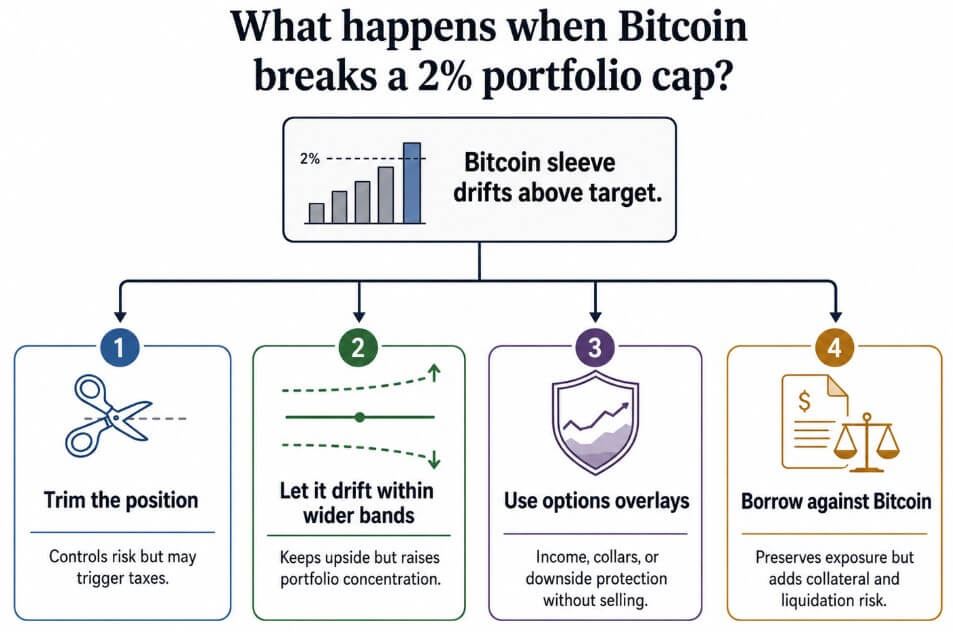
Advisors can rebalance using new client contributions, trim just part of a position, or put a Bitcoin sleeve in an IRA or Roth account. Selling with one of these accounts avoids an immediate tax charge.
Ye points out that many current ETF holders are still around the entry price. Glassnode estimates the cost basis for the average ETF holder to be nearly $83,000, well above the price of Bitcoin through the second half of the second quarter.
This means that most holders could incur a loss if they sold today.
The options market is backing her up, as IBIT’s options volume now rivals that of the native Bitcoin options market.
The OCC reported that 689.5 million ETF options contracts were traded in June, an increase of 69.7% from the same month last year. Open interest in IBIT options peaked at $53.3 billion in the first year, according to data from Kaiko and MerQube cited by ETF Express.
Goldman Sachs has filed for a Bitcoin ETF built to combine Bitcoin exposure with income from options trading, joining a suite of tools that have been built almost entirely since the ETF’s launch in 2024.
run the winner
If the toolkit works well, as expected by advisors, Bitcoin’s rally will accelerate even further, with only occasional selling. Wider tolerances absorb initial drift, and new customer cash flow automatically pushes your portfolio back toward your goals.
Retirement accounts will take up a larger percentage of your Bitcoin sleeve over time, reducing your taxes with each rebalancing.
An option overlay covers the rest, allowing the advisor to collect income or purchase protection while keeping the underlying position intact. In this version, Wall Street has financialized Bitcoin and its position continues to get complicated.
Trimming on schedule
Alternative paths are performed through stricter mechanisms. If you build Bitcoin into a model using the same narrow bands that large platforms apply to stocks and bonds, any rally will quickly cause a trim.
According to Bitwise, assets tracking portfolios of third-party models grew 62% from $400 billion in 2023 to more than $645 billion in 2025.
As the model portfolio infrastructure grows, the 2% Bitcoin Sleeve becomes a regular source of supply and winning positions become planned sales whenever Bitcoin rises violently.
If Bitcoin-backed borrowing increases at the same pace with less discipline, sharp drawdowns could result in additional forced liquidations on top of cuts.
Scenario What Happens Market Impact Managed Drift Advisor allows Bitcoin to rise above 2% within a wider tolerance limited forced sale. Tax-aware implementation of Bitcoin compounding within a portfolio Increased BTC ETF exposure moved to IRAs, Roth accounts, and retirement plans Reduced tax impact of rebalancing Option-driven management Advisors use covered calls, collars, and downside puts instead of selling spot exposure Manage volatility without completely reducing BTC exposure Mechanical trimming model Apply narrowbands to your portfolio to reduce BTC Sell if exceeds target Bitcoin rally creates regular supply from advisors Collateral stress Borrowers overuse Bitcoin-backed loans, Bitcoin plummets Liquidations do not avoid selling but extend the downside
Once an asset defined by a conviction to be held in perpetuity, Bitcoin is now becoming a managed sleeve with rules for things like rebalancing, where it’s taxed, and when a loan replaces a sale.
Control is an open battle fought through band rebalancing, tax locations, and for some holders loans to keep Bitcoin in place.
