




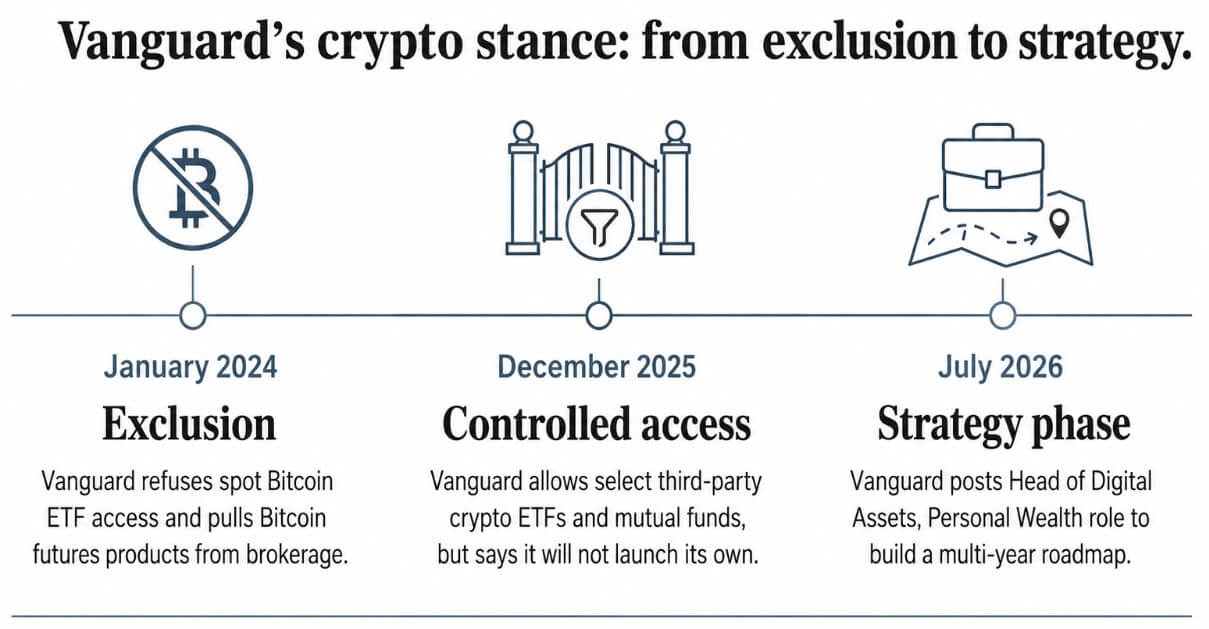
Vanguard created the position of head of digital assets and head of personal wealth on July 6, with positions in Dallas, Scottsdale, Charlotte and Malvern.
The post calls on the next executive to lead the company’s digital asset strategy, develop a multi-year roadmap, and execute business operations across Vanguard’s wealth businesses.
Two years ago, the company refused to list a spot Bitcoin ETF, and after the SEC approved the category in January 2024, it removed Bitcoin futures products from its brokerage platform.

This change is also evident within the world’s second-largest asset management company, which announced that as of December 2025, it managed approximately $12 trillion in assets and served more than 50 million investors. Job postings that mention custody, payments, tokenization, and stablecoins carry different weight at a company of that size than at a crypto-native brokerage firm.
This month, Citi lowered its 12-month Bitcoin price target from $112,000 to $82,000, lowered its Ethereum price target from $3,175 to $2,240, and lowered its own 12-month spot Bitcoin ETF inflow assumption from $10 billion to zero.
Interestingly, Vanguard is building out its digital asset capabilities as crypto market assumptions become more cautious.
Role content
This job posting asks executives to evaluate autonomous, advisory, and high-net-worth client-facing digital asset capabilities and design operating models for onboarding, custody, settlement, reconciliation, reporting, and third-party integration.
The same post lists tokenization, stablecoins, wallet and custody models, and blockchain-enabled infrastructure as areas the role will need to track, as well as the regulators, custodians, and vendors involved in each.
This scope separates decisions regarding hiring and Bitcoin ETFs, and Vanguard still says its stance on its products remains unchanged.
The company has no plans to launch its own crypto ETF or mutual fund, and continues to warn: Trading Crypto ETFs and Mutual Funds Involves risks that may not be suitable for all investors.
Companies can hold both positions simultaneously. It has no proprietary products and has senior authority to decide how digital assets move through its custody, settlement, and compliance systems, which currently only handle stocks and bonds.
Vanguard’s brand operates on low-cost, long-term investments for retirement savers, and creating storage and settlement standards for tokenized assets before regulators finalize their own framework risks locking in options that the $12 trillion-asset company cannot easily resolve.
The company has completely eliminated spot Bitcoin ETFs in 2024 and started brokered access to some third-party crypto ETFs and mutual funds by December 2025, but reiterated that it has no plans to build its own.
The July 2026 post added a third step: internal capabilities that determine how digital assets fit into Vanguard’s infrastructure beyond where they sit on the shelf.
Delegation Area Why Post Content Matters Client Channels Voluntary, Advisory, and High Net Worth ClientsDigital assets can be evaluated across Vanguard’s asset stack, not just brokered transactions. Product Strategy Digital Assets Features, Products, and Roadmap This role creates an internal framework without the need for a proprietary crypto ETF. Market Plumbing Storage, Settlement, Reconciliation, and Reporting Vanguard assesses how digital assets move through core financial infrastructure. Integration of Third-Party Vendors, Custodians and Infrastructure Providers The Company may determine external cryptocurrency product and service providers that meet its conservative platform standards. Emerging Rails Tokenization, Stablecoins, Wallets and Custody Models Its mandate extends beyond Bitcoin ETFs to questions of future market structure. Governance Risk, Legal, Compliance and Regulatory Authority Vanguard treats digital assets as an enterprise risk and policy issue, not just a shelf decision.
construction of piping
BlackRock’s trajectory runs through ETF wrappers, and the company’s iShares Bitcoin Trust (IBIT) held approximately $46.5 billion in net assets as of July 6. The fund charged a sponsor fee of 0.25% and traded at a median 30-day bid/ask spread of 0.03%.
Cumulative inflows into IBIT have exceeded $60.2 billion, and outflows from other funds such as Grayscale’s GBTC have brought the industry-wide net value of all U.S.-traded spot Bitcoin ETFs to about $51.4 billion as of July 7, according to data from Pharcyde Investors.

BlackRock’s market theory is to allow investors to trade Bitcoin through a wrapper they already understand.
Citi’s Tokenization 2030 report, released in June 2026, predicts that tokenized assets could grow from around $17 billion today to $5.5 trillion by 2030 in a base case scenario, with a range of $2.7 trillion to $8.2 trillion.
Citi values regulated stablecoins at $1.9 trillion by 2030, incorporating tokenized cash as the basis for delivery-to-pay payments, a payment layer directly named in Vanguard’s job posting.
Vanguard’s move comes as the $12 trillion asset manager decides how to connect its wealth platform to ETF wrappers, which BlackRock is already scaling, and tokenized asset infrastructure, which Citi expects to reach trillions of dollars by 2030.
Roadmap reach sizing
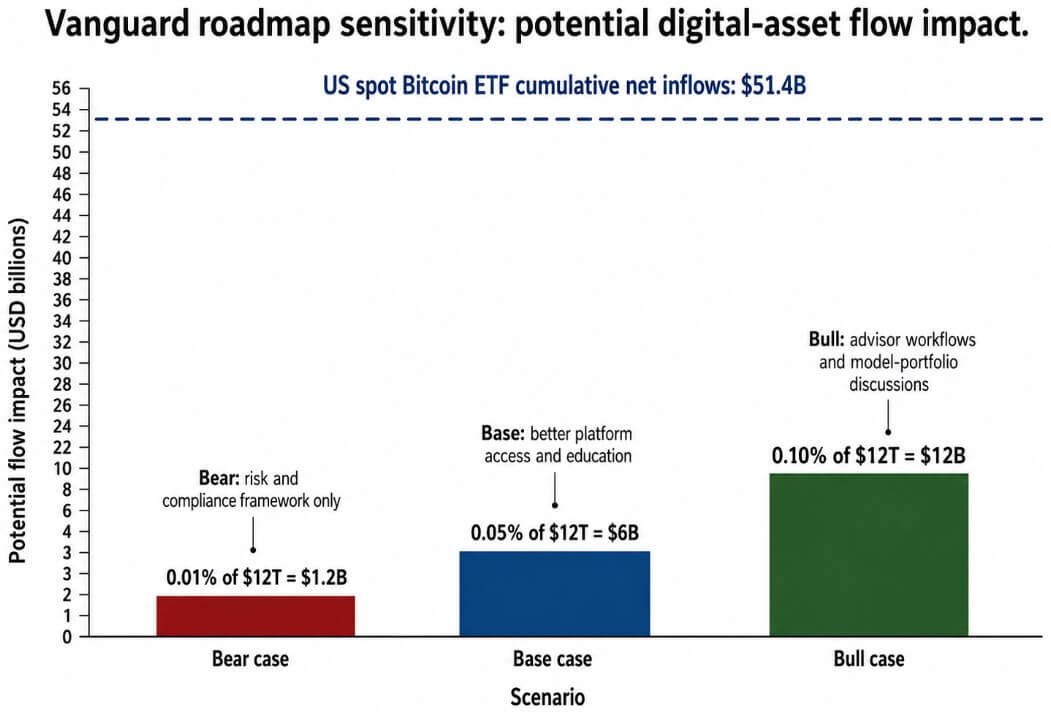
Vanguard’s $12 trillion in assets sets the scale for how its roadmap is likely to move, and a sensitivity model that uses this number in conjunction with Farside’s $51.4 billion cumulative net flow benchmark for U.S.-traded spot Bitcoin ETFs maps the range.
In a bearish scenario, Vanguard’s roadmap serves as a risk and compliance framework. Third-party access is passive, and Vanguard’s distribution power remains passive.
This represents 0.01% of Vanguard’s $12 trillion in assets, an increase of nearly $1.2 billion, and is large enough to make disclosure, access control, and guardrails central to any deployment.
In the bullish case, Vanguard is building access to digital assets into advisor workflows and model and portfolio conversations, but this is still via third-party products. At 0.1% of its asset base, this amounts to approximately $12 billion, or approximately 23% of the cumulative net inflows recorded by each U.S. spot Bitcoin ETF.
What regulators haven’t resolved
The Bank for International Settlements said in June 2026 that stablecoins have the potential to enable faster, programmable payments, noting that current designs fall short in terms of unity, redeemability, interoperability, and resilience to financial crime.
Separately, IOSCO has warned that tokenization can create uncertainty as to whether investors own the underlying assets or just a claim on the tokens, and that efficiency gains across the tokenization market remain uneven.
Vanguard’s post asks prospective adopters to monitor gaps in regulatory frameworks, vendor capabilities, and storage models.
Companies that run models based on predictable long-term investments are choosing to expose themselves to uncertainty before regulators resolve it.
Vanguard is determining whether digital assets can move through the custody, settlement, and advisory infrastructure that 50 million investors already use for their retirement accounts and index funds.
If Vanguard’s roadmap sets the standards for custody and settlement that other conservative platforms have adopted, the company, which declined to list a Bitcoin ETF in 2024, will set the terms for how the rest of Wall Street’s asset management arm handles tokenized assets.
Job listings list plumbing by name, and plumbing lasts longer than a single asset cycle.
