



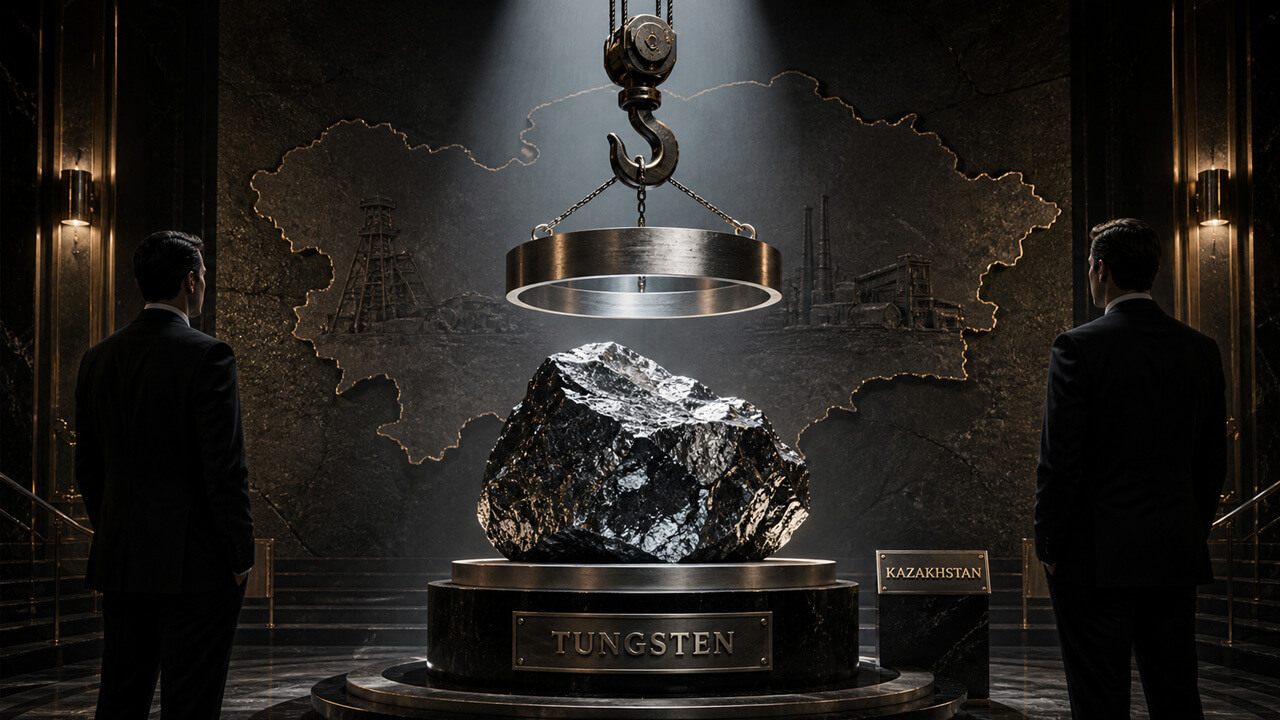


Donald Trump Jr. and Eric Trump plan to gain exposure to Kazakhstan’s tungsten business through Skyline Builders, according to a new Financial Times report. Skyline Builders is a Nasdaq-listed company that has entered into a transaction agreement with Kove Kaz Capital Group that, upon completion, will form Kaz Resources, Inc.
Skyline and Cove will trade under the ticker KAZR if the deal goes through, Kaz said.
target project is sitting Within the U.S. critical minerals policy lane, Increase supply chain resilience and reduce dependence on China-controlled resources.
The U.S. Export-Import Bank issued an interest notice of up to $900 million, and the U.S. International Development Finance Corporation issued an interest notice to consider up to $700 million in debt financing and project development financing, according to public transaction documents.
Governance issues are concrete. Visible chains connect the Trump family’s investment exposure, public market shells, and federal loan interest on the same assets reported by the FT.
Central questions also remain unanswered, including what Trump’s sons knew, whether they played any role in the government aid process, whether the loans were binding, and what their ultimate financial situation would be.
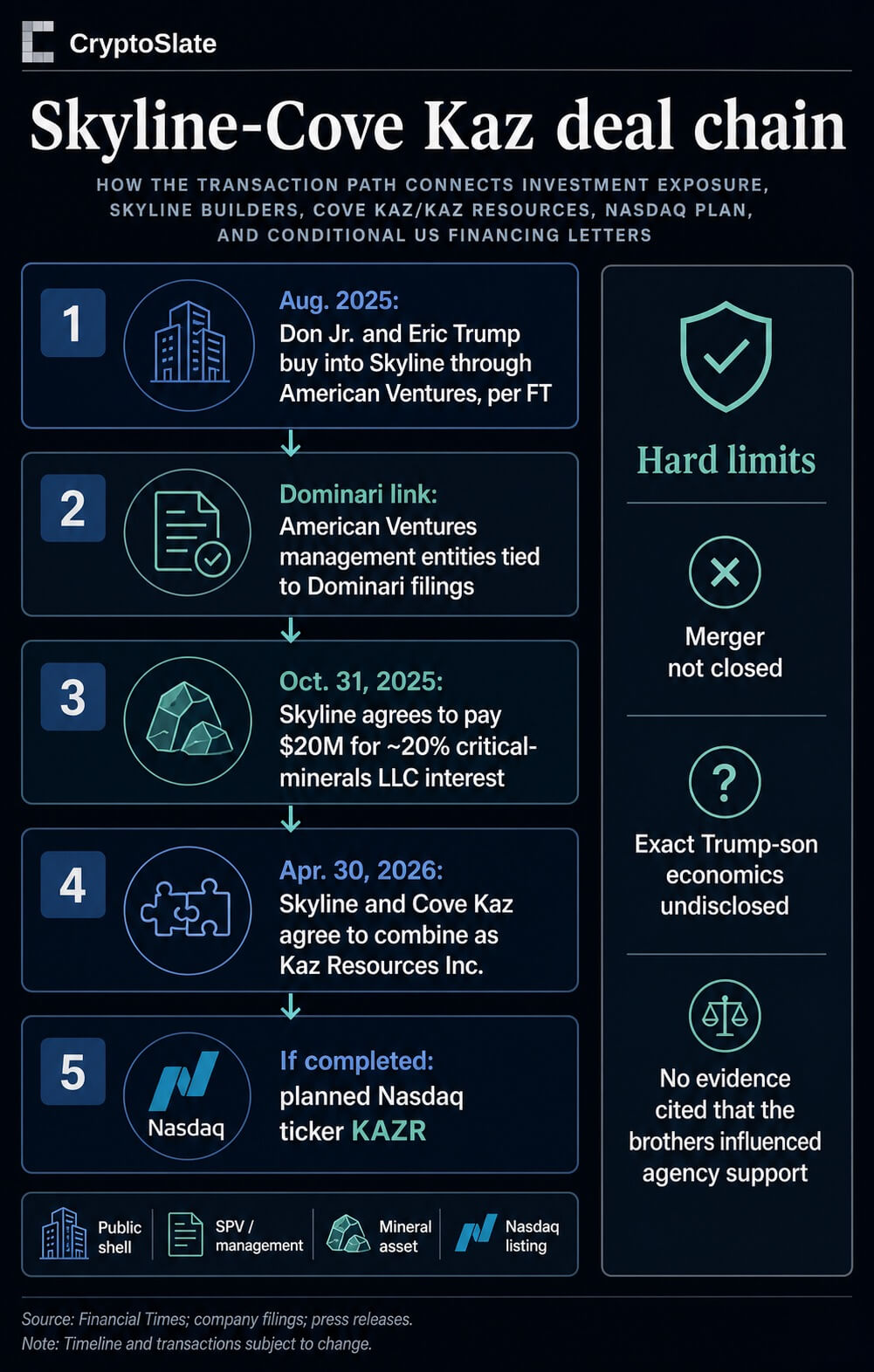
The chain is executed via a public shell
The first layer is Skyline itself. The company disclosed an August 2025 private placement that raised approximately $17.8 million, leaving Quantum Leap Energy with voting rights after the related transaction.
Dominari Securities was one of the introducing agents.
The FT’s coverage provides some of the private investment in that chain. It said Donald Trump Jr. and Eric Trump acquired Skyline in August through American Ventures, a special purpose vehicle operated by a subsidiary of Dominari, and added the position on October 28, 2025.
Skyline’s August resale filing and October sales filing each set a financing date, and subsequent registration statements identify the exposure of the American Ventures Series in connection with these sales.
The SEC filing does not name President Trump’s sons. They establish the placement chronology and American Ventures series exposure that the FT tied to the brothers.
Dominari links appear on company filings. Dominari disclosed in its quarterly report that it held a 90% ownership interest in American Ventures Management LLC and American Ventures IM LLC, and served as the management and investment manager of American Ventures LLC.
Subsequent annual reports list Donald Trump Jr. and Eric Trump as advisory board appointees and shareholders of more than 5% of Dominari.
Dominari also filed a February 2025 release announcing the role of the advisory board.
The second tier will occur on October 31, 2025, with Skyline disclosing that it has agreed to pay $20 million for an approximately 20% membership interest in a Delaware LLC engaged in critical minerals.
Skyline’s Oct. 31 filing does not list the LLC’s name. The FT identified it as Kazu Resources, which is related to Cove Capital and Cove Kazu.
Tier 3 arrived on April 30, 2026. Skyline and Cove Kaz have announced a transaction agreement to combine, with the planned company operating as Kaz Resources, Inc. and, upon completion, trading on the Nasdaq as KAZR.
In the final agreement summary, we separately explained the structure of the Kove Kaz transaction prior to its market announcement in April.
The same announcement said closing is expected in the fourth quarter of 2026 or early 2027, subject to shareholder approvals, regulatory approvals, a valid SEC registration statement and other conditions.
Role in Entity Chain Status Alert American Ventures FT reports that Trump sons have acquired Skyline Exact details of Trump sons’ revelations linked to Dominari management entity in media filings are private Skyline Builders Nasdaq listed public vehicle Kob Kaz Signs transaction agreement Merger not yet completed Kob Kaz and Kaz Resources Significant Minerals Platform and Assets Skyline and Kob Kaz have agreed to merge into Kaz Resources Inc. when completed. The agency letter remains a conditional expression of interest.
Governance issues start with access to the chain, then move to the status of the chain, and only then reach policy overlays.
This transaction functions more as a layered transaction map than as a single completed transfer of value.
There are still conditions for financial aid.
The venture announcement on November 6 places the Kazakh project in the national security and supply chain debate.
Cove Capital and Tauken Samruk announced that Cove Kaz will own 70% of the North Katopal and Upper Kayrakti development projects, and Kazakh State Mining Company will own 30%.
The announcement described the deposit as a major untapped tungsten resource, with total development costs estimated at approximately $1.1 billion.
Although this cost estimate is smaller than the primary funding facility, this comparison only illustrates scale.
Official US data also includes a broader mineral background. The USGS tracks the status of critical mineral supplies. Mineral Product Overview in 2026 and maintain tungsten data A hub that supports the industrial supply chain.
EXIM issued interest notices of up to $900 million, according to April transaction documents. DFC separately disclosed It had issued letters of interest seeking up to $700 million. Debt financing and project development funds related to investments in North Katopal.
These numbers are conditional maximums and are not a binding commitment or evidence that any government agency will provide the final funds accumulated.
Distinctions are operational. A letter of interest indicates that the agency is willing to consider assistance under specified conditions.
EXIM’s guidance explains that an interest letter is a tool that can outline potential loan terms, charges and terms before a final commitment.
While this is a useful policy signal, particularly in strategic areas, it still does not result in a binding funding agreement.
This status sets the evidentiary boundaries for conflict risk analysis. The FT also noted an important caveat. There was no suggestion that Donald Trump Jr. or Eric Trump, when they made the initial investment in Skyline through American Ventures, knew Kove was likely to win U.S. government support or that Kove influenced the award.
The same FT article said a spokesperson for Donald Trump Jr. said he was a passive investor in American Ventures, had no operational role and no federal point of contact for the companies he invests in or advises.
It also said that Eric Trump did not respond to the FT’s requests sent to the Trump Organization and American Bitcoin.
Transactions therefore sit within lanes defined by positioning, access, and disclosure. Trump family-linked capital gained exposure to Nasdaq-listed companies and later agreed to merge with a mineral group that carried funding letters from U.S. government agencies.
This chain raises real public ethics questions because private exposure, public market access, and federal industrial policy all refer to the same asset.
Knowledge, influence, and ultimately funding are still available.
This distinction also applies to broader ethical law. The U.S. Office of Government Ethics has long stated that certain federal conflict laws do not apply to the president and vice president in the same way they apply to other executive branch employees.
Other legal and governance issues are beyond the scope of this guidance.
This helps define why this is a conflict risk and governance story rather than a full legal conclusion.
Public shell connects mineral trading to crypto markets
For CryptoSlate readers, the relevance here is the route of capital. The product is secondary.
Transactions linked to the Trump family already span Bitcoin mining, token financing, public market combinations, and flows of politically sensitive digital assets.
Skyline adds a new lane: strategic resource companies using a public shell structure while federal agencies express conditional interest in the underlying project.
Recent Trump-related crypto transactions already include American Bitcoin exposure, an Eric Trump-linked miner using the public market merger route, and World Liberty Financial financing.
CryptoSlate also addresses foreign ownership concerns surrounding WLFI and the reverse merger structure surrounding Tron, which is linked to President Trump.
The Cove Kaz chain belongs to the same market structure conversation, even though the asset is tungsten rather than a token or mining fleet.
Policy overlap is also often underestimated. Bitcoin miners, AI data centers, drone manufacturers, defense suppliers, and critical minerals developers face similar questions around power, financing, permitting, extraction, government demand, and supply chain policy.
Sectors remain distinct. This overlap explains why politically connected capital can treat capital as an adjacent risk lane when the U.S. government selects preferred supply chains.
With Bitcoin’s market capitalization of approximately $1.55 trillion, the digital asset remains large enough that political capital, funding structures, and federal policy signals can influence how investors price affiliates, whether they hold Bitcoin, mine Bitcoin, issue tokens, or supply physical inputs used in AI or defense supply chains.
The next test is disclosure. Investors still need final merger documents, the combined company’s registration statement, related party details, dilution terms, and agency updates indicating whether EXIM and DFC’s letters move toward a binding commitment.
They also need to clarify the Trump sons’ exact financial exposure through American Ventures and related Skyline series vehicles.
The Skyline and Kove Kaz trade represents a qualified conclusion. Private company interests tied to President Trump’s sons could gain exposure to publicly traded companies moving into lucrative areas of U.S. industrial policy.
The boundaries are still clear. Knowledge, influence, ultimate funding, and ultimate financial exposure remain open tests.
