




The Trump administration is preparing to nominate Kevin Warsh to be the next chairman of the Federal Reserve, Bloomberg reported, citing people familiar with the matter. The selection will not be finalized until President Trump officially announces it Friday morning.
Warsh’s anti-quantitative easing stance could reshape the liquidity environment that has supported risk assets, including cryptocurrencies, since 2008.
Sponsored Sponsored
Bloomberg reports Warsh Pick
According to Bloomberg, Warsh, a former Fed director, visited the White House on Thursday. Markets reacted quickly to the news, with stocks falling, Treasury yields rising, the dollar gaining more ground, and precious metals falling.
Trump did not reveal his nomination, teasing Thursday night’s announcement. “It’s not that surprising,” he said, adding that he would become “a household name in the financial world.”
“Many people think this is someone who may have been there years ago,” he added.
Warsh’s Rise in Prediction Markets
Early Thursday, prediction markets were already moving toward warsh. Polymarket showed an 87% probability for Warsh with a trading volume of $289 million. Kalsi reflected similar odds of 86% on volume of $74 million.
The excitement was rapid. Rick Rieder, BlackRock’s chief investment officer, was the odds-on favorite by Wednesday before Warsh overtook him. Economist Justin Wolfers wrote in X that the White House sighting alone is “enough evidence for prediction markets” to reassess Warsh’s odds.
Sponsored Sponsored
Trump’s finalists also include Federal Reserve Board member Christopher Waller, who opposed this week’s decision to hold interest rates, and National Economic Council Chairman Kevin Hassett, but Trump has indicated he wants to keep Hassett in his current position.
Warsh’s policy stance: rate cuts without quantitative easing
Warsh served as Fed governor from 2006 to 2011 and advocated for structural reform of the central bank. Mr. Warsh has aligned himself with Mr. Trump in recent months by publicly advocating lower interest rates, reversing his long reputation as an inflation hawk.
Macro analyst Alex Krueger summed up Warsh’s position on X. He believes productivity gains from AI are disinflationary and justify aggressive rate cuts, while arguing that the Fed’s balance sheet subsidizes Wall Street and should shrink significantly.
Sponsored Sponsored
This combination of dovish interest rate policy and hawkish balance sheet stance is what sets Mr. Warsh apart. Deutsche Bank’s Matthew Ruzzetti wrote in December that Warsh’s desire to “lower interest rates, perhaps offset by balance sheet shrinkage” would require regulatory changes.
RSM chief economist Joseph Brusuelas was more critical. He wrote in X that Warsh’s “initial instincts were hawkish” and that he “misguided the policy response” following the global financial crisis.
Impact on cryptocurrencies
Warsh’s opposition to QE could put pressure on cryptocurrencies, which have historically risen with the expansion of the Fed’s balance sheet. Its balance sheet now stands at about $6.5 trillion, down from $8.9 trillion in 2022.
His stance on digital assets is mixed. Mr. Warsh invested in stablecoin project Basis in 2018, and in 2021 invested in asset management company Bitwise, of which he currently serves as an advisor.
However, in a 2022 WSJ op-ed, he dismissed private cryptocurrencies as “masquerading as money,” writing, “Cryptocurrency is a misnomer. It’s not money, it’s software.” He also supported a U.S. central bank digital currency, a position at odds with President Trump’s pro-Bitcoin rhetoric.
Sponsored Sponsored
Senate confirmation uncertain
It seems likely that Warsh will be nominated, but confirmation is far from certain. Polymarket indicates a 39% chance of passage with exactly 52 votes, which is the most likely scenario, but the 18% chance of outright rejection reflects uncertainty over Sen. Tillis’ threat of a blockade.
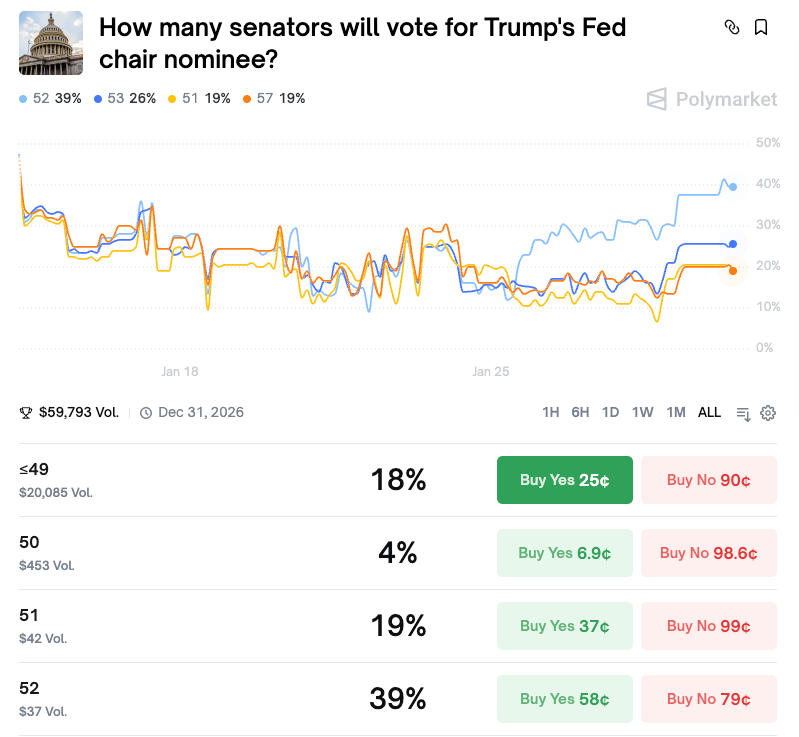
Republican Sen. Thom Tillis serves on the Banking Committee. He vowed to block any Fed nominations until the Justice Department concludes its investigation into Powell. The investigation focuses on the cost of renovations to the Federal Reserve’s headquarters and Mr. Powell’s testimony to Congress. Powell claimed the investigation was a “pretext” to put pressure on him.
Chairman Powell’s term ends on May 15, but his term as president runs through January 2028. President Trump almost nominated Warsh in 2018, but chose Powell instead. He publicly regrets this decision.
The Fed on Wednesday kept its policy rate unchanged at 3.75% from 3.50% in 2025, after cutting rates three times. President Trump wants to see interest rates “lower by two or even three points.”
